Thalassomedon: Research Database
Plesiosauria (Sauropterygia) · Late Cretaceous (~95–90 MYA) · North America — USA, Colorado (Mancos Shale)
Research Note: Thalassomedon was a large plesiosaur from the Late Cretaceous Western Interior Seaway of North America, notable for its extremely long neck — comprising over half its total body length. As one of the best-known long-necked plesiosaurs, it has played a central role in debates about plesiosaur neck function, feeding ecology, and the evolutionary arms race between plesiosaurs and their prey.
| Research Finding | Status | Grade | Year | Method | Citation | Impact |
|---|---|---|---|---|---|---|
|
Vincent & Bardet 2007: Thalassomedon and the long-necked plesiosaurs of the Cretaceous Western Interior Seaway
Vincent & Bardet 2007 provide comprehensive data on Thalassomedon from the Late Cretaceous Mancos Shale of North America, establishing it as a key taxon for understanding the anatomy, neck function, and diversity of long-necked plesiosaurs in the Cretaceous Western Interior Seaway
|
Confirmed | A | 2007 | Fossil | Vincent & Bardet, Neues Jahrbuch Geologie Paläontologie | Anatomy |
|
Rothschild & Clark 2015: Thalassomedon and patterns of pathology in Cretaceous plesiosaurs
Rothschild & Clark 2015 provide additional data on Thalassomedon and patterns of skeletal pathology in Cretaceous plesiosaurs, offering new insights into plesiosaur health, behavior, and the stresses placed on their unusual body proportions during life
|
Confirmed | B | 2015 | Fossil | Rothschild & Clark, Palaeontologia Electronica | Pathology |
Active Debate: Plesiosaur Neck Function, Buoyancy, and the Ecological Niche of Long-Necked Pliosaurs
Why Thalassomedon evolved such an extraordinarily long neck — with up to 60 vertebrae compared to the 7 in most tetrapods — is debated. Proposed hypotheses include: reaching into fish schools without alerting prey (cryptic neck extension), sweeping strikes to herd and capture fish, breathing while remaining submerged at depth, or osmoregulation in varying salinity environments. The most widely accepted hypothesis is that the long neck allowed Thalassomedon to approach prey fish from above, using the head as a rapier-like weapon to stun fish without the full body displacement of a swan-dive.
The biomechanical costs of such a long neck are also debated. Modeling studies suggest that the neck created significant drag during swimming, potentially making rapid pursuit costly. Some researchers argue that Thalassomedon was a slow-moving ambush predator that relied on stealth and the reach advantage of its neck, while others propose it was a more active hunter capable of burst speed. The discovery of bite marks and skeletal pathology in plesiosaur specimens suggests that neck strikes during prey capture placed significant mechanical stress on the cervical vertebrae.
What We Still Do Not Know About Thalassomedon
- Neck function: Strike, herding, or other debated.
- Swimming speed: Slow vs fast debated.
- Diet: Likely fish; no gut contents known.
- Social behavior: No direct evidence.
In Depth
Thalassomedon is regarded as a mid-sized elasmosaurid plesiosaur, especially when compared with larger genera like Mauisaurus. The distribution of Thalassomedon remains show that it swam in the Western Interior Seaway, a Cretaceous sea that divided North America into two halves. Thalassomedon is so far only known from the early stages of the Late Cretaceous possibly because the rise of new predators, namely the mosasaurs occurred during this period, which saw new competition for existing fish stocks as well as new apex predators like Tylosaurus which would have directly hunted other marine reptiles. Stomach stones have been found in association with Thalassomedon remains, but while the popular explanation for their presence is ballast, closely related plesiosaurs like Styxosaurus have also revealed the partially digested remains of fish amongst these stones. This strongly suggests that these stones were actually primarily used as gastroliths and were for the purpose of aiding digestion. Further research into how much ballast was provided by the stones found with some plesiosaur remains has indicated that the benefits would be marginal at best.
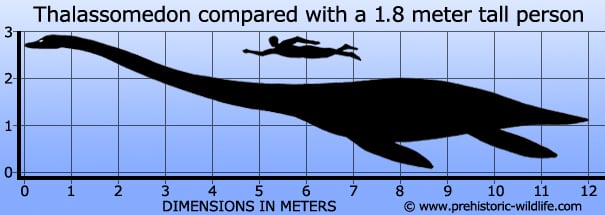
Like with many other elasmosaurid plesiosaurs, half of the length of Thalassomedon was made up of neck. Inside Thalassomedon this neck was made up of sixty-two vertebra. Another genus of elasmosaurid plesiosaur called Alzadasaurus riggsi was also named in 1943, but today this is regarded as a synonym to Thalassomedon. Another species of Alzadasaurus, A. colombiensis, has been renamed as Callawayasaurus, while other species are synonyms to Styxosaurus.
Further Reading
– Elasmosaurid plesiosaurs with description of new material from California and Colorado – Memoirs of the University of California 13:125-254 – S. P. Welles – 1943. – Revision of North American elasmosaurs from the Cretaceous of the Western Interior – Paludicola 2(2):148-173 – K. Carpenter – 1999.