In Depth
Dryptosaurus aquilunguis first started off being known as Laelaps aquilunguis when it was first named in 1866 by Edward Drinker Cope, and under the name Laelaps it was one of the first North American dinosaurs to be named. Cope chose the name Laelaps after a dog in Greek mythology which always caught what it was hunting (the name Laelaps translates to English as ‘storm wind’). Unfortunately however Cope was not the first to use this name as a genus of parasitic mite had already been named Laelaps. In 1877 Othniel Charles March renamed the dinosaur Dryptosaurus, something that probably did not sit well with Cope given that he and Marsh were embroiled in a bitter feud that today is popularly known as the ‘bone wars’.
Dryptosaurus has had a troubled history regarding its remains since all but the type species are today regarded as highly dubious. These include D. macropus, D. falculus, D. hazenianus and Laelaps trihedrodon which today are all thought by most palaeontologists to represent other theropods, although the remains of these species are so fragmentary themselves that it is exceedingly difficult to be certain. Today the type species of Dryptosaurus is regarded as being a primitive tyrannosauroid, and until the discovery of Appalachiosaurus in 2005, the first and only tyrannosaur that lived in Eastern North America.
During the late Cretaceous North America was divided into two island continents by the Western Interior Seaway which submerged what are today central USA and Canada, as well as much of Mexico. On the Western Island of Laramidia the more famous tyrannosaur genera such as Tyrannosaurus rex and Alebertosaurus in the North, as well as shorter snouted forms such as Bistahieversor in the southern regions held domain over the landscape. On the Eastern Island of Appalachia the known tyrannosaurs seem to have been more primitive in form, possibly due to their isolation from Laramidian tyrannosaurs which possibly still occasionally mixed with Asian genera via a land bridge connection. This split was not exclusive to tyrannosaurs however as horned dinosaurs like the ceratopsians and more advanced ankylosaurs seem to have also been more numerous upon Laramidia. Appalachia by contrast had surviving populations of hadrosaurs which seem to have significantly declined from their previous numbers in Laramidia by the end of the Cretaceous. These ‘older’ forms of potential prey may have also reduced the need for tyrannosaurs like Dryptosaurus to evolve into new killing forms.
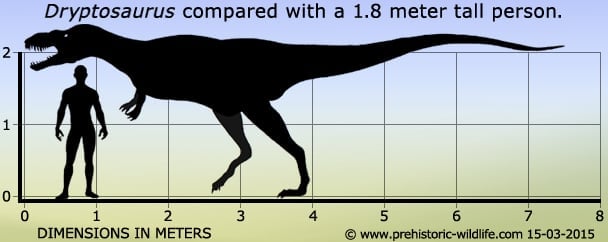
What makes Dryptosaurus stand out as a primitive tyrannosauroid more than anything else are the partially preserved arms that indicate that the arms were very long when compared to the later and more advanced forms. The fingers of the hands also had twenty centimetre long claws that have been likened to the talons of an eagle, hence the name D. aquilunguis which loosely means ‘eagle-clawed’. From this it’s possible to infer that Dryptosaurus got physical with its prey by grabbing onto it and maybe even using its claws to gouge deep cuts into the sides of its prey, either crippling it by striking an internal organ or just letting the prey bleed to death. It’s also possible that Dryptosaurus may not have had a deep snout with strong biting muscles like other advanced tyrannosaurs had, especially if it had a greater reliance upon using its claws to make a kill. This more physical method of hunting has also been envisioned for other primitive tyrannosaurs such as Eotyrannus from England and even Dilong from China which also have proportionately longer arms compared to later species.
Further Reading
– Discovery of a gigantic dinosaur in the Cretaceous of New Jersey.” Proceedings of the Academy of Natural Sciences of Philadelphia, 18: 275-279. – Edward Drinker Cope – 1866. – Notice of a new and gigantic dinosaur. – American Journal of Science and Arts 14:87-88. – Othniel Charles Marsh – 1877. – Redescription of the holotype of Dryptosaurus aquilunguis (Dinosauria: Theropoda) from the Upper Cretaceous of New Jersey. – Journal of Vertebrate Paleontology 17 (3): 561–573. – Ken Carpenter, Dale A. Russel, Donald Baird & R. Denton – 1997. – The Anatomy of Dryptosaurus aquilunguis (Dinosauria: Theropoda) and a Review of its Tyrannosauroid Affinities. – American Museum Novitates, 3717 . pp. 1-53. – S. L. Brusatte, R B. J. Benson & M. A. Norell – 2011.