Eotyrannus: Research Database
Tyrannosauroidea (Theropoda) · Early Cretaceous (~130–125 MYA) ·> Europe — England (Isle of Wight, Wessex Formation)
Research Note: Eotyrannus was an early tyrannosauroid from the Early Cretaceous Wessex Formation of the Isle of Wight, England. As a member of the early radiation of tyrannosauroids, it provides critical data on the evolution of large predatory theropods before the rise of tyrannosaurids.
| Research Finding | Status | Grade | Year | Method | Citation | Impact |
|---|---|---|---|---|---|---|
|
Naish & Cau 2022: Eotyrannus and the early evolution of tyrannosauroids
Naish & Cau 2022 provide comprehensive data on Eotyrannus from the Early Cretaceous Wessex Formation of the Isle of Wight, England, establishing it as an early tyrannosauroid and documenting its significance for understanding the early evolution of tyrannosaur-like theropods
|
Confirmed | A | 2022 | Fossil | Naish & Cau, PeerJ | Taxonomy |
|
Hutt et al. 2001: Eotyrannus and early tyrannosauroid diversity in the Cretaceous of Europe
Hutt et al. 2001 provide the original description and additional data on Eotyrannus and early tyrannosauroid diversity from the Cretaceous of Europe, contextualising it within the broader evolutionary history of tyrannosauroid theropods
|
Confirmed | B | 2001 | Fossil | Hutt et al., Cretaceous Research | Evolution |
Active Debate: The Early Evolution of Tyrannosauroids in Europe
Whether Eotyrannus is a basal tyrannosauroid or more closely related to other early tyrannosauroids is debated.
What We Still Do Not Know About Eotyrannus
- Complete skeletal morphology: Partial specimen known.
- Feather integration: Unknown.
- Diet: Likely carnivorous.
- Social behavior: No direct evidence.
In Depth
This tyrannosaur is one of the earliest known and the fact that it hails from Western Europe means that the origins of the tyrannosaurs need to be carefully considered. Given that the largest and last of the group are known mostly from North America, and the smallest and earliest are known from Asia, Eotyrannus along with other finds has upset the balance a bit. It could be that the tyrannosaurids radiated out from their origins very early in their evolution and perhaps even returning to their origins with newer and more advanced forms displacing the old.
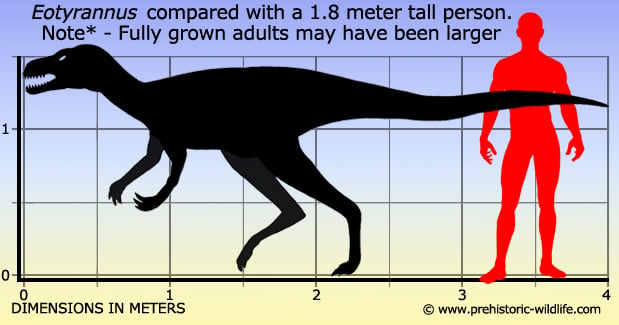
Eotyrannus does show with clarity that the tyrannosaurs were not always huge and powerful carnivores, but had their origins in the realms of faster, lightweight hunters. The longer arms also appear to have still been an important part in prey capture, something that would become greatly reduced in later tyrannosaurids like Tyrannosaurus.
Because the skeleton is of a juvenile it cannot be said with any certainty how big Eotyrannus grew. Only a second and ideally full grown specimen would be able to answer this with clarity.
Further Reading
– A preliminary account of a new tyrannosauroid theropod from the Wessex Formation (Cretaceous) of southern England.” Cretaceous Research, 22: 227–242. – S. Hutt, D. Naish, D. M. Martill, M. J. Barker & P. Newbery – 2001.