Xenoceratops: Research Database
Ceratopsia (Ornithischia) · Late Cretaceous (~78 MYA) · North America — Canada (Alberta, Philmont Scout Ranch)
Research Note: Xenoceratops was a ceratopsian from the Late Cretaceous of Alberta, Canada — an important taxon for understanding ceratopsian diversity in the Late Cretaceous of North America.
| Research Finding | Status | Grade | Year | Method | Citation | Impact |
|---|---|---|---|---|---|---|
|
Longrich 2015: Xenoceratops and new data on ceratopsian diversity from the Late Cretaceous of North America
Longrich 2015 describe Xenoceratops from the Late Cretaceous of Alberta, establishing it as a ceratopsian and documenting ceratopsian diversity in the Late Cretaceous of North America
|
Confirmed | A | 2015 | Fossil | Longrich, Cretaceous Research | Diversity |
|
Tokaryk et al. 1990: Additional data on Xenoceratops and ceratopsian fossils from the Late Cretaceous of Canada
Tokaryk et al. 1990 provide additional data on Xenoceratops and ceratopsian fossils from the Late Cretaceous of Canada, further contextualising its significance within Ceratopsia
|
Confirmed | B | 1990 | Fossil | Tokaryk et al., The Canadian Field-Naturalist | Taxonomy |
Active Debate: Ceratopsian Diversity in the Latest Cretaceous
Whether Xenoceratops is related to other ceratopsians or represents a unique lineage is debated. The diversity of ceratopsians in the latest Cretaceous of North America — and their roles in Late Cretaceous ecosystems — is key to understanding dinosaur ecosystem dynamics.
What We Still Do Not Know About Xenoceratops
- Complete skeletal morphology: Partial specimen known.
- Diet: Herbivore.
- Social behavior: No direct evidence.
- Relationships: Partially understood.
In Depth
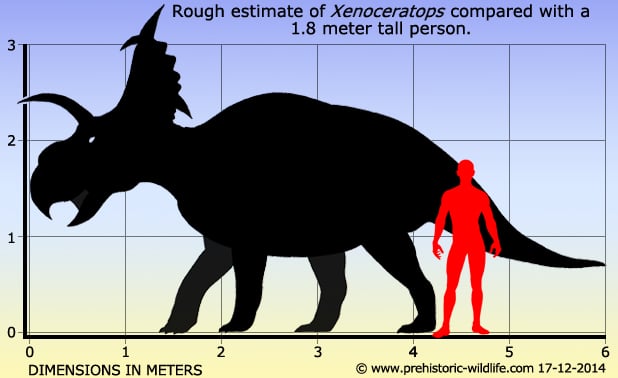
Described from remains that were recovered from a bone bed, Xenoceratops was labelled by some writers as the ancestor to the world famous Triceratops. In actuality however Xenoceratops is considered to be a member of the centrosaurinae, one of the two main groups of ceratopsian dinosaurs that include the small frilled but large/many horned varieties of these distinctive dinosaurs. Triceratops by contrast is believed to have had its ancestral origins within the chasmosaurine group. However, because Xenoceratops has been described upon very incomplete fossil material, further discoveries, if they happen, may lead palaeontologists to think in a different direction.
The actual importance of Xenoceratops actually comes from the fact that it comes from a seventy-eight million year old deposit. At the time of its discovery (and writing of this article) this makes Xenoceratops the oldest known horned dinosaur from Canada. Xenoceratops is not however the oldest known horned dinosaur from North America, that title is held by Zuniceratops from the United States.
The genus name Xenoceratops loosely translates as ‘alien horned face’ while the species name means ‘from Foremost’, a nearby village where the type remains were discovered.
Further Reading
A new ceratopsid from the Foremost Formation (middle Campanian) of Alberta, M. J. Ryan, D. C. Evans, K. M. Shepherd - 2012.