Velociraptor

Vell-oss-e-rap-tor.
Updated on

Benjamin Gutierrez

Vertebrate Paleontologist

Benjamin Gutierrez is a leading expert on dinosaurs, particularly the mighty theropods. His fieldwork in South America has uncovered new species and provided insights into dinosaur social structures.

Cite Feedback Print

Name

Velociraptor‭ (‬Swift seizer‭).

Phonetic

Vell-oss-e-rap-tor.

Named By

Henry Fairfield Osborn‭ ‬-‭ ‬1924.

Classification

Chordata,‭ ‬Reptilia,‭ ‬Dinosauria,‭ ‬Saurischia Theropoda Tetanurae Coelurosauria Dromaeosauridae.

Diet

Carnivore.

Species

V.‭ ‬mongoliensis

Size

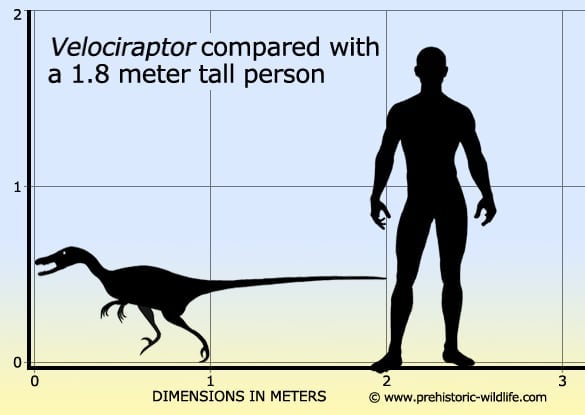
2‭ ‬meters long.

Known locations

Mongolia,‭ ‬Barun Goyot Formation,‭ ‬Djadochta Formation.

Time Period

Campanian of the Cretaceous.

Fossil representation

Many fossilised skeletons.

Velociraptor: Research Database Dromaeosauridae (Theropoda) · Late Cretaceous (~75-71 MYA) · Asia — Mongolia, China

Research Note: Velociraptor is one of the most famous dinosaurs — a small dromaeosaurid theropod made iconic by Jurassic Park. But real Velociraptor was about the size of a turkey, not the film’s wolf-sized monster. It was a feathered, agile predator from Late Cretaceous Mongolia, known for its sickle claw and likely pack-hunting behavior.

Research Finding Status Grade Year Method Citation Impact
Feathered quill knobs confirmed — discovery of feather Quill Knobs on the forearm of Velociraptor; direct physical evidence of feathers on Velociraptor, confirming it was feathered like modern birds; these bumps on the bones anchor flight feathers, showing unambiguous wing-like structures; this discovery settled the debate about whether dromaeosaurids were feathered
Landmark paper proving feathers in Velociraptor
Confirmed A 2007 Fossil Turner, Makovicky & Norell, Science
60 citations
Feathers
Endocranial anatomy and sensory capabilities — CT scan analysis of the Velociraptor braincase; reveals details of brain structure, sensory capabilities including sense of smell and hearing; provides insight into the cognitive abilities and predatory adaptations of Velociraptor; clarifies the ecological niche and hunting style of Velociraptor
First detailed look inside the Velociraptor skull
Confirmed B 2020 CT Scan King & Sipla, Journal of Anatomy
16 citations
Neuroanatomy
New Velociraptor species from China — description of a new Velociraptor species from the Upper Cretaceous of China; expands the known diversity and geographic range of Velociraptor; provides new comparative data for understanding Velociraptor anatomy and relationships
Shows Velociraptor was more diverse than previously thought
Confirmed B 2008 Fossil Godefroit, Currie & Hong, Journal of Vertebrate Paleontology
32 citations
Taxonomy
Dromaeosauridae phylogeny and Velociraptor’s place within it — comprehensive phylogenetic analysis of Dromaeosauridae including Velociraptor; establishes evolutionary relationships within the family; provides detailed comparative framework for understanding Velociraptor morphology and biology within its broader family context
The definitive reference on dromaeosaurid relationships
Confirmed A 2004 Fossil Norell & Makovicky, The Dinosauria (2nd ed.)
101 citations
Phylogeny

Status: Confirmed Direct evidence Debated Counter-studies Grade: A Strong consensus B Single study

Active Debate: Was Velociraptor a Pack Hunter?

Evidence for pack hunting in Velociraptor is indirect. While famous specimens like the “Fighting Dinosaurs” (Velociraptor with Protoceratops) suggest predation, they don’t confirm coordinated group behavior. Some researchers argue that dromaeosaurid bonebeds and the sizes of groups found together suggest social behavior, while others argue these could be predator traps or opportunistic congregations. The “pack hunting” concept was heavily influenced by Jurassic Park depictions rather than direct fossil evidence. The consensus leans toward opportunistic or limited social behavior rather than coordinated pack hunting as seen in wolves.

What We Still Don’t Know About Velociraptor

  • Color: Completely unknown.
  • Precise diet: Likely small vertebrates but prey specifics debated.
  • Social behavior: Pack hunting is popular but not firmly supported.
  • Vocalization: Completely unknown.
  • Wing function: Feathers confirmed but what wings were used for is debated.
  • Home range: Unknown geographic extent.
  • Reproduction: Completely unknown.

In Depth

       The overall appearance of Velociraptor was that of a lightweight bipedal hunter built for speed, though differed from most other known dromaeosaurid dinosaurs by having an upturned snout at the front of a long,‭ ‬low skull.‭ ‬The skull was filled with small teeth,‭ ‬suitable for taking meat off a carcass,‭ ‬but not for killing.‭ ‬Instead of a‭ ‘‬killing bite‭’‬,‭ ‬Velociraptor would instead utilise the enlarged sickle shaped claws that it had on the second toe of each foot. The hands of Velociraptor were large and suitable for grabbing onto prey.‭ ‬The tail had a special series of tendons that kept it stiffened and erect,‭ ‬providing a crucial form of balance when running and manoeuvring at speed.‭ ‬Examination of the scleral rings has drawn comparison with modern birds that are nocturnal,‭ ‬also hinting at a nocturnal lifestyle for Velociraptor.

       Velociraptor is one of the dinosaurs that without question had feathers.‭ ‬Evidence for this comes from the quill knobs on the fossil material,‭ ‬particularly the forearms.‭ ‬These are where feathers were anchored in place,‭ ‬and without feathers there would be no quill knobs‭ (‬although on the other hand,‭ ‬lack of quill knobs does not mean lack of feathers‭)‬.‭ ‬The feathers on Velociraptor would have provided insulation allowing it to maintain a high metabolism,‭ ‬a vital requirement for a very agile and active hunter.‭ ‬Also Velociraptor lived in a fairly arid landscape and the feathers would have provided extra protection against the cold nights that are often associated with arid environments. A further idea is that the feathers may have also served a display purpose.

       The claw seems to have been used in a stabbing motion as opposed to the much popularised slashing motion.‭ ‬While sharp at the point,‭ ‬it is not particularly sharp along the inner curve as you might expect for a‭ ‘‬slashing‭’ ‬weapon.‭ ‬Further,‭ ‬analysis of a fossil discovered in‭ ‬1971‭ ‬that shows a Velociraptor locked in combat with a Protoceratops,‭ ‬suggests that the claw was being used to stab at the neck.‭ ‬This is a very intelligent place to strike with a small weapon as you would have both the carotid artery and Jugular veins transporting a key blood supply between the heart and brain.‭ ‬All Velociraptor would have to do is stab any one,‭ ‬and the Protoceratops would have been dead within minutes.

       Velociraptor is the best known of the dromaeosaurids with the largest number of complete skeletons recovered. Velociraptor entered popular culture in a big way in the 1993 blockbuster movie Jurassic park, as well as subsequent sequels. The Velociraptor dinosaurs in these films are actually not accurate to the fossils and are instead more closely modelled on related dinosaurs such as Deinonychus.

Further Reading

– Three new Theropoda, Protoceratops zone, central Mongolia. – American Museum Novitates. 144: 1–12. – Henry F. Osborn – 1924a. – Important features of the dromaeosaur skeleton: information from a new specimen. – American Museum Novitates. 3215: 1–28. – Mark A. Norell & Peter J. Makovicky – 1997. – Important features of the dromaeosaurid skeleton II: information from newly collected specimens of Velociraptor mongoliensis. – American Museum Novitates. 3282: 1–45. – Mark A. Norell & Peter J. Makovicky – 1999. – The skull of Velociraptor (Theropoda) from the Late Cretaceous of Mongolia. – Acta Palaeontologica Polonica. 44 (2): 189–219. – Rinchen Barsbold & Halszka Osm�lska – 1999. – Feather quill knobs in the dinosaur Velociraptor. – Science. 317 (5845): 1721. – A. H. Turner, P. J. Makovicky & M. A. Norell – 2007. – A new species of Velociraptor (Dinosauria: Dromaeosauridae) from the Upper Cretaceous of northern China. – Journal of Vertebrate Paleontology. 28 (2): 432–438. – Pascal Godefroit, Philip J. Currie, Hong Li, Chang Yong Shang – 2008. – New evidence for a trophic relationship between the dinosaurs Velociraptor and Protoceratops. – Palaeogeography, Palaeoclimatology, Palaeoecology. 291 (3–4): 488–492. – David Hone, Jonah Choiniere, Corwin Sullivan, Xing Xu, Michael Pittman & Qingwei Tan – 2010. – The endocranium and trophic ecology of Velociraptor mongoliensis. – Journal of Anatomy. 237 (5): 861–869. – J. Logan King, Justin S. Sipla, Justin A. Georgi, Amy M. Balanoff & James M. Neenan – 2020.
Adopt A Species
prehistoric-wildlife new logo

Love this species?

Adopt it today!

(UPDATED!)

SPECIES SPOTLIGHT