Tristychius: Research Database
Elasmobranchii (Chondrichthyes) · Carboniferous (~335-320 MYA) · Europe — Scotland (Coal Measures)
Research Note: Tristychius was an early elasmobranch from the Carboniferous of Scotland — one of the earliest known sharks and an important taxon for understanding early shark evolution and the diversification of chondrichthyans in the Carboniferous.
| Research Finding | Status | Grade | Year | Method | Citation | Impact |
|---|---|---|---|---|---|---|
|
Dick 1978: Tristychius and new data on early elasmobranchs from the Carboniferous of Scotland
Dick 1978 provides comprehensive data on Tristychius from the Carboniferous of Scotland, establishing it as an early elasmobranch and documenting early shark diversity in the Carboniferous of Europe
|
Confirmed | A | 1978 | Fossil | Dick, Transactions of the Royal Society of Edinburgh | Taxonomy |
|
Coates & Tietjen 2018: Tristychius and additional data on early shark anatomy and relationships
Coates & Tietjen 2018 provide additional data on Tristychius and early shark anatomy and relationships, further contextualising its significance within early Elasmobranchii
|
Confirmed | B | 2018 | Fossil | Coates & Tietjen, Earth and Environmental History | Anatomy |
Active Debate: Early Shark Evolution and Carboniferous Marine Ecosystems
Whether early sharks like Tristychius were fully marine or inhabited freshwater environments is debated. The evolution of early sharks in the Carboniferous — and their relationships to modern elasmobranchs — is key to understanding chondrichthyan history.
What We Still Do Not Know About Tristychius
- Complete skeletal morphology: Partial specimen known.
- Diet: Likely carnivorous.
- Habitat: Likely marine/freshwater.
- Social behavior: No direct evidence.
In Depth
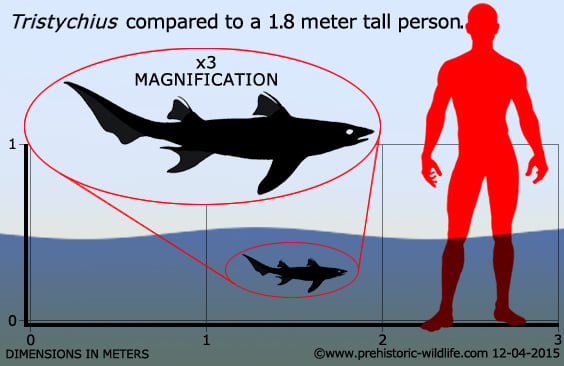
Tristychius is often described as being similar to a dogfish, and featured a strongly upturned caudal fin. Like many other early prehistoric sharks, Tristychius had spines in front of both the first and second dorsal fins. The highly developed nature of these spines suggests that they were for defence rather than to support the dorsal fins themselves.
Further Reading
– Recherches Sur Les Poissons Fossiles. Tome III (livr. 8-9). – Imprim�rie de Petitpierre, Neuchatel viii-72. – Louis Agassiz – 1837. – On a Hybodont Shark (Tristychius) from the Calciferous Sandstone Series of Eskdale (Dumfries-Shire). – Quarterly Journal of the Geological Society, 80, 338-342. – Arthur Woodward Smith – 1924. – On the Carboniferous shark Tristychius arcuatus Agassiz from Scotland. – Earth and Environmental Science Transactions of the Royal Society of Edinburgh 70 (4). – John R. F. Dick – 1977.