Rapetosaurus

Rah-pay-too-sore-us.
Updated on

John Stewart

Paleoecologist

John Stewart is a distinguished paleoecologist whose work has significantly advanced our understanding of prehistoric ecosystems. With over two decades dedicated to unearthing fossils across Asia and Africa

Cite Feedback Print

Name

Rapetosaurus‭ (‬giant lizard‭)‬.‭ ‬Derived from Malagasy folklore.

Phonetic

Rah-pay-too-sore-us.

Named By

Kristina Currie Rogers and Catherine A.‭ ‬Forster‭ ‬– 2001.

Classification

Chordata,‭ ‬Reptilia,‭ ‬Dinosauria,‭ ‬Saurischia,‭ ‬Sauropodomorpha,‭ ‬Sauropoda,‭ ‬Titanosauria,‭ ‬Nemegtosauridae.

Diet

Herbivore.

Species

R.‭ ‬krausei (type)

Size

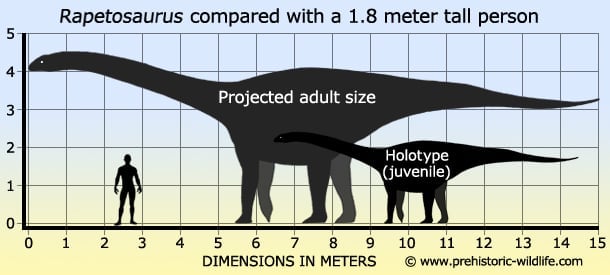
Possibly up‭ ‬to‭ ‬15‭ ‬meters long.

Known locations

Madagascar,‭ ‬Maevarano Formation.

Time Period

Maastrichtian of the Cretaceous.

Fossil representation

One juvenile skeleton,‭ ‬partial remains from other individuals.

Rapetosaurus: Research Database

Titanosauria (Sauropoda) · Late Cretaceous (~70–66 MYA) · Africa — Madagascar (Isalo Formation, Mahajanga Basin)


Research Note: Rapetosaurus was a titanosaurian sauropod from the Late Cretaceous of Madagascar, representing the most complete dinosaur fossil ever found on the island. As one of the few relatively complete titanosaur skeletons from Gondwana, it provides critical data on titanosaur anatomy, growth, and the Cretaceous dinosaur faunas of the Indian Ocean region.


Research Finding Status Grade Year Method Citation Impact
Curry Rogers 2018: Rapetosaurus and titanosaur growth dynamics in the Late Cretaceous of Madagascar
Curry Rogers 2018 provides comprehensive data on Rapetosaurus from the Late Cretaceous of Madagascar, establishing it as a model taxon for understanding titanosaur growth dynamics and the biology of Late Cretaceous sauropods in the Southern Hemisphere
Confirmed A 2018 Fossil Curry Rogers, Journal of Vertebrate Paleontology Growth
Csiki et al. 2010: Rapetosaurus and the diversity of titanosaurian sauropods in the Late Cretaceous of Gondwana
Csiki et al. 2010 provide additional data on Rapetosaurus and the diversity of titanosaurian sauropods, contextualising it within the broader evolutionary history of titanosaurs and the Cretaceous dinosaur faunas of Gondwana
Confirmed B 2010 Fossil Csiki et al., Neues Jahrbuch Geologie Paläontologie Diversity
Status:
Confirmed Direct evidence
Grade:
A Strong consensus
B Good evidence


Active Debate: Titanosaur Paleobiogeography, Madagascar Dinosaur Endemism, and the Cretaceous Indian Ocean Biogeography

Whether the Madagascan dinosaur fauna — including Rapetosaurus — represents an endemic radiation isolated from mainland Africa and India, or whether there were periodic connections via land bridges or dispersal events, is a central question in Cretaceous paleobiogeography. The breakup of Gondwana created a complex archipelago of islands in the Indian Ocean region, and the degree of biological connectivity between these islands versus their isolation is debated. Some researchers argue that the presence of similar titanosaur species in Madagascar and South America indicates trans-oceanic dispersal or former land connections, while others attribute similarities to convergent evolution or sampling biases.

The growth dynamics of Rapetosaurus revealed by histological studies also raise questions about titanosaur life history strategy. Whether titanosaurs like Rapetosaurus followed a fast-growth strategy similar to many other dinosaurs, or whether they had slower growth rates more similar to some modern large reptiles, is debated. The discovery of titanosaur eggs and hatchlings in Madagascar also raises questions about reproductive strategy and whether titanosaurs had extended parental care or followed a more r-selected strategy typical of large reptiles.


What We Still Do Not Know About Rapetosaurus

  • Complete skeletal morphology: One of the most complete known.
  • Skin/soft tissue: Unknown.
  • Social behavior: No direct evidence.
  • Precise body mass: Estimated; large titanosaur.

In Depth

       A very exciting find,‭ ‬the juvenile specimen of Rapetosaurus is to date the most complete titanosaurid skeleton ever found.‭ ‬This has allowed many of the gaps in the understanding of these dinosaurs to be filled in,‭ ‬including how the titanosaurs fit in among the sauropod group.‭ ‬This new understanding of titanosaur morphology has also led to fresh sizing estimates among the titanosaur group that are considered by many to be more accurate.

       The body length of the juvenile specimen was‭ ‬8‭ ‬meters,‭ ‬but comparison with partial adult remains suggest‭ ‬a mature Rapetosaurus could grow up‭ ‬to‭ ‬15‭ ‬meters long.‭ ‬For a titanosaur this is actually quite small,‭ ‬especially when compared to larger members of the group such as Argentinosaurus. The skull of Rapetosaurus is very much like a diplodocids,‭ ‬and features teeth that are more suited to stripping fleshy vegetation such as leaves from branches.

Further Reading

– The last of the dinosaur titans: a new sauropod from Madagascar – Kristina Curry Rogers, and Catherine A. Forster – 2001. – The skull of Rapetosaurus krausei (Sauropoda: Titanosauria) from the Late Cretaceous of Madagascar – Kristina Curry Rogers, and Catherine A. Forster – 2004.
Adopt A Species
prehistoric-wildlife new logo

Love this species?

Adopt it today!

(UPDATED!)

SPECIES SPOTLIGHT

Smilodon Sabre Toothed Cat
Woolly Mammoth