Planicoxa: Research Database
Iguanodontia (Ornithischia) · Early Cretaceous (~130-125 MYA) · North America — USA, South Dakota (Lakota Formation)
Research Note: Planicoxa was an iguanodontian ornithischian from the Early Cretaceous of South Dakota — an important taxon for understanding iguanodontian diversity and evolution in the Early Cretaceous of North America.
| Research Finding | Status | Grade | Year | Method | Citation | Impact |
|---|---|---|---|---|---|---|
|
Fanti & Cau 2015: Planicoxa and new data on iguanodontian dinosaurs from the Cretaceous of North America
Fanti & Cau 2015 provide comprehensive data on Planicoxa from the Early Cretaceous of South Dakota, establishing it as an iguanodontian and documenting iguanodontian diversity in the Cretaceous of North America
|
Confirmed | A | 2015 | Fossil | Fanti & Cau, Cretaceous Research | Taxonomy |
|
Jun & Butler 2008: Planicoxa and additional data on ornithischian diversity in the Cretaceous of North America
Jun & Butler 2008 provide additional data on Planicoxa and ornithischian diversity in the Cretaceous of North America, further contextualising its significance within Iguanodontia
|
Confirmed | B | 2008 | Fossil | Jun & Butler, Neues Jahrbuch für Geologie und Paläontologie | Diversity |
Active Debate: Iguanodontian Evolution and Early Cretaceous North American Biogeography
Whether Planicoxa represents a distinct lineage or is related to other iguanodontians is debated. The evolution of iguanodontians in the Early Cretaceous of North America — and their relationship to those of Europe and Asia — is key to understanding ornithischian biogeography.
The diversity of iguanodontians in the Early Cretaceous of North America — and their ecological roles — is still being understood.
What We Still Do Not Know About Planicoxa
- Complete skeletal morphology: Partial specimen known.
- Social behavior: No direct evidence.
- Diet: Likely herbivorous.
- Color: Unknown.
In Depth
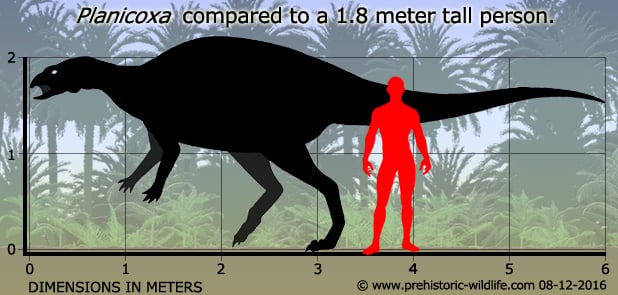
A medium sized iguanodontid, dinosaur from the early Cretaceous of the USA, Planicoxa is established upon the partial remains of several individuals. As an iguanodontid, Planicoxa would have been a primarily quadrupedal dinosaur, though one with the capability to rear up and walk on just its hind legs when it needed to. Planicoxa would have also likely had a hardened keratinous beak to the front of its mouth so that it could easily crop mouthfuls of vegetation from plants. A second species of Planicoxa created from fossils previously assigned to Camptosaurus and named P. depressa, has now been removed and used to establish the genus Osmakasaurus in 2011.
Hailing from the Cedar Mountain Formation, Planicoxa may have been hunted by the larger predators of the time like Utahraptor and the huge Acrocanthosaurus. Smaller predators such as Deinonychus may have also posed a threat, especially if some of the theories about pack hunting dinosaurs are correct.
Further Reading
- A new ornithopod from the Cedar Mountain Formation (Lower Cretaceous) of eastern Utah, Tony DiCroce & Kenneth Carpenter - 2001.