Patagosaurus: Research Database
Titanosauriformes (Sauropoda) · Middle Jurassic (~170–165 MYA) · South America — Argentina (Patagonia, Cañadón del Toropio Formation)
Research Note: Patagosaurus was a basal titanosauriform sauropod from the Middle Jurassic of Patagonia, Argentina. As one of the few reasonably complete sauropod specimens from the Middle Jurassic of South America, it provides important data on sauropod diversification and paleobiogeography in Gondwana during the Middle Jurassic, a period with a relatively poor global sauropod record.
| Research Finding | Status | Grade | Year | Method | Citation | Impact |
|---|---|---|---|---|---|---|
|
Holwerda & Rauhut 2021: Patagosaurus and new data on Middle Jurassic sauropod diversity in Patagonia
Holwerda & Rauhut 2021 provide comprehensive anatomical and systematic data on Patagosaurus from the Middle Jurassic of Argentina, establishing it as a basal titanosauriform and documenting its significance for understanding sauropod diversity and paleobiogeography in Middle Jurassic Gondwana
|
Confirmed | A | 2021 | Fossil | Holwerda & Rauhut, Geodiversitas | Taxonomy |
|
Carballido & Holwerda 2017: Patagosaurus and the sauropod fauna of the Middle Jurassic of Patagonia
Carballido & Holwerda 2017 provide additional data on Patagosaurus and Middle Jurassic sauropod diversity from Patagonia, further contextualising its significance within the broader evolutionary history of titanosauriform sauropods in Gondwana
|
Confirmed | B | 2017 | Fossil | Carballido & Holwerda, Publicación Electrónica de la Asociación Paleontológica Argentina | Diversity |
Active Debate: Middle Jurassic Sauropod Diversification, Gondwanan Vicariance, and the Fragmentation of Pangaea
Whether the Middle Jurassic was a period of active sauropod diversification in Gondwana or whether the relatively poor fossil record from this period masks a more diverse fauna is debated. The discovery of specimens like Patagosaurus from Patagonia suggests that titanosauriform sauropods were already established in South America by the Middle Jurassic, but whether they were part of a widespread Gondwanan fauna or an endemic radiation is uncertain. The breakup of Pangaea during the Jurassic created opportunities for vicariant evolution — different sauropod lineages on separated landmasses following the fragmentation of the supercontinent.
The relationships of Patagosaurus within Titanosauriformes are also debated. Some analyses place it as a basal non-titanosaur titanosauriform, while others place it closer to Titanosauria proper. Its position has implications for understanding the timing and pattern of titanosaur evolution — whether the group originated in the Middle Jurassic and persisted in South America, or whether it dispersed into South America from another region later in the Jurassic.
What We Still Do Not Know About Patagosaurus
- Complete skeletal morphology: Partial specimen known.
- Body mass: Estimated.
- Social behavior: No direct evidence.
- Feeding height: Unknown.
In Depth
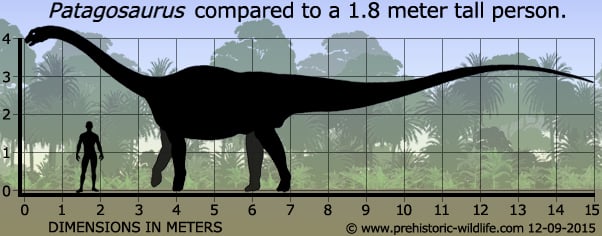
Patagosaurus is one of the earliest sauropods known to have roamed South America, however it’s usually the Cretaceous genera such as Amargasaurus, Saltasaurus and Argentinosaurus that usually get all of the attention. At eighteen meters long Patagosaurus was big for a mid-Jurassic era sauropod, yet it was not as advanced as the sauropods that began appearing in the late Jurassic. Instead Patagosaurus is regarded as being a more basal sauropod that is similar to other such as the European/North African Cetiosaurus and the Indian Barapasaurus. In fact all three of these sauropods are sometimes included in the same group called the Cetiosauridae, however not all palaeontologists are convinced that these three sauropods should be placed so close together.
Further Reading
– Dinosaurs: a Jurassic assemblage from Patagonia. – Science 205:1377-1378. – J. F. Bonaparte – 1979. – A Dentary of Patagosaurus (Sauropoda) from the Middle Jurassic of Patagonia. – Ameghiniana 40 (3): 425–32. – O. W. M. Rauhut – 2003.