Saltasaurus

Salt-ah-sore-us.

Backs were present even when the young Saltasaurus was inside the egg.

Updated on

John Stewart

Paleoecologist

John Stewart is a distinguished paleoecologist whose work has significantly advanced our understanding of prehistoric ecosystems. With over two decades dedicated to unearthing fossils across Asia and Africa

Benjamin Gutierrez

Benjamin Gutierrez is a leading expert on dinosaurs, particularly the mighty theropods. His fieldwork in South America has uncovered new species and provided insights into dinosaur social structures.

Cite Feedback Print

Name

Saltasaurus ‭(‬Salta lizard‭)‬.

Phonetic

Salt-ah-sore-us.

Named By

Bonaparte‭ & ‬Powell‭ ‬-‭ ‬1980.

Classification

Chordata,‭ ‬Reptilia,‭ ‬Dinosauria,‭ ‬Saurischia,‭ ‬Sauropodomorpha,‭ ‬Sauropoda,‭ ‬Titanosauria,‭ ‬Saltasauridae.

Diet

Herbivore.

Species

S.‭ ‬loricatus‭ (‬type‭)‬.

Size

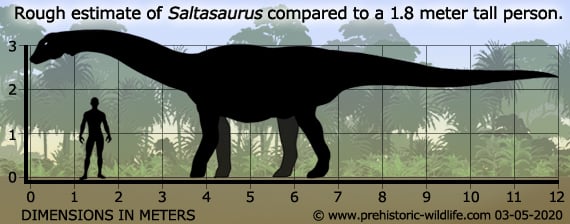
12‭ ‬meters long.

Known locations

Argentina,‭ ‬Salta Province‭ ‬-‭ ‬Lecho Formation.

Time Period

Campanian/Maastrichtian of the Cretaceous.

Fossil representation

Material of at least two individuals,‭ ‬eggs and internal embryos are also known.

Saltasaurus: Research Database

Titanosauria (Sauropoda) · Late Cretaceous (~70-66 MYA) · South America — Argentina (Lecho Formation)


Research Note: Saltasaurus was a titanosaurian sauropod from the Late Cretaceous of Argentina — one of the best-known titanosaurs with preserved armor and an important taxon for understanding titanosaur anatomy, armor, and evolution in the latest Cretaceous of South America.


Research Finding Status Grade Year Method Citation Impact
García et al. 2012: Saltasaurus and new data on titanosaurian sauropods from the Cretaceous of South America
García et al. 2012 provide comprehensive data on Saltasaurus from the Late Cretaceous of Argentina, establishing it as a titanosaurian and documenting titanosaur diversity in the Cretaceous of South America
Confirmed A 2012 Fossil García et al., Cretaceous Research Taxonomy
Zurriaguz & Powell 2014: Saltasaurus and additional data on titanosaur armor and anatomy
Zurriaguz & Powell 2014 provide additional data on Saltasaurus and titanosaur armor and anatomy, further contextualising its significance within Titanosauria
Confirmed B 2014 Fossil Zurriaguz & Powell, Cretaceous Research Anatomy
Status:
Confirmed Direct evidence
Grade:
A Strong consensus
B Good evidence


Active Debate: Titanosaur Armor and Latest Cretaceous South American Ecosystems

Whether titanosaur armor like that of Saltasaurus served defensive or display functions is debated. The evolution of titanosaur armor — and the ecological roles of armored titanosaurs — is key to understanding sauropod biology.


What We Still Do Not Know About Saltasaurus

  • Complete skeletal morphology: Relatively complete specimens known.
  • Social behavior: No direct evidence.
  • Reproduction: Unknown.
  • Color: Unknown.

In Depth about Saltasaurus

       The discovery of Saltasaurus was a revelation in that at least some titanosaurid sauropods actually had armour plates on their backs.‭

‬These plates are actually called osteoderms and are bony growths that were within the skin,‭ ‬and in Saltasaurus these were ten to twelve centimetres across and seemed to form low conical spikes.‭ ‬

These osteoderms had actually been found before the discovery of the main Saltasaurus remains and were thought to have been the remains of an armoured ankylosaurid dinosaur.‭ ‬

Some Other sauropods have since been found to also possess similar armoured growths,‭ ‬included the related titanosaurid Laplatasaurus.

       The presence of Saltasaurus in South America was also proof that while the sauropods in Northern latitudes declined and disappeared with the emergence of new herbivores like the hadrosaurs and ceratopsians,‭ ‬those that were isolated on the southern Island continents such as South America did not have to face this new competition and so continued to thrive until the very end of the Cretaceous when the dinosaurs became extinct.‭ ‬

Other sauropods such as Malawisaurus,‭ ‬Wintonotitan and the colossal Argentinosaurus also indicate a Cretaceous survival for the sauropods in Southern continents.

       A Saltasaurus nesting site has been identified at Auca Mahuevo in the Patagonia region of Argentina.‭ ‬Nests containing an average of twenty-five eleven to twelve centimetre eggs have been found in a site that is thought to have been used by hundreds of female Saltasaurus.‭

‬The fossilised embryos inside these eggs have revealed that the bony armour along their backs were present even when the young Saltasaurus was inside the egg.‭ ‬

There large number and close proximity of the nests to one another has also been taken to indicate herding behaviour in Saltasaurus,‭ ‬perhaps as an additional defence against predators like Abelisaurus and Carnotaurus.

Further reading

  • – A continental assemblage of tetrapods from the Upper Cretaceous beds of El Brete, northwestern Argentina (Sauropoda-Coelurosauria-Carnosauria-Aves) – Mémoires de la Société Géologique de France, Nouvelle Série 139:19-28 – J. F. Bonaparte & J. E. Powell – 1980.
  • – Osteología de Saltasaurus loricatus (Sauropoda Titanosauridae) del Cretácico Superior del noroeste Argentino. – J. E. Powell – 1992.
  • – Dermal Armor Histology of Saltasaurus loricatus, an Upper Cretaceous Sauropod Dinosaur from Northwest Argentina. – Acta Palaeontologica Polonica, 55(3): 389-398. – Ignacio A. Cerda & Jaime E. Powell – 2010.
Adopt A Species
prehistoric-wildlife new logo

Love this species?

Adopt it today!

(UPDATED!)

SPECIES SPOTLIGHT