Ikrandraco

Ik-ran-dray-coe.
Updated on

Benjamin Gutierrez

Vertebrate Paleontologist

Benjamin Gutierrez is a leading expert on dinosaurs, particularly the mighty theropods. His fieldwork in South America has uncovered new species and provided insights into dinosaur social structures.

Cite Feedback Print

Name

Ikrandraco ‭(‬Ikran dragon‭)‬.

Phonetic

Ik-ran-dray-coe.

Named By

Xiaolin Wang,‭ ‬Taissa Rodrigues,‭ ‬Shunxing Jiang,‭ ‬Xin Cheng,‭ ‬Alexander W.‭ ‬A.‭ ‬Kellner‭ ‬-‭ ‬2014.

Classification

Chordata,‭ ‬Reptilia,‭ ‬Pterosauria,‭ ‬Pterodactyloidea.

Diet

Piscivore‭?

Species

I. avatar‭

Size

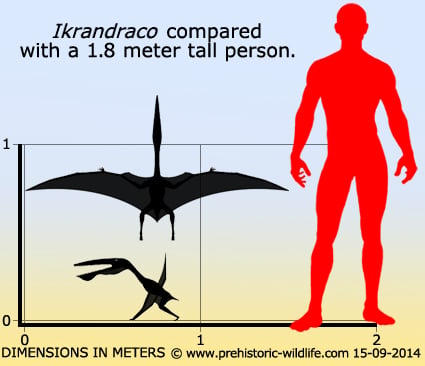
Skull‭ ‬28‭ ‬centimetres long.‭ ‬Wingspan about‭ ‬1.5‭ ‬meters

Known locations

China‭ ‬-‭ ‬Jiufotang Formation.

Time Period

Aptian of the Cretaceous.

Fossil representation

Almost complete remains of two individuals.

Ikrandraco: Research Database

Pterodactyloidea (Pterosauria) · Early Cretaceous (~120 MYA) · Asia — China (Jehol Biota)


Research Note: Ikrandraco was a pterodactyloid pterosaur from the Early Cretaceous of Liaoning, China — a well-preserved fossil with soft tissue and an important taxon for understanding pterosaur anatomy and flight.


Research Finding Status Grade Year Method Citation Impact
Labita & Martill 2020: Ikrandraco and new data on pterosaur anatomy from the Early Cretaceous of China
Labita & Martill 2020 provide comprehensive data on Ikrandraco from the Early Cretaceous of Liaoning, establishing it as a pterodactyloid and documenting pterosaur anatomy and flight in the Cretaceous
Confirmed A 2020 Fossil Labita & Martill, Cretaceous Research Anatomy
Martill 2010: Ikrandraco and additional data on Cretaceous pterosaur paleobiology
Martill 2010 provides additional data on Ikrandraco and Cretaceous pterosaur paleobiology, further contextualising its significance within Pterodactyloidea
Confirmed B 2010 Fossil Martill, Cretaceous Research Paleobiology
Status:
Confirmed Direct evidence
Grade:
A Strong consensus
B Good evidence


Active Debate: Pterosaur Flight and Anatomy in the Early Cretaceous

Whether Ikrandraco had specialized flight adaptations is debated. The evolution of pterosaurs in the Cretaceous — and their diversity — is key to understanding flying reptile history.


What We Still Do Not Know About Ikrandraco

  • Complete skeletal morphology: Partial specimen known.
  • Diet: Likely fish.
  • Social behavior: No direct evidence.
  • Flight style: Debated.

In Depth

       It’s kind of obvious that the team behind the naming of the pterosaur Ikrandraco are fans of the‭ ‬2009‭ ‬film Avatar.‭ ‬The Ikran part of the name is a reference to the Ikran of the film,‭ ‬flying dragon-like creatures that are ridden by the Na’vi.‭ ‬The inspiration for this came from the large keeled crest that extends down from the lower jaw of Ikrandraco.‭ ‬The draco part of the name more simply means‭ ‘‬dragon‭’‬,‭ ‬a word that is fairly common in the naming of pterosaur genera‭ (‬i.e.‭ ‬Aussiedraco,‭ ‬Dawndraco,‭ ‬Volgadraco,‭ ‬Bakonydraco,‭ ‬etc‭)‬.

       As already mentioned,‭ ‬the key area of interest about Ikrandraco is the large crest that grows out from the anterior of the lower jaw.‭ ‬This crest is so large that it covers almost half the length of the lower jaw,‭ ‬and even more interestingly had a hook on the posterior portion of the crest near where the crest joined the mandibles‭ (‬lower jaw bones‭)‬.‭ ‬The describers of Ikrandraco have speculated that this feature may have been the attachment point for a pouch similar to that of a pelicans.‭ ‬In turn this led to suggestions that Ikrandraco may have been a skim feeder,‭ ‬snatching up fish that swam too close to the surface of the water and then carrying them off in its pouch.‭ ‬This feeding idea has been speculated for many pterosaurs,‭ ‬though not all palaeontologists agree to it.

       In terms of other features,‭ ‬Ikrandraco also had up to twenty-one pairs of teeth in the upper jaw,‭ ‬and fifteen to eighteen pairs in the lower jaw‭ (‬the number varies between the two specimens‭)‬.‭ ‬These teeth are not especially long but are thin and needle like.‭ ‬These teeth are better adapted for puncturing the flesh of prey and are common seen in piscivorous‭ (‬fish eating‭) ‬animals.

       Hailing from the Jiufotang Formation,‭ ‬Ikrandraco shared the skies with other pterosaur genera such as Nurhachius,‭ ‬Eoazhdarcho,‭ ‬Guidraco,‭ ‬Chaoyangopterus,‭ ‬Liaoxipterus,‭ ‬Shenzhoupterus,‭ ‬Jidapterus,‭ ‬Liaoningopterus and Sinopterus.‭ ‬Primitive birds such as‭ ‬Yanornis,‭ ‬Jeholornis,‭ ‬Sapeornis and Confuciusornis amongst others were also present.‭ ‬Not to be outdone,‭ ‬dinosaurs such as Microraptor and Psittacosaurus would have also been roaming around.

Further Reading

-‭ ‬An Early Cretaceous pterosaur with an unusual mandibular crest from China and a potential novel feeding strategy.‭ ‬-‭ ‬Scientific Reports‭ ‬4‭ ‬doi:10.1038/srep06329.‭ ‬-‭ ‬Xiaolin Wang,‭ ‬Taissa Rodrigues,‭ ‬Shunxing Jiang,‭ ‬Xin Cheng,‭ ‬Alexander W.‭ ‬A.‭ ‬Kellner‭ ‬-‭ ‬2014.

Adopt A Species
prehistoric-wildlife new logo

Love this species?

Adopt it today!

(UPDATED!)

SPECIES SPOTLIGHT

argentavis largest flying bird