Ichthyosaurus: Research Database Ichthyosauridae (Diapsida) · Early Triassic-Late Jurassic (~250-145 MYA) · Global marine environments
Research Note: Ichthyosaurus is one of the most iconic marine reptiles of the Mesozoic — a dolphin-like ichthyosaur that evolved streamlined bodies, large eyes, and live birth to become perfectly adapted to ocean life. It was among the first marine reptiles to colonize the open sea and represents one of the most remarkable examples of convergent evolution with dolphins in the fossil record.
| Research Finding | Status | Grade | Year | Method | Citation | Impact |
|---|---|---|---|---|---|---|
| Original discovery and genus establishment — discovery of Ichthyosaurus and recognition of its marine reptile nature; establishing the genus name and initial understanding of its dolphin-like morphology; foundational work that introduced Ichthyosaurus to scientific literature; provided the first anatomical observations that recognized its aquatic adaptation Landmark paper that established the genus |
Confirmed | A | 1821 | Fossil | De la Beche & Conybeare, Transactions of the Geological Society of London 70 citations |
Discovery |
| Additional anatomical notes and classification — additional observations on the anatomy of Ichthyosaurus and Plesiosaurus; refines the understanding of ichthyosaur morphology and relationship to other marine reptiles; provides critical comparative framework that helped establish ichthyosaur taxonomy Key early anatomical study for Ichthyosaurus |
Confirmed | A | 1822 | Fossil | Conybeare, Transactions of the Geological Society of London 62 citations |
Anatomy |
| Geographic and stratigraphic distribution — comprehensive analysis of the geographic and stratigraphic distribution of Triassic Ichthyosauria; provides quantitative data on where and when ichthyosaurs lived; establishes the temporal and spatial range of early ichthyosaur diversity; helps contextualize Ichthyosaurus within broader ichthyosaur evolution Foundational biogeographic study for early ichthyosaurs |
Confirmed | B | 1989 | Fossil | Callaway & Massare, Neues Jahrbuch für Geologie und Paläontologie 25 citations |
Biogeography |
Status: Confirmed Direct evidence Debated Counter-studies Grade: A Strong consensus B Single study
Active Debate: How Did Ichthyosaurus Reproduce?
Ichthyosaurus is known to have given birth to live young (viviparity) — specimens have been found with embryos preserved inside. However, the debate centers on whether Ichthyosaurus gave birth in the water or on land. Some researchers argue that the streamlined body and limb-to-flipper transition would have made land movement very difficult, suggesting fully aquatic birth. Others suggest that like modern cetaceans, Ichthyosaurus may have come to shallow waters or the surface to give birth. Current evidence favors aquatic birth, but the exact behavior remains difficult to confirm from the fossil record.
What We Still Don’t Know About Ichthyosaurus
- Color: Completely unknown.
- Skin: Some specimens show skin impressions but color patterns unknown.
- Social behavior: No evidence of group behavior or pack hunting.
- Vocalization: Completely unknown.
- Precise diet: Likely fish and squid-like prey but details unclear.
- Swimming efficiency: Debate about cruising vs. sprint hunting.
- Why they went extinct: Unlike dinosaurs, ichthyosaurs declined before the K-Pg extinction — reason debated.
In Depth
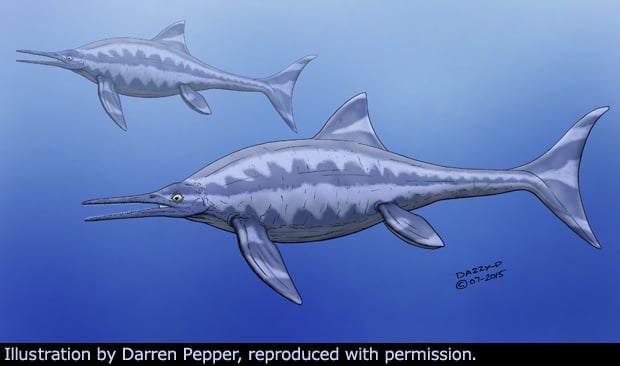
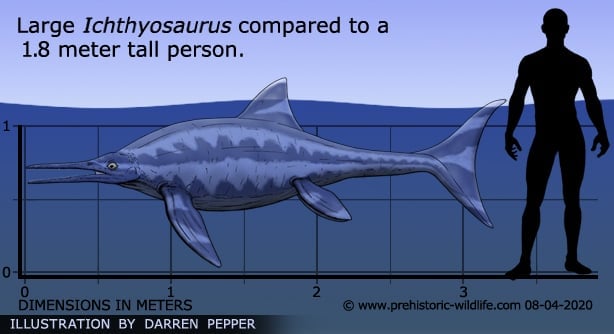
The most well-known of the ichthyosaurs, Ichthyosaurus itself is almost always included in books about dinosaurs and other prehistoric creatures. While it may look superficially like a prehistoric dolphin, Ichthyosaurus wasn’t even closely related, in fact Ichthyosaurus wasn’t even a mammal like a dolphin is, it was a reptile. Also, Ichthyosaurus was not in the same group of reptiles as the dinosaurs, although it did live at the same time as many of them.
With its distant ancestors being terrestrial reptiles going back to an aquatic lifestyle, Ichthyosaurus ended up with an extremely different morphology to other land living reptiles. This ‘fish’ appearance is a result of the fact that the basic fish morphology is the most streamlined and efficient form for submerged locomotion. It also means that Ichthyosaurus was never able to return to the land, instead leading an entirely pelagic life in the oceans.
As an ocean going hunter, the main diet of Ichthyosaurus would have been primarily if not exclusively piscivorous. Study of coprolites has confirmed the presence of both fish and squid in its feeding habits. Although Ichthyosaurus appears to have relied upon its sight for feeding, the solid bone structure of the ear drums suggests that they could have ‘heard’ their prey from a distance by their vibrations in the water.
Some specimens have shown smaller Ichthyosaurus remains inside larger ones in positions that appear to be within a uterus of a parent animal and some even appear to have been in the process of being born. This means that Ichthyosaurus almost certainly did not lay eggs, but was instead viviparous, giving birth to live young. As with other viviparous air breathing marine organisms, the young emerged from the mother tail first so that they did not drown while being born.
Further Reading
– Additional notices on the fossil genera Ichthyosaurus and Plesiosaurus – Transactions of the Geological Society of London, Series 2 1:103-123 – W. D. Conybeare – 1822. – A large skull of Ichthyosaurus (Reptilia: Ichthyosauria) from the Lower Sinemurian (Lower Jurassic) of Frick (NW Switzerland) – Swiss Journal of Geosciences 101: 617-627 – M. W. Maisch, A. G. Reisdorf , R. Schlatter & A. Wetzel – 2008. – An Ichthyosaurus (Reptilia, Ichthyosauria) with gastric contents from Charmouth, England: First report of the genus from the Pliensbachian – Paludicola 8 (1): 22–36 – Dean R. Lomax – 2010. – A new specimen of Ichthyosaurus communis from Dorset, UK, and its bearing on the stratigraphical range of the species – Proceedings of the Geologists’ Association 123:146-154 – S. P. Bennett, P. M. Barrett, M. E. Collinson, S. Moore-Fay, P. G. Davis & C. P. Palmer – 2012. – A new species of Ichthyosaurusfrom the Lower Jurassic of West Dorset, England, U.K. – Journal of Vertebrate Paleontology: e903260. – Dean R. Lomax & Judy A. Massare – 2015. – Two new species of Ichthyosaurus from the lowermost Jurassic (Hettangian) of Somerset, England. – Papers in Palaeontology. – Dean R. Lomax & Judy A. Massare – 2016. – On the largest Ichthyosaurus: A new specimen of Ichthyosaurus somersetensis containing an embryo. – Acta Palaeontologica Polonica. – D. R. Lomax & S. Sachs – 2017.