In Depth
Name: Dorygnathus (Spear jaw).
Phonetic: Dor-e-nay-fus (the ‘g’ is silent).
Named By: Johann Andreas Wagner - 1860.
Synonyms: Dorygnathus mistelgauensis, Parapsicephalus.
Classification: Chordata, Reptilia, Pterosauria, Rhamphorhynchoidea, Rhamphorhynchidae.
Species: D. banthensis (type).
Type: Piscivore.
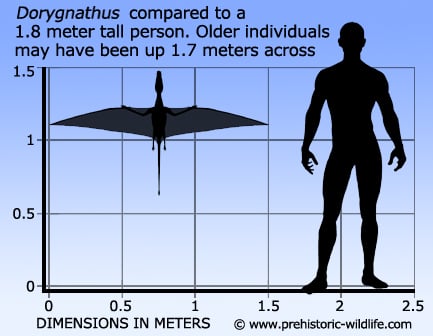
Size: Up to 1.5 meter wingspan, although older individuals may have been slightly larger, as evidenced by remains with a wingspan measuring 169 centimetres. Skull up to 16 centimetres long.
Known locations: Germany, Bavaria - Posidonia shale. France, Nancy. United Kingdom.
Time period: Toarcian of the Jurassic.
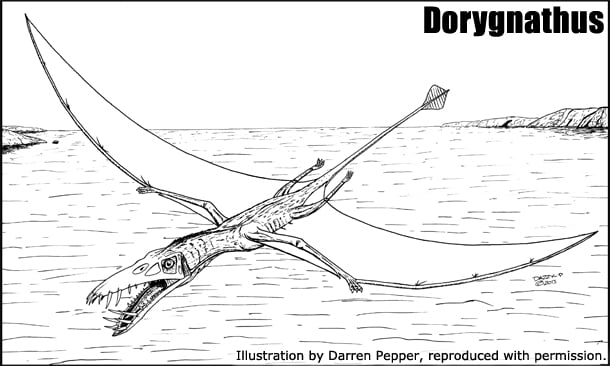
Fossil representation: Over 50 individual specimens. Dorygnathus is typical of the basal rhamphorhynchoid group of pterosaurs which include Rhamphorhynchus itself. This includes Dorygnathus having a similar overall morphology including a long tail that was held stiff by a network of tendons. Although no one knows if the tail of Dorygnathus had a vane on the end like in Rhamphorhynchus, one specimen seems to show evidence of hairs, or more correctly ‘pycnofibres’ that extended from the tail.
The teeth of Dorygnathus have quite a special arrangement, with the front teeth of the lower jaw not just pointing forwards but outwards. The other teeth in the lower jaw just point upwards, as do the teeth in the upper, and both sets of teeth get smaller the further back they ago. When closed the teeth intermeshed making for an effective prey trap.
By having the front teeth fanning out from the lower jaw, Dorygnathus would have certainly been an effective fish hunter. The lower teeth in this arrangement would have significantly increased the ‘catch’ area, kind of like if you wore a baseball glove instead of just relying upon your hand to catch a baseball. The arrangement may also suggest a preference for smaller fish species as larger ones would not have required the special adaptation.
The wings of Dorygnathus are quite short when compared to some other pterosaurs, and it has been speculated that Dorygnathus may have been more restricted to coastal waters rather than flying out many kilometres and spending extended periods over open water. When first discovered in 1830, Dorygnathus was thought to have potentially been similar to Dimorphodon, then attributed to Pterodactylus. This opinion continued until 1858 when Richard Owen described two Dimorphodon specimens that actually had their skulls, and in so doing creating the genus Dimorphodon and splitting it from Pterodactylus in the process. With this new description it became instantly clear that Dorygnathus was actually very different to Dimorphodon and so was given its own group.
A second species of Dorygnathus was once named in 1971 as D. mistelgauensis, after Mistelgau in Bavaria where it was discovered. This specimen was split into a separate species on the grounds that it was larger than most other species in fact it was about half as big again as the average. This was accepted until 2008 when Kevin Padian referenced a confirmed D. banthensis specimen that was even larger than D. mistelgauensis. Since the second specimen could no longer be separated on the basis of size alone the result was that D. mistelgauensis became a synonym to D. banthensis.
Another pterosaur called Campylognathoides has also been found, albeit in smaller numbers, in the same areas as Dorygnathus. These specimens have also been found to date to the same time period making it highly probable that Dorygnathus and Campylognathoides shared the same skies and possibly feeding grounds as one another.
Further Reading
– Studies of Liassic Pterosauria, I. The holotype and referred specimens of the Liassic Pterosaur Dorygnathus banthensis (Theodori) in the Petrefaktensammlung Banz, Northern Bavaria. – K. Padian & R. Wild – 1992. – The Early Jurassic Pterosaur Dorygnathus Banthensis(Theodori, 1830) – Kevin Padian – 2008.