In Depth
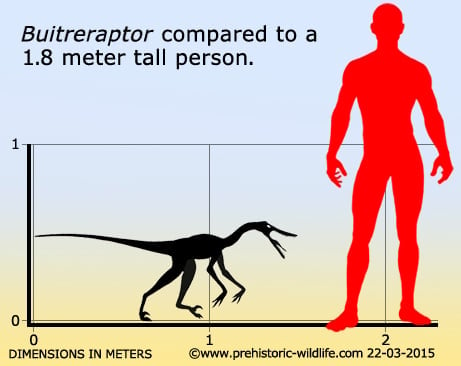
Buitreraptor was small, even for a dromaeosaurid dinosaur. Buitreraptor however is markedly different to most other currently known dromaeosaurid genera, especially by its skull. The jaws of Buitreraptor are long and slender, both advantages that could theoretically help in seizing prey like small lizards and mammals that might be hiding amongst rocks. The teeth, while small, recurve around so that the tips angle towards the back of the mouth, meaning that they would act like hooks to prevent prey wriggling off and moving forward out of the jaws. The serrations of the teeth also would have allowed for easy cutting into the flesh of soft bodied prey like the aforementioned lizards and mammals. Interestingly the sickle claw, usually so well developed in dromaeosaurids, is actually quite short and thick. It may be that while the sickle claw was likely a killing weapon in other genera, Buitreraptor simply used it to pin the bodies of small prey to the ground while it pulled off pieces with its mouth.
Like with its relatives, Buitreraptor is expected to have had a covering of feathers over its body, either completely or in certain parts like the arms and tail. Although no feathers have been found to conclusively prove that Buitreraptor had them, this lack of evidence has been factored down to lack of preservation, especially as remains have so far never been found to be one hundred percent complete anyway. The expectation for feathers in Buitreraptor arises from the observation from the discoveries of very well preserved dromaeosaurid individuals which have either been preserved with the feathers or the attachment points for them.
Although a predator itself, the small size of Buitreraptor meant that individuals of the genus were themselves likely prey for larger and more powerful predators. Two possible examples of these predators include Mapusaurus and Giganotosaurus, large carcharodontosaurids that were roaming around South America at roughly the same time as Buitreraptor.
Further Reading
- The earliest dromaeosaurid theropod from South America, Peter J. Makovicky, Sebastian Apestegu�a & Frederico L. Agnol�n - 2005. - The unusual dentiton of Buitreraptor gonzalezorum (Theropoda: Dromaeosauridae), from Patagonia, Argentina: new insights on the unenlagine teeth, F. A. Gianechini, S. Apestegu�a & P. J. Makovicky - 2009. – Postcranial osteology of a new specimen of Buitreraptor gonzalezorum (Theropoda, Unenlagiidae). – Cretaceous Research. 83: 127–167. – Fernando E. Novas, Federico Briss�n Egli, Federico L. Agnolin, Federico A. Gianechini & Ignacio Cerda – 2018. – Tail anatomy of Buitreraptor gonzalezorum (Theropoda, Unenlagiidae) and comparisons with other basal paravians. – Cretaceous Research. 83: 168–181. – Mat�as J. Motta, Federico Egli Briss�n, Fernando E. Novas – 2018. – Postcranial skeletal anatomy of the holotype and referred specimens of Buitreraptor gonzalezorum Makovicky, Apestegu�a and Agnol�n 2005 (Theropoda, Dromaeosauridae), from the Late Cretaceous of Patagonia. – PeerJ. 6: e4558 – F. A. Gianechini, P. J. Makovicky, S. Apesyegu�a & I Cerda – 2018.