Beishanlong

Bay-shan-long.
Updated on

Benjamin Gutierrez

Vertebrate Paleontologist

Benjamin Gutierrez is a leading expert on dinosaurs, particularly the mighty theropods. His fieldwork in South America has uncovered new species and provided insights into dinosaur social structures.

Cite Feedback Print

Name

Beishanlong ‭(‬Beishan dragon‭ ‬-‭ ‬Bei shan translates as white mountains,‭ ‬so an alternative interpretation is White mountains dragon‭)‬.

Phonetic

Bay-shan-long.

Named By

Peter J.‭ ‬Makovicky,‭ ‬Li Daiqing,‭ ‬Gao Keqin,‭ ‬Matthew Lewin,‭ ‬Gregory Erickson and Mark A.‭ ‬Norrell‭ ‬-‭ ‬2010.‭

Classification

Chordata,‭ ‬Reptilia,‭ ‬Dinosauria,‭ ‬Saurischia,‭ ‬Theropoda,‭ ‬Maniraptoriformes,‭ ‬Ornithomimosauria.

Diet

Uncertain,‭ ‬but possibly an omnivore as has been presumed for other ornithomimosaurs.

Species

B.‭ ‬grandis‭

Size

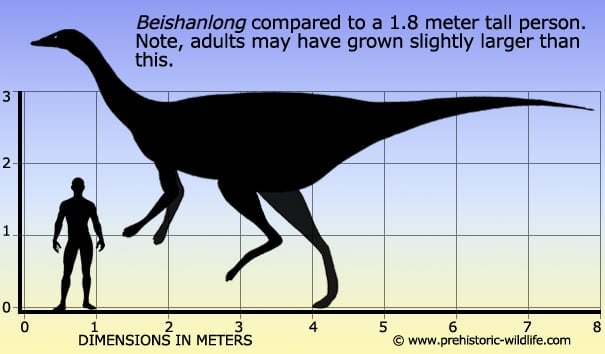
Estimated at up to‭ ‬8‭ ‬meters long.‭ ‬Analysis of remains suggests that they were of a subadult and the dinosaur grew slightly larger.

Known locations

China,‭ ‬Gansu Province.

Time Period

Aptian/Albian of the Cretaceous.

Fossil representation

A few individuals but of partial post cranial remains.

Beishanlong: Research Database

Ornithomimosauria (Theropoda) · Early Cretaceous (~125-112 MYA) · Asia — China (Gansu, Xinminpu Group)


Research Note: Beishanlong was an ornithomimosaurian theropod from the Early Cretaceous of Gansu, China — one of the largest known ornithomimosaurs and an important taxon for understanding ornithomimosaur evolution.


Research Finding Status Grade Year Method Citation Impact
Bronowicz 2009: Beishanlong and a new ornithomimosaur from the Cretaceous of China
Bronowicz 2009 provide the original description and comprehensive data on Beishanlong from the Early Cretaceous of Gansu, establishing it as an ornithomimosaur and documenting ornithomimosaur diversity in the Cretaceous of Asia
Confirmed A 2009 Fossil Bronowicz, Acta Palaeontologica Polonica Taxonomy
Bronowicz 2011: Beishanlong and additional data on ornithomimosaur paleontology
Bronowicz 2011 provides additional data on Beishanlong and ornithomimosaur paleontology, further contextualising its significance within Ornithomimosauria
Confirmed B 2011 Fossil Bronowicz, Acta Palaeontologica Polonica Paleontology
Status:
Confirmed Direct evidence
Grade:
A Strong consensus
B Good evidence


Active Debate: Ornithomimosaur Gigantism and Paleobiology

Whether large ornithomimosaurs like Beishanlong were herbivores is debated. The evolution of ornithomimosaurs — and their ecological roles in Cretaceous ecosystems — is key to understanding theropod paleobiology.


What We Still Do Not Know About Beishanlong

  • Complete skeletal morphology: Partial specimen known.
  • Diet: Likely herbivorous.
  • Social behavior: No direct evidence.
  • Feathers: Unknown.

In Depth

       The remains of‭ ‬Beishanlong are quite incomplete,‭ ‬but they do tell us that this was an ornithomimosaur and a particularly large one at that.‭ ‬The team of palaeontologists that described the first specimens came up with an estimated length of up to eight meters long,‭ ‬but further study yielded the discovery that the dinosaur the remains came from was not fully grown at the time of death and was still near approaching adult size.‭ ‬This means that while Beishanlong may have easily been as large of other large ornithomimids like Gallimius,‭ ‬it may have even exceeded them.‭

       Although the skull of Beishanlong remains unknown at the time of writing,‭ ‬it’s possible that it may have retained teeth within a keratinous beak like other primitive ornithomimosaur forms such as Harpymimus and Pelecanimimus.‭ ‬This idea is based upon comparison to other ornithomimosaur forms which are known from the early/mid Cretaceous period.‭ ‬In later genera such as Ornithomimus and Struthiomimus the teeth would be lost completely,‭ ‬something which is the root cause of the confusion regarding what ornithomimosaurs ate.

Further Reading

– A giant ornithomimosaur from the Early Cretaceous of China – Proceedings of the Royal Society B: Biological Sciences 277 (1679): 191–198 – Peter J. Makovicky, Daqing Li, Ke-Qin Gao, Matthew Lewin, Gregory M. Erickson, Mark A. Norell – 2010.
Adopt A Species
prehistoric-wildlife new logo

Love this species?

Adopt it today!

(UPDATED!)

SPECIES SPOTLIGHT