In Depth
Archaeoceratops is yet another of the increasingly large number of basal ceratopsian dinosaur remains that are coming from Asia. These remains point to an Asian ancestral origin for all ceratopsians from Protoceratops of Mongolia, to huge and horned Triceratops and Styracosaurus of North America.
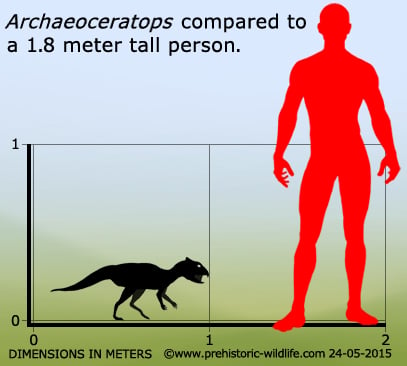
Archaeoceratops however was very different to these larger later forms. First, Archaeoceratops seems to be better suited to a bipedal stance when walking, although it was probably quick to adopt a quadrupedal posture for feeding upon low vegetation. Grasses had not yet evolved so Archaeoceratops would have been a browser of low vegetation, something that would not change throughout the lineage of the ceratopsian dinosaurs. Despite its small size lack of horns and bipedal stance however, the early indications of how its descendants would form can already be seen in the size of the skull. This skull when compared to the proportions of similarly sized dinosaurs like the ornithopods actually appears to be too big for the body, and later quadrupedal ceratopsian dinosaurs would go down in natural history as having some of the proportionately largest skulls in relation to their overall body sizes.
Further Reading
– On a primitive neoceratopsian from the Early Cretaceous of China. Sino-Japanese Silk Road Dinosaur Expedition. – China Ocean Press, Beijing 68-89. – Z. Dong & Y. Azuma – 1997. – A new species of Archaeoceratops (Dinosauria: Neoceratopsia) from the Early Cretaceous of the Mazongshan area, northwestern China, Hai-Lu You, Kyo Tanque & Peter Dodson, In New Perspectives on Horned Dinosaurs: The Royal Tyrrell Museum Ceratopsian Symposium (Bloomington and Indianapolis: Indiana University Press) – Michael J. Ryan, Brenda J. Chinnery-Allgeier & David A. Eberth – 2010.