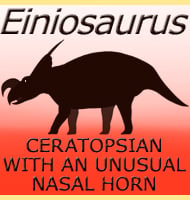
Einiosaurus

einiosaurus

In Depth        The nasal horn of Einiosaurus is quite unusual in that it curves forward to point towards the ground,‭ ‬something which is reflected in the species name E.‭ ‬procurvicornis which translates to English as‭ ‘‬forward curving horn‭’‬.‭ ‬In young Einiosaurus this horn is thought to have started out small,‭ ‬but as the individual grew … Read more

Arrhinoceratops

In Depth        An often included genus in dinosaur books,‭ ‬Arrhinoceratops is another example of a popular dinosaur known by very little fossil material.‭ ‬In this case Arrhinoceratops has been based upon the description of only a single partially preserved skull.‭ ‬Arrhinoceratops was named because William Parks thought that it lacked a nasal horn,‭ ‬and too … Read more

Nedoceratops

In Depth        Nedoceratops is a genus of ceratopsian dinosaur that lived in North America in the late Cretaceous.‭ ‬So far only a single skull has been attributed to the genus,‭ ‬but originally this skull was called Diceratops.‭ ‬When this name was found to already be in use however,‭ ‬the name Nedoceratops was given to the … Read more

Ajkaceratops

In Depth        Although only named from partial skull remains representing what seems to be a small dinosaur,‭ ‬Ajkaceratops has been one of the most important dinosaur discoveries of the early twenty-first century‭; ‬it is the first ceratopsian dinosaur definitively proven to have come from Europe.‭ ‬Ceratopsian dinosaurs were very common across Asia and North America … Read more

Agujaceratops

Agujaceratops: Research Database Ceratopsidae (Ornithischia) · Late Cretaceous (~80–75 MYA) · North America — Texas (Aguja Formation)   Research Note: Agujaceratops was a chasmosaurine ceratopsid from the Late Cretaceous of Texas — one of the few named ceratopsids from the southern United States. As a member of the Ceratopsidae, it provides data on ceratopsid diversity … Read more

Vagaceratops

In Depth        The material of Vagaceratops was first removed from its block in‭ ‬2001‭ ‬when palaontologists identified it as a species of Chasmosaurus,‭ ‬C.‭ ‬irvinensis.‭ ‬Further study in‭ ‬2010‭ ‬however revealed it to be different enough to give it its own genus.‭ ‬Normal procedure for this occurrence is to take the specific species name of … Read more

Xenoceratops

Xenoceratops: Research Database Ceratopsia (Ornithischia) · Late Cretaceous (~78 MYA) · North America — Canada (Alberta, Philmont Scout Ranch)   Research Note: Xenoceratops was a ceratopsian from the Late Cretaceous of Alberta, Canada — an important taxon for understanding ceratopsian diversity in the Late Cretaceous of North America.   Research Finding Status Grade Year Method … Read more

Aquilops

In Depth        Initially thought to represent a new specimen of Zephyrosaurus,‭ ‬the small partial skull of the holotype was soon realised to be a whole new genus of small ceratopsian dinosaur.‭ ‬Like most primitive ceratopsian dinosaurs,‭ ‬Aquilops was a fairly small dinosaur measuring just over half a meter in length.‭ ‬The name Aquilops means‭ ‘‬eagle … Read more

Archaeoceratops

Archaeoceratops: Research Database Ceratopsia (Ornithischia) · Early Cretaceous (~130–120 MYA) · Asia — China (Liaoning)   Research Note: Archaeoceratops was a basal ceratopsian dinosaur from the Early Cretaceous of Liaoning, China. As one of the earliest known ceratopsians, it provides critical data on the early evolution of the ceratopsian body plan.   Research Finding Status … Read more