Arthropleura: Research Database Arthropleuridae (Myriapoda) · Carboniferous (~300 MYA) · Europe and North America
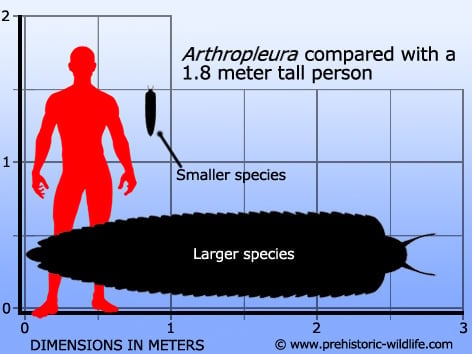
Research Note: Arthropleura was the largest known land invertebrate of all time — a giant millipede-like arthropod that could reach 2.5 meters in length and weighed around 50 kg. It lived in the Carboniferous coal swamps of Europe and North America, a time when atmospheric oxygen levels were much higher than today. Arthropleura represents an extraordinary example of gigantism in invertebrates driven by high atmospheric oxygen.
| Research Finding | Status | Grade | Year | Method | Citation | Impact |
|---|---|---|---|---|---|---|
| Limb structure, affinity and diet — comprehensive analysis of the limb structure of Arthropleura; establishes the taxonomic affinity of Arthropleura within the myriapod group; provides evidence for the diet and ecological role of Arthropleura in Carboniferous ecosystems; establishes the phylogenetic context of this giant arthropod Foundational study of Arthropleura anatomy and classification |
Confirmed | A | 1967 | Fossil | Rolfe & Ingham, Scottish Journal of Geology 37 citations |
Anatomy |
| Walking traces and locomotion — analysis of trace fossils (trackways) attributed to Arthropleura; provides evidence for the locomotion and gait of this giant arthropod; reveals how Arthropleura moved across Carboniferous landscapes; estimates speed and gait patterns from trackway geometry First trace fossil evidence for Arthropleura locomotion |
Confirmed | B | 1992 | Trace Fossil | Pearson, Scottish Journal of Geology 18 citations |
Locomotion |
| Walking trails from the Carboniferous — describes new trackway evidence for Arthropleura from Carboniferous deposits; expands the known geographic and temporal range of Arthropleura trace fossils; provides additional data on the locomotion and behavior of this giant arthropod Expands the trace fossil record of Arthropleura |
Confirmed | B | 2009 | Trace Fossil | Martino & Greb, Journal of Paleontology 13 citations |
Behavior |
Status: Confirmed Direct evidence Debated Counter-studies Grade: A Strong consensus B Single study
Active Debate: What Did Arthropleura Eat?
The diet of Arthropleura has been debated for decades. Some researchers argue it was herbivorous, feeding on the lycopod (club moss) vegetation that dominated Carboniferous coal swamps. Others suggest it was carnivorous, feeding on other invertebrates. Evidence from mouthpart morphology and gut contents is inconclusive. A third view proposes that Arthropleura was a detritivore, feeding on decaying plant matter. The high atmospheric oxygen of the Carboniferous (up to 35% vs. today’s 21%) is thought to have enabled its giant size, but whether it fed on living plants or detritus remains unresolved. Current evidence most strongly favors herbivory or detritivory, but this is not settled.
What We Still Don’t Know About Arthropleura
- Color: Completely unknown.
- Precise diet: Herbivore, detritivore, or carnivore — still debated.
- Body segments: Number of body segments unknown.
- Leg count: Exact number of legs unknown.
- Social behavior: No evidence of group behavior.
- Reproduction: Completely unknown.
- Cause of extinction: Likely related to declining oxygen and drying climates at end of Carboniferous.
In Depth
Arthropleura is a contender for the biggest arthropod of all time, and like with other arthropods of the Carboniferous period, this gigantism has been attributed to the greater abundance of oxygen in the atmosphere of this time. Many fossilised track ways have also been preserved with some even showing Arthropleura moving around trees as it made its way through the Carboniferous forests.
Because the mouth of Arthropleura has never been recovered it is has been difficult to say with certainty if it was a herbivore or carnivore. Instead scientists have had to look at the digestive tract and coprolites of this animal, which have been found to contain spores from plants like ferns, something that is not seen in a carnivorous animal suggesting it was a herbivore.
Arthropleura disappears from the fossil record during the early Permian when the climate dried and the lush forests were replaced with arid and desert like environments. Not only did the oxygen content become reduced from the lack of oxygen producing vegetation, the dry conditions would not have suited Arthropleura because of its crustacean ancestry. Crustaceans as a whole need moist conditions to stop themselves from drying out which is why today you either see them in aquatic environments, or the shaded areas of the ground such as amongst the leaf litter where the ground cannot get dried out by the sun.For another surprisingly large arthropod, check out the eurypterid Jaekelopterus.
Further Reading
– Evidence of pteridophyte–arthropod interactions in the fossil record. – Proceedings of the Royal Society of Edinburgh 86B: 133–140. – A. C. Scott, W. G. Chaloner & S. Paterson – 1985. – The giant Arthropleura trackway Diplichnites cuithensis from the Cutler Group (Upper Pennsylvanian) of New Mexico”. Geological Society of America Abstracts with Programs 36 (5): 66. – Adrian P. Hunt, Spencer G. Lucas, Allan Lerner & Joseph T. Hannibal – 2004. – The largest arthropod in Earth history: insights from newly discovered Arthropleura remains (Serpukhovian Stainmore Formation, Northumberland, England). – Journal of the Geological Society. 179 (3). – Neil Davies et al – 2021.