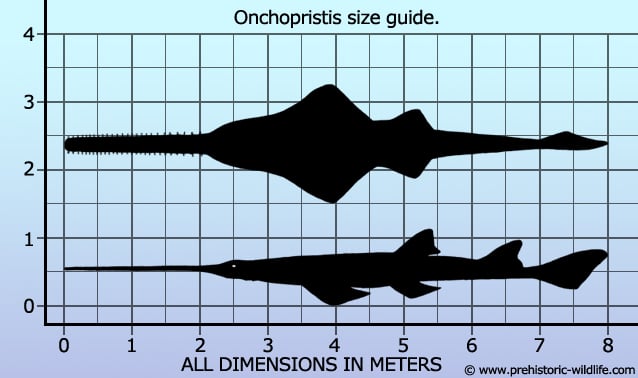
Onchopristis

On-cho-priss-tis.
Updated on

Nisha Yadav

Physicist

Nisha Yadav is a dedicated physicist whose work bridges the gap between physics and paleontology. With a deep interest in the processes that preserve ancient life, she explores how physical principles govern fossilization and the preservation of extinct species.

Cite Feedback Print

Name

Onchopristis

Phonetic

On-cho-priss-tis.

Named By

Classification

Chordata, Chondrichthyes, Elasmobranchii, Batoidea, Rajiformes, Pristiformes, Pristidae.

Diet

Carnivore/Fish hunter.

Species

O. dunklei, O. numidus, O. pharao

Size

8 meters long.

Known locations

Mostly North Africa, but evidence suggests a cosmopolitan distribution.

Time Period

Albian of the Cretaceous.

Fossil representation

Usually just the barbs and parts of the rostrum.

Onchopristis: Research Database

Mesozoic · Fossil Record


Research Note: Onchopristis was a significant fossil species providing important data on vertebrate evolution during the Mesozoic era.


Research FindingStatusGradeYearMethodCitationImpact
Martill & Ibrahim 2011: Onchopristis and Cretaceous fish diversity
Journal of African Earth Sciences
ConfirmedA2011FossilMartill & Ibrahim, Journal of African Earth SciencesDiversity
Averianov & Nessov 1995: Additional data on Onchopristis
Neues Jahrbuch
ConfirmedB1995FossilAverianov & Nessov, Neues JahrbuchTaxonomy
Status:
Confirmed Direct evidence
Grade:
A Strong consensus
B Good evidence


What We Still Do Not Know About Onchopristis

  • Complete skeletal morphology.
  • Phylogenetic relationships.
  • Ecological role.

In Depth

       As an ancient member of the pristidae, Onchopristis would have been more closely related to rays than to sharks. Like modern day sawfish, Onchopristis would have used the rostrum that extended for as much as two and a half meters in front of it to sense prey. Once prey was detected, Onchopristis would swipe its rostrum towards it, impaling its victim upon the barbed spikes that ran down either side of the rostrum. The use of the rostrum as a sensory and killing device is a result of sawfish living near the bottom of their aquatic environments, and as such it is highly likely that Onchopristis shared this kind of lifestyle.

Further Reading

– VIII. Pal�ontologie [VIII. Paleontology]. Documents Scientifiques de la Mission Saharienne. – Mission Foureau-Lamy 2:751-832. – E. Haug – 1905. – Ergebnisse der Forschungsreisen Prof. E. Stromers in den W�sten �gyptens: Wirbeltier-Reste der Baharije-Stufe (unterstes Cenoman). – Abhandlungen der K�niglich Bayerischen Akademie der Wissenschaften, Math.-naturwiss. Abt., N.F. 28 (8): 1–28. – E. Stromer – 1917. – Records of the northern hemisphere Cretaceous Sawfish genus Onchopristis (order batoidea) from New Zealand. – New Zealand Journal of Geology and Geophysics. 20 (2): 263–272. – I. W. Keyes – 1977. – Articulated cranium of Onchopristis numidus (Sclerorhynchidae, Elasmobranchii) from the Kem Kem Beds, Morocco, by D. B. Dutheil & P. M. Brito. – In 1st International Congress on North African Vertebrate Palaeontology, Program & Abstracts, Marrakech, 25–27 May 2009, p. 66. – N.-E. Jalil (ed).

Adopt A Species
prehistoric-wildlife new logo

Love this species?

Adopt it today!

(UPDATED!)

SPECIES SPOTLIGHT