In Depth
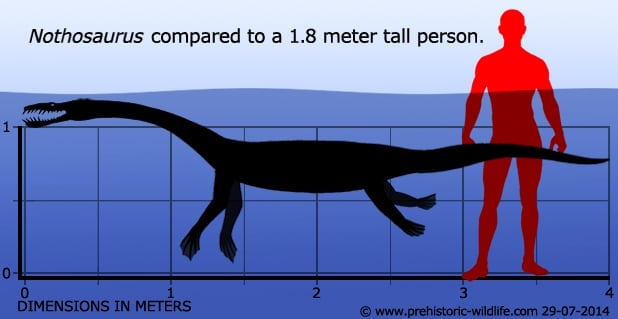
Nothosaurus is representative of one of the dominant groups of marine reptiles of the Triassic, the other main group being the primitive ichthyosaurs like Cymbospondylus. The nothosaurs are often dubbed the seals of the Triassic because while they were adapted for aquatic life, they still held onto to clear terrestrial adaptations. This would see Nothosaurus living and spending much of its time on the coast where it could dive into the sea in search of prey.
When in the water Nothosaurus would have used a combination of its tail and its webbed feet to propel itself through the water. The jaws of Nothosaurus were filled with long thin teeth that pointed out of the mouth and intermeshed together when the jaws were closed. These jaws formed an effective prey trap for use in catching slippery prey like fish, and were similar in arrangement to the later elasmosaurid plesiosaurs like Elasmosaurus as well as some fish eating pterosaurs. Despite the popular interpretation of Nothosaurus being a dedicated fish eater, it may have also tackled small and juvenile marine reptiles as well. Evidence for this suggestion can be taken from the presences of juvenile placodonts like Cyamodus inside the stomach of the much smaller nothosaur Lariosaurus.
When not searching for food in the sea Nothosaurus probably spent most of its time on land, although probably not so far as to lose sight of the sea. Returning to land meant that Nothosaurus would not have to spend all of its time swimming in the ocean, as well as possibly avoiding marine predators like sharks and possibly ichthyosaurs. The land may not have been totally safe however as archosaur reptiles may have been a threat if they were able to access the same coastal areas that Nothosaurus used.
Although Nothosaurus lived on land it remains uncertain if it reproduced by giving birth to live young or if it laid eggs. Fossils of nothosaurs of other genera suggest that live birth was possible, and live birth also seems to be the norm in the ichthyosaurs as well as possibly the later plesiosaurs which are thought to have evolved from the nothosaurs. The problem remains however of exactly when live birth in marine reptiles started to occur.
Further Reading
– Ein Nothosaurier-Sch�del aus dem Muschelkalk des Wadi Ramon (Negev, Israel). – Annalen des Naturhistorischen Museums in Wien 83:119-125. – G. Haas – 1980. – The braincases of Simosaurus and Nothosaurus: monophyly of the Nothosauridae (Reptilia: Sauropterygia). – Journal of Vertebrate Paleontology 14(1):9-23. – O. Rieppel – 1994. – Nothosaurus edingerae Schultze, 1970: diagnosis of the species and comments on its stratigraphical occurrence. – Stuttgarter Beitr�ge f�r Naturkunde, Serie B. – O. Rieppel & R. Wild – 1994. – The status of the sauropterygian reptile Nothosaurus juvenilis from the Middle Triassic of Germany. – Palaeontology 37(4):733-745. – O. Rieppel – 1995. – A revision of the genus Nothosaurus (Reptilia: Sauropterygia) from the Germanic Triassic, with comments on the status of Conchiosaurus clavatus. – Fieldiana: Geology, new series 34:1-82. – O. Rieppel & R. Wild – 1996. – The status of Shingyisaurus unexpectus from the Middle Triassic of Kweichou, China. Journal of Vertebrate Paleontology 18(3):541-544. – O. Rieppel – 1998. – A new species of the sauropterygian genus Nothosaurus from the Lower Muschelkalk of Winterswijk, The Netherlands. – Journal of Paleontology 77(4):738-744. – P. C. H. Albers & O. Rieppel – 2003. – A new specimen of Nothosaurus marchicus with features that relate the taxon to Nothosaurus winterswijkensis. – Vertebrate Palaeontology 3 (1): 1–7. – P. C. H. Albers – 2005. – Nothosaurus yangjuanensis n. sp. (Reptilia, Sauropterygia, Nothosauridae) from the middle Anisian (Middle Triassic) of Guizhou, southwestern China. – NeuesJahrbuch f�r Geologie und Pal�ontologie, Monatshefte 5: 257–276. – W. Jiang, M. W. Maisch, W. Hao, Y. Sun & Z. Sun – 2006. – A new species of Nothosaurus from the early Middle Triassic of Guizhou, China. – Vertebrata PalAsiatica 44(3):237-249. – Q. -H. Shang – 2006. – New information on the dentition and tooth replacement of Nothosaurus (Reptilia: Sauropterygia). – Palaeoworld 16: 254–263. – Q. -H. Shang – 2007. – A new species of the sauropsid reptile Nothosaurus from the Lower Muschelkalk of the western Germanic Basin, Winterswijk, The Netherlands. – Acta Palaeontologica Polonica 54 (4): 589–598. – N. Klein & P. C. H. Albers – 2009. – New Nothosaurus skulls from the Lower Muschelkalk of the western Lower Saxony Basin (Winterswijk, the Netherlands) shed new light on the status of Nothosaurus winterswijkensis. – Netherlands Journal of Geosciences. 90 (1): 15–22. – P. C. H. Albers – 2011. – A gigantic nothosaur (Reptilia: Sauropterygia) from the Middle Triassic of SW China and its implications for the Triassic biotic recovery. – Scientific Reports. 4: 7142. – Jun Liu – 2014.