In Depth
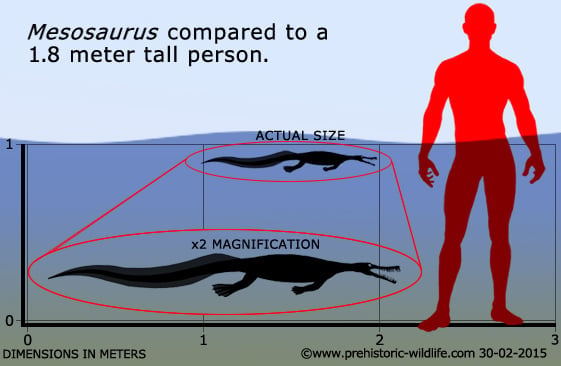
Mesosaurus is one of the first reptiles to return to an aquatic lifestyle. The nostrils are on top of the skull and the legs are suited more for aquatic movement than that on land. The tail may have sported a fin similar to the earlier tetrapod amphibians, and the feet were webbed. As an early reptile is possible that Mesosaurus would have had to return to the land to lay its eggs. When on land it might of had to push itself with its legs as opposed to lift its body and actually walk. A further development is the pachyostosis of the bones. This is where the bones become thickened and more solid resulting in a denser bone structure. This development may have helped to deal with buoyancy issues allowing Mesosaurus to have greater agility in the water.
The teeth of Mesosaurus are very fine and were originally interpreted to have formed a comb like structure for filtering food out of the water. However, further specimens have cast doubt upon this method of feeding as the teeth are always too few to form such a structure. With this in mind it is more likely that Mesosaurus hunted small fish and invertebrates. It is generally considered that Mesosaurus dwelt in freshwater.
When the theory of continental drift was still being debated amongst the scientific community, the fossils of Mesosaurus recovered from both sides of the Atlantic ocean were taken as evidence to support the theory.
Further Reading
– Description du Mesosaurus tenudiens. Reptile fossile de l’Afrique australe. Acad�mie des Sciences et Lettres de Montpellier. – M�moires de la Section des Sciences 6(2):169-175 – P. Gervais – 1865. – Mesosaurus brasiliensis nov. sp. by J. H. MacGregor – Appears in, Commission for Studies on Brazilian Coal Mines – Final Report; (Bilingual report, Portuguese & English), Imprensa Nacional, Rio de Janeiro, Brazil, 617 p.: Part II, pp. 301-336. – I. C. White – 1908. – Osteologie und systematische Stellung von Mesosaurus. – Palaeontographica. Abteilung A. Palaeozoologie-Stratigraphie 92: 45–58. – Friedrich von Huene – 1940. – The cranial skeleton of the Early Permian aquatic reptile Mesosaurus tenuidens: implications for relationships and palaeobiology. – Zoological Journal of the Linnean Society 146 (3): 345–368. – S. P. Modesto – 2006. – The postcranial skeleton of the aquatic parareptile Mesosaurus tenuidens from the Gondwanan Permian. – Journal of Vertebrate Paleontology 30 (5): 1378–1395. – S. P. Modesto – 2010. – Cranial morphology of the Early Permian mesosaurid Mesosaurus tenuidens and the evolution of the lower temporal fenestration reassessed. – Comptes Rendus Palevol 11 (5): 379–391. – G. Pi�eiro, J. Ferigolo, A. Ramos & M. Laurin – 2012. – Was Mesosaurus a Fully Aquatic Reptile? Frontiers in Ecology and Evolution. – Pablo Nu�ez Demarco, Melitta Meneghel, Michel Laurin & Graciela Pi�eiro – 2018.