In Depth
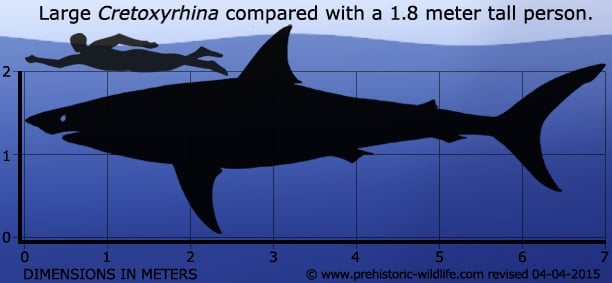
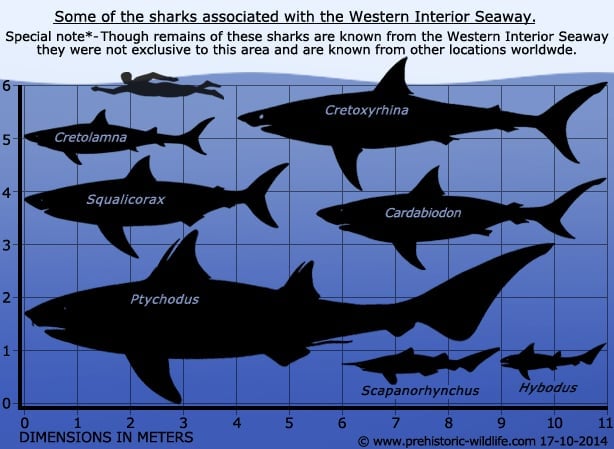
Also known as the ‘Ginsu shark’, Cretoxyrhina was one of the biggest sharks of its time, considerably bigger even than its contemporary Squalicorax. Cretoxyrhina was near the top of the food chain, and it had a diet that included almost anything that was in front of it, including mosasaurs. There is also strong evidence for its predation of the bony fish Xiphactinus, a four to six meter long predator itself, and even the large turtles of the day were fair game for Cretoxyrhina.
Cretoxyrhina acquired the name ‘Ginsu Shark’ in reference to its teeth. At up to seven centimetres long, the teeth are smooth and have thick enamel, suggesting that they were for work against tough shells and bones. Like the advert for Ginsu knifes said, they could cut through anything, and Cretoxyrhina probably had little difficulty in removing bite sized chunks from whatever prey item it chose.
The overall morphology for Cretoxyrhina is lamniform, similar to a Great White shark today. The tail also shows adaption form fast swimming, enabling Cretoxyrhina to give chase after faster prey.
Further Reading
– Late Cretaceous sharks Cretoxyrhina and Cardabiodon from Montana, USA. Acta Palaeontologica Polonica 50 (2): 301–314. – Mikael Siverson & Johan Lindren – 2005. – Ontogenetic parameters and life history strategies of the late Cretaceous lamniform shark, Cretoxyrhina mantelli, based on verterbal grown increments. – Journal of Vertebrate Paleontology 28: 21-33. – K. Shimada – 2008. – Caudal fin of the Late Cretaceous shark, Cretoxyrhina mantelli (Lamniformes: Cretoxyrhinidae), morphometrically compared to that of extant lamniform sharks, Society of Vertebrate Paleontology – Phillip Sternes & Kenshu Shimada 2018. – Large deadfall of the ‘ginsu’ shark Cretoxyrhina mantelli (Agassiz, 1835) (Neoselachii, Lamniformes) from the Upper Cretaceous of northeastern Italy. – Cretaceous Research. 98 250–275. – Jacopo Amalfitano, Luca Giusberti, Eliana Fornaciari, Fabio Marco Dalla Vicchia, Valeria, Luciani, J�rgen Kriwet, Giorgio Carnevale – 2019.