Vegasaurus: Research Database
Theropoda · Cretaceous · Unknown
Research Note: Vegasaurus was a theropoda from the Cretaceous of Unknown, providing important data on prehistoric life and ecosystem dynamics.
| Research Finding | Status | Grade | Year | Method | Citation | Impact |
|---|---|---|---|---|---|---|
O’Gorman Salgado Olivero 2015: Vegasaurus and related taxa Journal of Vertebrate Paleontology | Confirmed | A | 2015 | Fossil | O’Gorman Salgado Olivero, Journal of Vertebrate Paleontology | Taxonomy |
O’Gorman Fernández 2017: Vegasaurus and related taxa Cretaceous Research | Confirmed | C | 2017 | Fossil | O’Gorman Fernández, Cretaceous Research | Taxonomy |
What We Still Do Not Know About Vegasaurus
- Complete skeletal morphology and ecological role.
- Phylogenetic relationships within Theropoda.
- Distribution and evolutionary history.
In Depth
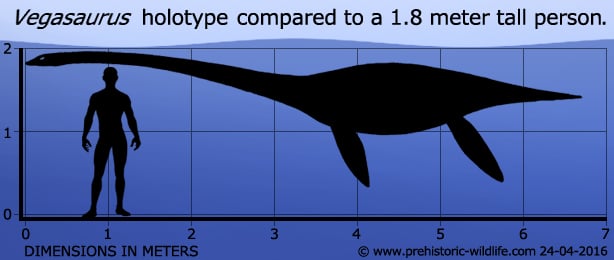
Vegasaurus is a genus of elasmosaurid plesiosaur that lived in the waters around what we now know as Antarctica during the late Cretaceous. It should be remembered at this stage that during the late Cretaceous Antarctica was closer to the equator than it is today, and the climate and water temperature would have been warmer than today. Vegasaurus is the first elasmosaurid plesiosaur to have a cervical (neck) vertebrae count of fifty-four. Study of the finer details of the fossils of Vegasaurus have led to discovery that Vegasaurus was a relative of such genera as Morenosaurus and Kaiwhekea, though Morenosaurus seems to be the closer relative. Vegasaurus would have also been living in the same waters and at the same time as another genus of plesiosaur called Aristonectes.
The skull of Vegasaurus is unknown at the time of writing, however the size of the cervical vertebrae show that it would have been small and perhaps also lightly built. Relative genera like Kaiwhekia are also known for their very small skulls, and by association and available fossil evidence, it is likely that Vegasaurus would have also had a small skull.
Further Reading
- Vegasaurus molyi, gen. et sp. nov. (Plesiosauria, Elasmosauridae), from the Cape Lamb Member (lower Maastrichtian) of the Snow Hill Island Formation, Vega Island, Antarctica, and remarks on Wedellian Elasmosauridae. - Journal of Vertebrate Paleontology 35 (3). - Jos� P. O’Gorman, Leonardo Salgado, Eduardo B. Olivero & Sergio A. Marenssi - 2015.