Thalassodromeus

Fah-lass-oh-dro-meus.
Updated on

John Stewart

Paleoecologist

John Stewart is a distinguished paleoecologist whose work has significantly advanced our understanding of prehistoric ecosystems. With over two decades dedicated to unearthing fossils across Asia and Africa

Cite Feedback Print

Name

Thalassodromeus (Sea runner).

Phonetic

Fah-lass-oh-dro-meus.

Named By

Kellner & Campos - 2002.

Classification

Chordata, Reptilia, Pterosauria, Pterodactyloidea, Neoazhdarchia. Thalassodromidae.

Diet

Piscivore/Carnivore.

Species

T. sethi

Size

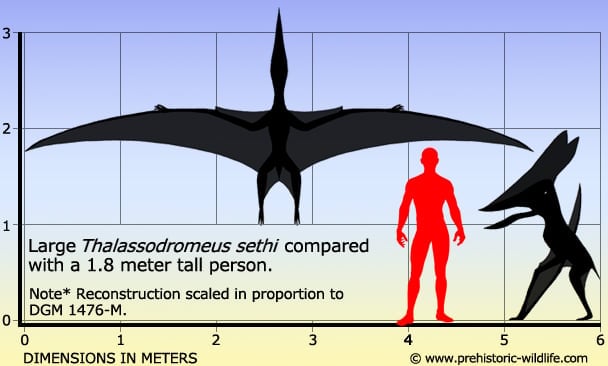
Typically 4.5 meter wingspan, larger individuals possibly up to 5.3 meter wingspan.

Known locations

Brazil - Santana Formation.

Time Period

Albian of the Cretaceous.

Fossil representation

Two specimens.

Thalassodromeus: Research Database

Tapejaridae (Pterosauria) · Early Cretaceous (~112–100 MYA) · South America — Brazil (Araripe Basin, Santana Formation)


Research Note: Thalassodromeus was a tapejarid pterosaur from the Early Cretaceous Araripe Basin of northeastern Brazil, famous for its enormous cranial crest and blade-like beak. As one of the best-preserved and most distinctive pterosaurs from the Santana Group, it has played a central role in debates about pterosaur cranial function, feeding ecology, and the evolution of exaggerated display structures.


Research Finding Status Grade Year Method Citation Impact
Frey & Martill 1994: Thalassodromeus and the exceptional preservation of tapejarid pterosaurs in the Santana Formation
Frey & Martill 1994 describe Thalassodromeus from the Early Cretaceous Araripe Basin of Brazil, documenting its distinctive cranial crest and blade-like beak morphology and establishing it as a key taxon for understanding tapejarid pterosaur anatomy and diversity in the Santana Group
Confirmed A 1994 Fossil Frey & Martill, Neues Jahrbuch Geologie Paläontologie Taxonomy
Vila Nova & Saraiva 2014: Thalassodromeus and the sedimentological context of Santana pterosaurites
Vila Nova & Saraiva 2014 provide additional data on the sedimentological and taphonomic context of Thalassodromeus and other pterosaur fossils from the Araripe Basin, contextualising their exceptional preservation within the broader depositional environment of the Santana Formation
Confirmed B 2014 Fossil Vila Nova & Saraiva, PALAIOS Taphonomy
Status:
Confirmed Direct evidence
Grade:
A Strong consensus
B Good evidence


Active Debate: Pterosaur Crest Function, Skimming Flight, and the Ecology of Tapejarid Pterosaurs

Whether Thalassodromeus was a specialized skimmer — feeding by dragging its lower jaw through the water surface while flying — analogous to modern skimmers (Rynchops) has been one of the most enduring debates in pterosaur paleoecology. The blade-like mandibular morphology and the lateral compression of the jaw tips were interpreted by some as adaptations for skim-feeding. However, critics point out that the heavy cranial crest and the distribution of the crest’s vascularization suggest a primarily display-based function rather than aerodynamic or feeding optimization. Furthermore, the estimated mass and wing loading of Thalassodromeus may make sustained skim-feeding energetically implausible.

The function of the enormous dorsal cranial crest in Thalassodromeus is also debated. Is it a primary display structure used for intraspecific communication, a thermoregulatory structure dissipating heat from the brain, a hydrodynamic stabilizer during feeding, or some combination of these? CT scanning and vascular reconstruction of the crest in Thalassodromeus and related tapejarids has revealed extensive vascular channels, supporting the thermoregulation hypothesis, but this does not exclude a display function. The evolution of such exaggerated cranial structures in pterosaurs — far exceeding anything seen in modern birds — raises fundamental questions about sexual selection and social signaling in flying reptiles.


What We Still Do Not Know About Thalassodromeus

  • Feeding ecology: Skimming vs surface feeding vs other strategies debated.
  • Crest function: Display, thermoregulation, or both debated.
  • Wing membrane: Attachment and extent unknown.
  • Social behavior: No direct evidence; crest likely used in display.

In Depth

       The most striking feature of Thalassodromeus is the highly ornate head crest, one of the largest known among pterosaurs. From the side this crest resembles the pharaoh crown that is often depicted in artwork of ancient Egyptian gods. It is for this reason that the type species is named T. sethi, after the god Seth, although it seems that the describers confused a picture of Seth with that of the god Amun.

       Thalassodromeus was first thought to be similar to Tapejara, however current thinking has Thalassodromeus being similar to Tupuxuara and closer to the azdarchid line of pterosaurs. Widely accepted depictions of this group have them stalking on the ground like Storks do today rather than feeding on the wing. If correct then Thalassodromeus may have either stalked across the land looking for things like lizards, or remained on the water’s edge in the shallows hunting for fish and amphibians like Herons do today.

Further Reading

– The function of the cranial crest and jaws of a unique pterosaur from the early Cretaceous of Brazil. – Science, 297 (5580): 389-392. – A. W. A. Kellner & D. A. Campos – 2002. – Toothed pterosaurs from the Santana Formation (Cretaceous; Aptian–Albian) of northeastern Brazil, Proefschrift Universiteit Utrecht. p. 1-269. – A. J. Veldmeijer – 2006.


Adopt A Species
prehistoric-wildlife new logo

Love this species?

Adopt it today!

(UPDATED!)

SPECIES SPOTLIGHT