Tanystropheus: Research Database
Tanystropheidae (Archosauromorpha) · Middle–Late Triassic (~240–210 MYA) · Europe — Switzerland, Italy, Germany
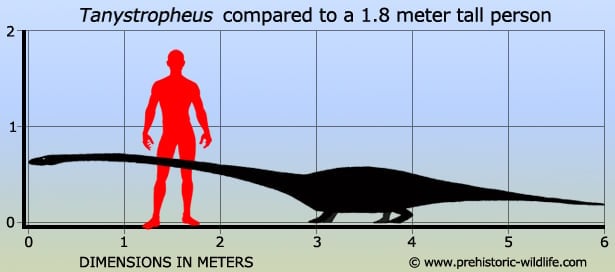
Research Note: Tanystropheus is one of the most bizarre reptiles ever discovered — a 6-metre animal with an extremely elongated neck that made up fully one-third of its total body length. Living during the Middle to Late Triassic, it was a semi-aquatic predator that inhabited the shallow coastal seas of the Tethys Ocean. Despite its extraordinary neck, it had only 13 elongated cervical vertebrae. Its long neck gave it access to fish in rocky reef environments while its body remained at a safe distance from potential predators or competitors — a unique ecological strategy among known Triassic marine reptiles.
| Research Finding | Status | Grade | Year | Method | Citation | Impact |
|---|---|---|---|---|---|---|
|
Aquatic habits and niche partitioning in Tanystropheus — comprehensive analysis demonstrating aquatic foraging behaviour and how different Tanystropheus species partitioned ecological niches based on size and habitat.
Spiekman & Neenan 2020 provides the most detailed analysis of Tanystropheus ecology and niche partitioning, using multiple lines of evidence to establish it as a semi-aquatic ambush predator in Triassic coastal environments
|
Confirmed | A | 2020 | Comparative Anatomy | Spiekman & Neenan, Current Biology34 citations | Ecology |
|
Taxonomic revision of the genus Tanystropheus — comprehensive taxonomic reassessment resolving long-standing confusion about species diversity and synonymy within Tanystropheus.
Spiekman et al. 2019 provides the first comprehensive taxonomic revision of Tanystropheus, clarifying the number of valid species and their stratigraphic and geographic distributions across European Triassic deposits
|
Confirmed | A | 2019 | Phylogenetic Analysis | Spiekman et al., Palaeontologia Electronica18 citations | Taxonomy |
|
New species of Tanystropheus and cranial anatomy — description of new material providing the first detailed look at the skull anatomy of this unusual protorosaur.
Rieppel 2001 established important baseline anatomical observations for Tanystropheus, providing the foundational cranial description upon which later analyses built
|
Confirmed | B | 2001 | Fossil | Rieppel, Neues Jahrbuch für Geologie9 citations | Anatomy |
Active Debate: Neck Function and Terrestrial Locomotion
Despite being classified as semi-aquatic, the exact function of Tanystropheus’s extraordinary neck remains debated. One hypothesis proposes the long neck allowed it to sweep its head through schools of fish without moving its bulky body, functioning like a钓鱼竿 (fishing rod). Others suggest the neck may have been used for breathing at the surface while the body remained submerged — similar to modern plunge-diving birds. The question of whether Tanystropheus could move effectively on land, and for what purposes, is also contested. Its limb proportions suggest aquatic propulsion but its ribcage shows adaptations for terrestrial breathing. The discovery of specimen clusters with multiple individuals suggests possible gregarious behaviour.
What We Still Don’t Know About Tanystropheus
- Precise diet: No stomach contents known; fish scales and cephalopod hooks found associated but not conclusively linked.
- Limb function: Whether the short limbs could support terrestrial movement is debated.
- Reproduction: No eggs, embryos, or birth sites identified; unclear if viviparous or ovoviviparous.
- Colouration: Completely unknown.
- Species diversity: Historical wastebasket taxonomy; the full number of valid species is still being resolved by recent revisions.
In Depth
Taking up half of its total body length, Tanystropheus’s neck is almost inconceivable. Indeed, when Francesco Bassani discovered Tanystropheus remains in 1886 (although he named it Tribelesodon), he conceived the extra long neck vertebrae as the wing bones of a pterosaur. It was not until later that the mistake was realised and Tribelesodon became a synonym of Tanystropheus.
Analysis of Tanystropheus remains and the areas that they are recovered from strongly suggests a life spent on the Triassic shorelines. The teeth are adapted in a way that would enable them to easily snatch marine prey like fish, and the elongated neck would have given it significant each over and under the water. The legs however appear to be more suited for terrestrial locomotion. An interesting feature is that the front legs are shorter than the rear, suggesting that Tanystropheus may have pitched itself forward at the water’s edge for feeding.
For hunting strategy, it is possible that Tanystropheus visited tidal pools that would have been re-stocked with fresh prey items at high tide that would then in turn be trapped in the pools when the tide receded. This would provide a naturally trapped and easily sought out food supply.
In 2006 Dr. Silvio Renesto discovered a specimen in Switzerland that appears to display the impressions of soft tissue. One of the main discoveries here is a skin impression that shows Tanystropheus did not have overlapping scales. The other discovery is a dark impression that suggests that there was a significant development of muscle to the rear of Tanystropheus. This counter weight of muscle would have shifted the centre of mass back allowing the neck to move in a more balanced manner. It may have also had a secondary function of giving Tanystropheus great strength to grip onto shoreline rocks.
Further Reading
– �bersicht �ber die Reptilien der Trias” [Review of the Reptilia of the Triassic] – F. von Huene – 1902. – A new specimen of Tanystropheus (Reptilia Protorosauria) from the Middle Triassic of Switzerland and the ecology of the genus – S. Renesto – 2005. – Tanystropheus longobardicus (Reptilia Protorosauria): Re-interpretations of the anatomy based on new specimens from the Middle Triassic of Besano (Lombardy, northern Italy). – Memorie della Societa Italiana di Scienze Naturali e del Museo Civico di Storia Naturale di Milano. 35 (3). – Stefania Nossotti – 2007. – Tanystropheus cf. T. Longobardicus from the early Late Triassic of Guizhou Province, southwestern China. – Journal of Vertebrate Paleontology. 30 (4): 1082–1089. – Olivier Rieppel, Da-Yong Jiang, Nicholas C. Fraser, Wei-Cheng Hao, Ryosuke Motani, Yuan-Lin Sun & Zuo-Yu Sun – 2009. – Land or water: using taphonomic models to determine the lifestyle of the Triassic protorosaur Tanystropheus (Diapsida, Archosauromorpha). – Palaeobiodiversity and Palaeoenvironments. 98 (2): 243–258. – S. R. Beardmore & H. Furrer – 2017. – Evidences for a semi aquatic life style in the triassic diapsid reptile tanystropheus. – Rivista Italiana di Paleontologia e Stratigrafia (Research in Paleontology and Stratigraphy). 124 (1): N.1 – Silvio Renesto & Franco Saller – 2018. – A taxonomic revision of the genus Tanystropheus (Archosauromorpha, Tanystropheidae). – Palaeontologia Electronica. 22.3.80. – Stephan N.F. Spiekmann & Torsten M. Scheyer – 2019. – Aquatic Habits and Niche Partitioning in the Extraordinarily Long-Necked Triassic Reptile Tanystropheus. – Current Biology. 0 (19): 3889–3895.e2. – Stephan N. F. Spiekman, James M. Neenan, Nicholas C. Fraser, Vincent Fernandez, Olivier Rieppel, Stefania Nosotti & Torsten M. Scheyer – 2020.