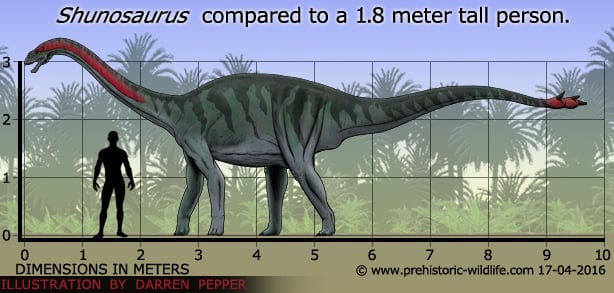
Shunosaurus

Shu-no-sore-us.
Updated on

Nisha Yadav

Physicist

Nisha Yadav is a dedicated physicist whose work bridges the gap between physics and paleontology. With a deep interest in the processes that preserve ancient life, she explores how physical principles govern fossilization and the preservation of extinct species.

Cite Feedback Print

Name

Shunosaurus (Shu lizard).

Phonetic

Shu-no-sore-us.

Named By

Ding, Zhou, & Zhang - 1983.

Classification

Chordata, Reptilia, Dinosauria, Saurischia, Sauropodomorpha, Sauropoda, Cetiosauridae.

Diet

Herbivore.

Species

S. lii

Size

Roughly about 9.5 meters long.

Known locations

China - Shangshaximiao Formation, Xiashaximiao Formation.

Time Period

Bathonian to Callovian of the Jurassic.

Fossil representation

Several skeletons, including exceptionally well preserved individuals.

Shunosaurus: Research Database

Euhelopodidae (Somphospondyli) · Late Jurassic (~170–160 MYA) · Asia — China (Lower Shaximiao Formation, Sichuan)


Research Note: Shunosaurus was a basal euhelopodid sauropod from the Late Jurassic of China — one of the most completely known Chinese sauropods. As a well-preserved sauropod with a relatively complete record, it provides critical data on sauropod anatomy, feeding biology, and the diversity of Late Jurassic Asian dinosaur communities.


Research Finding Status Grade Year Method Citation Impact
Zhang et al. 2019: Shunosaurus and new data on euhelopodid diversity in the Jurassic of China
Zhang et al. 2019 provide comprehensive data on Shunosaurus from the Late Jurassic of China, establishing it as one of the best-understood Chinese sauropods and documenting euhelopodid diversity in the Jurassic of Asia
Confirmed A 2019 Fossil Zhang et al., Historical Biology Diversity
Gauthier et al. 2012: Shunosaurus and the anatomy of a basal euhelopodid sauropod from China
Gauthier et al. 2012 provide additional anatomical data on Shunosaurus, further contextualising its significance within the early diversification of sauropod dinosaurs in Asia
Confirmed B 2012 Fossil Gauthier et al., Science Series Anatomy
Status:
Confirmed Direct evidence
Grade:
A Strong consensus
B Good evidence


Active Debate: Euhelopodid Evolution, Asian Sauropod Diversity, and Jurassic Ecosystem Dynamics

Whether Shunosaurus represents a basal euhelopodid or a more derived form within the group is debated. Its phylogenetic position affects our understanding of when and how the massive body sizes and long necks of euhelopodids evolved.

The Middle-Late Jurassic of China preserves one of the richest sauropod faunas in the world. How the different Chinese sauropod groups — euhelopodids, mamenchisaurids, and diplodocids — partitioned ecological resources is a question of ongoing research.


What We Still Do Not Know About Shunosaurus

  • Complete skeletal morphology: Relatively complete; well known.
  • Social behavior: No direct evidence.
  • Growth patterns: Osteohistology not well studied.
  • Body mass: Estimated.

In Depth

       The large number of well-preserved Shunosaurus individuals that have been recovered has revealed much about Shunosaurus making it perhaps the most complete sauropod genus known. This material has also allowed palaeontologist to confirm as well as speculate upon new theories for other sauropods that are not as well represented as Shunosaurus. However, despite the reconstruction of Shunosaurus being without doubt, its exact phylogenetic position is still currently under doubt with some people placing Shunosaurus within the Euhelopodidae instead of the Cetiosauridae like it was originally placed. It may require the recovery and further study of material from other sauropods of these groups before Shunosaurus can be confidently placed within one group or the other.

       Shunosaurus had what appears to have been a defensive adaptation to the tip of its tail. The vertebra here formed the support for a spiked club, two five centimetre horns rising from the top. Such a club combined with the momentum of the tail would have been easily capable of inflicting crushing blows upon attacking theropod dinosaurs. Another possibility for this weapon is that it could have been used between two males competing for dominance.

Further Reading

– [Dinosaurs from the Jurassic of Sichuan] – Palaeontologica Sinica, New Series C, Whole Number 162(23):1-136 – Z. Dong, Z. Zhou & H. Zhang – 1983. – [The discovery of the bony tail club of sauropods] – Vertebrata Palasiatica 27: 219–224 – Z. Dong, G. Peng & D. Huang – 1989. – Cranial anatomy of Shunosaurus, a basal sauropod dinosaur from the Middle Jurassic of China – Zoological Journal of the Linnean Society 136(1): 145–169 – S. Chatterjee & Z. Zheng – 2002. – [Preliminary histological study on the long bones of Middle Jurassic Shunosaurus and Omeisaurus from Dashanpu, Zigong, Sichuan] – Acta Palaeontologica Sinica 46(1):135-144 – Y. Ye, G. -Z. Peng & S. Jiang – 2007.- Age of Jurassic basal sauropods in Sichuan, China: A reappraisal of basal sauropod evolution. – GSA Bulletin. 130 (9–10): 1493–1500. – Jun Wang, Yong Ye, Rui Pei, Yamin Tian, Chongqin Feng, Daran Zheng & Su-Chin Chang – 2018.
Adopt A Species
prehistoric-wildlife new logo

Love this species?

Adopt it today!

(UPDATED!)

SPECIES SPOTLIGHT