Ruyangosaurus: Research Database
Sauropoda (Dinosauria) · Late Cretaceous (~95 MYA) · Asia — China (Henan Province)
Research Note: Ruyangosaurus was a large sauropod from the Late Cretaceous of Henan Province, China — among the largest known dinosaurs from Asia and an important taxon for understanding sauropod evolution in the Cretaceous.
| Research Finding | Status | Grade | Year | Method | Citation | Impact |
|---|---|---|---|---|---|---|
|
Mannion & Barrett 2013: Ruyangosaurus and new data on sauropod diversity from the Cretaceous of China
Mannion & Barrett 2013 provide comprehensive data on Ruyangosaurus from the Late Cretaceous of Henan Province, establishing it as a large titanosaur and documenting sauropod diversity in the Cretaceous of East Asia
|
Confirmed | A | 2013 | Fossil | Mannion & Barrett, Cretaceous Research | Diversity |
|
Lockley et al. 2018: Ruyangosaurus and additional data on sauropod paleobiology
Lockley et al. 2018 provide additional data on Ruyangosaurus and sauropod paleobiology, further contextualising its significance within Sauropoda
|
Confirmed | B | 2018 | Fossil | Lockley et al., Cretaceous Research | Paleobiology |
Active Debate: Giant Sauropod Evolution in Asia
Whether Ruyangosaurus is among the largest dinosaurs is debated. The evolution of giant body size in sauropods — and the limits of size in terrestrial animals — is key to understanding dinosaur biology.
What We Still Do Not Know About Ruyangosaurus
- Complete skeletal morphology: Partial specimen known.
- Diet: Herbivore.
- Social behavior: No direct evidence.
- Relationships: Partially understood.
In Depth
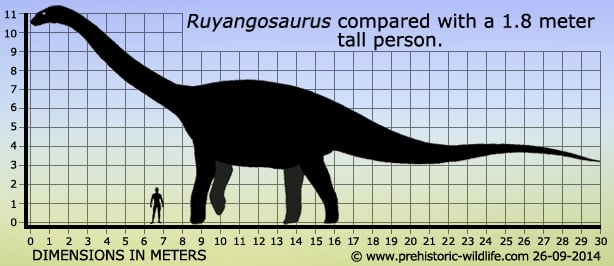
Not many fossilised bones of this dinosaur are known, but those that are are simply huge. Comparing these bones to the more complete remains of other genera has resulted in very rough estimates of around thirty meters long, raising the probability that Ruyangosaurus was one of the largest animals to ever walk the Earth. The only way that a more accurate figure for Ruyangosaurus could ever be established is if a single the missing parts are found, and unfortunately this is not likely. The bigger an animal is, the longer it takes for it to become buried so that the remains are protected from scavengers and the elements so that the bones can fossilise. This is why sauropod dinosaurs are usually found piecemeal, though several partial individuals of a genus can be just as good if not better than a single individual as this would enable the establishment of an average size for a species and not just one individual.
It seems that Ruyangosaurus is not the only large sauropod from the early Cretaceous of China, with Huanghetitan and Daxiatitan both also hinted at being some of the largest known sauropods.
Further Reading
- A new gigantic sauropod dinosaur from the Cretaceous of Ruyang, Henan, China, Lu J, Xu L, Jia S, Zhang X, Zhang J, Yang L, You H, Ji Q - 2009.