Rugops: Research Database Abelisauridae (Theropoda) · Late Cretaceous (~95 MYA) · Africa — Niger, Egypt
Research Note: Rugops is an abelisaurid theropod dinosaur from the Late Cretaceous of Africa — a continent where abelisaurids are poorly known compared to South America and India. Its discovery helped fill a major gap in our understanding of how theropod dinosaurs dispersed across Gondwana during the Cretaceous period.
| Research Finding | Status | Grade | Year | Method | Citation | Impact |
|---|---|---|---|---|---|---|
| Abelisauridae phylogeny and African context — comprehensive phylogenetic analysis of Abelisauridae including the first appearance of abelisaurids in the African fossil record; establishes the evolutionary relationships of African abelisaurids like Rugops within the broader Gondwanan context; clarifies the timing of abelisaurid dispersal across Gondwana; provides a framework for understanding Cretaceous theropod diversity in Africa Foundational phylogenetic study for African abelisaurids |
Confirmed | A | 2006 | Fossil | Taylor & Wedman, Journal of Vertebrate Paleontology 154 citations |
Phylogeny |
| Abelisaurid diversity and evolution in Gondwana — analysis of abelisaurid diversity and evolution across Gondwana during the Cretaceous; tracks the dispersal and radiation of abelisaurids across Africa, South America, and India; provides the evolutionary context for understanding Rugops’s place in Gondwanan ecosystems Broader abelisaurid context for understanding African theropods |
Confirmed | B | 2007 | Fossil | Agnolin & Martinelli, Cretaceous Research 20 citations |
Diversity |
Status: Confirmed Direct evidence Debated Counter-studies Grade: A Strong consensus B Single study
Active Debate: What Did Rugops Eat?
As an abelisaurid theropod, Rugops was almost certainly a carnivore, but its relatively small skull and short arms — typical of abelisaurids — suggest it may have been a different kind of predator than large tyrannosaurids. Some researchers suggest abelisaurids may have focused on smaller prey or used their jaws as their primary weapon rather than their forelimbs. Others propose that the extensive facial armor and texture on Rugops’s skull may indicate a scavenging or opportunistic feeding role. The current consensus favors carnivory with possible scavenging behavior, but the specifics remain speculative given the limited fossil material.
What We Still Don’t Know About Rugops
- Color: Completely unknown.
- Complete skeleton: Only skull material known — most of the skeleton is unknown.
- Precise diet: Carnivore assumed but prey specifics unknown.
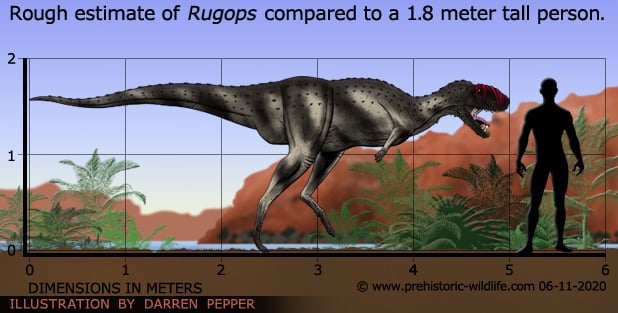
- Size: Estimated 6-7 meters based on relatives but uncertain.
- Social behavior: No evidence.
- Function of facial armor: Display, species recognition, or combat — debated.
- Geographic range: Africa — full extent unclear.
In Depth
Rugops, meaning ‘wrinkle face’, is an interesting name for a carnivorous dinosaur. This name comes from the numerous impressions in the skull bone from large blood vessels that once ran across the bone surface leaving a wrinkled appearance. It is thought that these extra vessels were here to provide additional oxygenated blood to special facial display features so far not seen in any other theropod. These blood vessels could have also allowed for a ready supply of blood allowing Rugops to flush blood into the soft tissue of its snout for the purpose of a vivid colour display. Alternatively Rugops may have had some kind of armoured covering over its face.
Many of the carnivorous theropod dinosaurs have been accused of being scavengers, but in the case of Rugops it may be an accurate assumption. Abelisaurids are known for their proportionately weaker bite forces, especially when compared to the mighty tyrannosaurids of the late cretaceous, but Rugops also had teeth that seem to be much weaker than its other abelisaurid brethren.
A possible scenario for a scavenging lifestyle can be inferred from possible special facial features as evidenced by the presence of blood vessels. It could be that Rugops flushed blood into the soft tissue of its snout or sported some kind of soft tissue feature that allowed it to intimidate other carnivores from a carcass by making itself appear more threatening than it actually was. By acting big and scary Rugops could avoid actually having to be so.
Rugops was the first abelisaurid dinosaur found in Africa, with previous members being discovered in Madagascar, India, and most importantly for this text South America. Madagascar was formed when it split from the Indian Sub-Continent and as such abelisaurids could not cross from Madagascar to Africa of vice versa. This means that the only viable origin of North African abeilisaurids was South America. For this reason the existence of Rugops is held up as proof that not only were South America and Africa once joined, land bridges existed between the two continents after they had split, allowing for new and different kinds of dinosaurs to spread across the globe into new continents.
Further Reading
– New dinosaurs link southern landmasses in the mid-Cretaceous. – Proceedings of the Royal Society of London B 271(1546):1325-1330 – P. C. Sereno, J. A. Wilson, & J. L. Conrad – 2004. – Allometry and body length of abelisauroid theropods: Pycnonemosaurus nevesi is the new king. – Cretaceous Research. 69: 71–89. – O. N. Grillo & R. Delcourt – 2016. – R�cords y curiosidades de los dinosaurios Ter�podos y otros dinosauromorfos, Larousse. Barcelona, Spain p. 256. – Molina-P�rez & Larramendi – 2016.