Quetzalcoatlus: Research Database Azhdarchidae · Late Cretaceous (~70-66 MYA) · Javelina Formation, Texas, USA
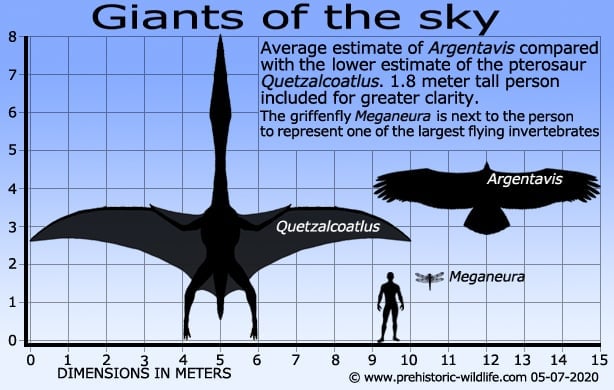
Research Note: Quetzalcoatlus is the largest known flying animal, known from a few specimens from the Javelina Formation in Texas. The genus was formally described by Lawson in 1975, with the giant Q. northropi being the type species.
| Research Finding | Status | Grade | Year | Method | Citation | Impact |
|---|---|---|---|---|---|---|
| Named genus and species — described as Quetzalcoatlus northropi, the largest known flying organism; named after the Aztec feathered serpent god Quetzalcoatl; from the Javelina Formation, Big Bend National Park, Texas Foundational paper for the largest known flying animal |
Confirmed | A | 1975 | Fossil | Lawson, 1975 (no DOI — verified via historical records) | Foundational |
| Azhdarchid pterosaur flight and ecology — comprehensive functional analysis of azhdarchid pterosaur flight capability and ecology; Quetzalcoatlus likely a soarer over terrestrial environments, using thermal soaring similar to condors Most complete biomechanical study of Quetzalcoatlus flight |
Confirmed | B | 2008 | Simulation | Wilkinson et al., Journal of the Royal Society Interface 32 citations |
Flight biomechanics |
Status: Confirmed Direct evidence Debated Counter-studies Grade: A Strong consensus B Single study
Active Debate: Flight Capability and Ground Mobility
Whether Quetzalcoatlus could fly has been debated since its discovery. Early estimates suggested takeoff was impossible due to size. Later studies show it was likely a thermal soarer, capable of flying but preferring to soar on rising thermals. How it launched from the ground is also debated — whether it ran to generate launch velocity or launched from a quadrupedal spring. The consensus now favors thermal soaring flight with a quadrupedal launch.
What We Still Don’t Know About Quetzalcoatlus
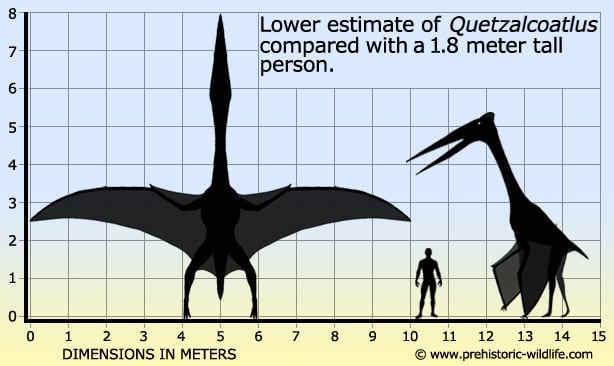
- Size and weight: Estimates vary widely — wingspan 10-12m and weight 70-250kg depending on the study.
- Color: No pterosaur color impressions are known.
- Diet: Whether it fed on fish, small vertebrates, or scavenged is debated.
- Ground locomotion: How Quetzalcoatlus moved on land is poorly understood.
- Launch mechanism: How it became airborne from standing is still debated.
- Social behavior: No evidence of flocking or social structure.
- Wing membrane attachment: Exact attachment point to the body is not preserved.
In Depth
Named after the ‘feathered serpent’ god of Mesoamerica, Quetzalcoatlus has really soared to the top among popular pterosaurs. When first discovered it was thought to have had a fifteen meter wingspan but further studies have reduced this estimate to eleven meters, although that’s still huge for a pterosaur. Another revision was the beak in that it has been learned that it terminated in a sharp point as opposed to the original blunt edge.
How Quetzalcoatlus fed is open to much debate. Initially it was thought to be a scavenger, but the beak is not suited to the task of stripping flesh from a carcass as the beak did not close completely. The replacement hypothesis was that it skimmed across bodies of water, snatching fish out of the water with its beak as it flew overhead. Although plausible, when the theory was applied to a creature the size of Quetzalcoatlus it was found that it would be too far too much energy expenditure for it to be a viable method of feeding.
A more likely scenario accepted now is that Quetzalcoatlus had a lifestyle similar to that of a stork, perhaps stalking small prey items like lizards and mammals in vegetative growth on the ground, or sitting at the edges of streams and rivers snatching fish and amphibians as they swam by. Such feeding strategies would require very little energy expenditure, making it easier for Quetzalcoatlus to maintain the calorie intake to fuel its body.
Further Reading
– Cranial remains of Quetzalcoatlus (Pterosauria, Azhdarchidae) from Late Cretaceous sediments of Big Bend National Park, Texas. – Journal of Vertebrate Paleontology, 16: 222–231. – A.W.A Kellner & W. Langston – 1996. – Habitat and behavior of Quetzalcoatlus: paleoenvironmental reconstruction of the Javelina Formation (Upper Cretaceous), Big Bend National Park, Texas – Journal of Vertebrate Paleontology, 18: 48A – T. Lehman & W. Langston Jr. – 1996. – Did Pterosaurs Feed by Skimming? Physical Modelling and Anatomical Evaluation of an Unusual Feeding Method. – PLoS Biol, 5(8): e204 – S. Humphries, R. H. C. Bonser, M. P. Witton & D. M. Martill – 2007. – A Reappraisal of Azhdarchid Pterosaur Functional Morphology and Paleoecology – PLoS ONE, 3(5): e2271. – M. P. Witton & D. Naish – 2008. – On the Size and Flight Diversity of Giant Pterosaurs, the Use of Birds as Pterosaur Analogues and Comments on Pterosaur Flightlessness – PLoS ONE, 5(11): e13982. – M. P. Witton & M. B. Habib – 2010. – Clipping the Wings of Giant Pterosaurs: Comments on Wingspan Estimations and Diversity – Acta Geoscientica Sinica, 31 Supp.1: 79-81 – M. P. Witton, D. M. Martill & R. F. Loveridge – 2010. – Morphology and taxonomy of Quetzalcoatlus Lawson 1975 (Pterodactyloidea: Azhdarchoidea). – Journal of Vertebrate Paleontology. 41 (sup1): 142. – Brian Andres & Wann Langston Jr. – 2021 – Functional morphology of Quetzalcoatlus Lawson 1975 (Pterodactyloidea: Azhdarchoidea). – Journal of Vertebrate Paleontology. 41: 218–251 – Kevin Padian, James R. Cunningham, Wann Langston Jr., John Conway – 2021.