In Depth
When first discovered, Protoceratops was heralded as the ancestor to the massive North American ceratopsian dinosaurs such as Triceratops. However with the advent of new and continuing studies of the group, Protoceratops is now considered to be more representative of the type of dinosaur that led to the larger North American species as opposed to being ‘the’ ancestor of them.
Protoceratops is nevertheless significant in its discovery as it has revealed many fascinating insights into dinosaur life. The large numbers of remains found relatively close to one another is taken as evidence of herding behaviour. Preservation of the scleral rings indicates a cathermal lifestyle meaning that Protoceratops was active for short periods throughout the day, perhaps as a reaction to the arid conditions of the time. It would make sense to spend shorter amounts of time foraging before retreating to more sheltered areas when conditions were too intense such as the heat associated with midday.
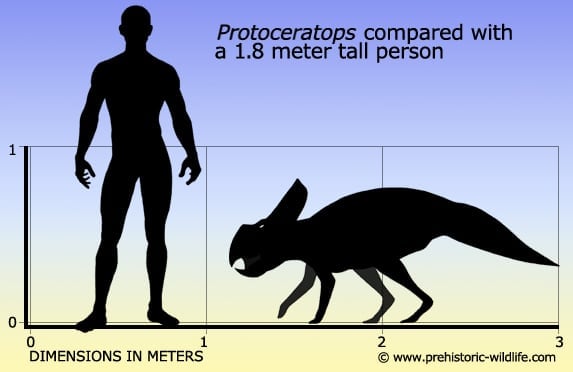
The head of Protoceratops appears to be oversized when seen in relation to its body, and this housed a large cropping beak at the front, the extra size maybe to make use of more powerful jaw muscles allowing the beak to slice through tough vegetation. Inside its mouth, several dozen teeth worked to grind the plant material, allowing for more effective digestion.
Although Protoceratops did not have the elaborate horns that were typical of some ceratopsian dinosaurs, it still possessed a frill that covered its neck. It also had two greatly enlarged jugal bones, but there is a great amount of variation in size and shape of both these and the frill between individuals. Explanations for these variations include possible indications of age, with older animals having larger projections, to maybe even signs of sexual dimorphism, with males having larger frill and jugals for display purposes. However, Protoceratops remains have also proved to be a bit of a ‘Red Herring’ on occasion. When the first dinosaur eggs were discovered in the Gobi Desert, the large number of Protoceratops remains in the area was taken as indicative that these eggs belonged to them. However a specimen of Oviraptor was also discovered with them, and since its skull was crushed, it was presumed that the Oviraptor had been killed by a Protoceratops that had been defending the nest.
In 1992 the truth of the matter was revealed when a new study by Mark Norrel et al on a presumed Protoceratops egg revealed the presence of an Oviraptor embryo. This immediately flipped the scenario upside down as the eggs were now confirmed to belong to an Oviraptor, not a Protoceratops as had been thought for roughly seventy years.
If the Oviraptor had indeed been killed by a Protoceratops, then the scenario may be along the lines of a Protoceratops stumbling upon an Oviraptor nest and startling the brooding parent. The Oviraptor, only thinking of defending its nest immediately begins a threat display, maybe even an attack on the Protoceratops, which in turn perceiving the Oviraptor as a threat to itself, manages to crush its skull in its beak.
The most famous fossil of a Protoceratops is the ‘Fighting Dinosaurs’ specimen which features an individual Protoceratops locked in combat with a Velociraptor. Here the Protoceratops can be seen to have the right forearm of the Velociraptor trapped in its powerful beak, while the Velociraptor seems to have one of its killing claws lunged into where the Protoceratops would have had its throat exposed. Both animals are believed to have been killed by a sudden event such as a landslide which entombed them both during combat.
Further Reading
– Protoceratops andrewsi, a pre-ceratopsian dinosaur from Mongolia, with an appendix on the structural relationships of the Protoceratops beds – American Museum Novitates 72:1-9 – W. Granger & W. K. Gregory – 1923. – On Protoceratops, a primitive ceratopsian dinosaur from the Lower Cretaceous of Mongolia – American Museum Novitates 156:1-9 – W. K. Gregory & C. C. Mook – 1925. – Protoceratopsidae (Dinosauria) of Asia – Palaeontologica Polonica 33:133-181 – T. Maryanska & H. Osmolska – 1975. – Quantitative aspects of relative growth and sexual dimorphism in Protoceratops – Journal of Paleontology 50: 929–940 – P. Dodson – 1976. – A new species of Protoceratops (Dinosauria, Neoceratopsia) from the Late Cretaceous of Inner Mongolia (P. R. China) – Bulletin de l’Institut Royal des Sciences Naturelles de Belgique, Science de la Terre: 5–28. – O. Lambert, P. Godfroit, H. Li, C. -Y. Shang & Z. -M. Dong – 2001. – The Function of Large Eyes in Protoceratops: A Nocturnal Ceratopsian? – N. Longrich – 2010. In: Michael J. Ryan, Brenda J. Chinnery-Allgeier, and David A. Eberth (eds), New Perspectives on Horned Dinosaurs: The Royal Tyrrell Museum Ceratopsian Symposium, Indiana University Press, 656 pp – Nocturnality in Dinosaurs Inferred from Scleral Ring and Orbit Morphology – Science 332 – L. Schmitz & R. Motani.