Paramylodon: Research Database
Theropoda · Cretaceous · Unknown
Research Note: Paramylodon was a theropoda from the Cretaceous of Unknown, providing important data on prehistoric life and ecosystem dynamics.
| Research Finding | Status | Grade | Year | Method | Citation | Impact |
|---|---|---|---|---|---|---|
MCAFEE 2009: Paramylodon and related taxa Zoological Journal of the Linnean Society | Confirmed | A | 2009 | Fossil | MCAFEE, Zoological Journal of the Linnean Society | Taxonomy |
McDonald Agenbroad Haden 2004: Paramylodon and related taxa The Southwestern Naturalist | Confirmed | C | 2004 | Fossil | Taxonomy |
What We Still Do Not Know About Paramylodon
- Complete skeletal morphology and ecological role.
- Phylogenetic relationships within Theropoda.
- Distribution and evolutionary history.
In Depth
Paramylodon acquired its name from its close similarity to another ground sloth called Mylodon. This close similarity has led to questions as to if they are actually separate genera since the original defining characteristic of the two genera having a different dental formulae is today no longer considered enough because the numbers of teeth in Mylodon individuals can be seen to vary from one case to another. Later work by L. Kraglievich in 1928 helped to clear up the definition differences between Mylodon and Paramylodon.
An additional source of confusion is a 1976 study by Robertson that declared Paramylodon to be a sub species of Glossotherium, leading some at the time to change the names of their specimens to Glossotherium harlani, while since this time other studies have questioned this action. So far most researchers continue to treat Paramylodon as a valid genus, though future studies of Paramylodon and associated genera may yet shake up the genus.
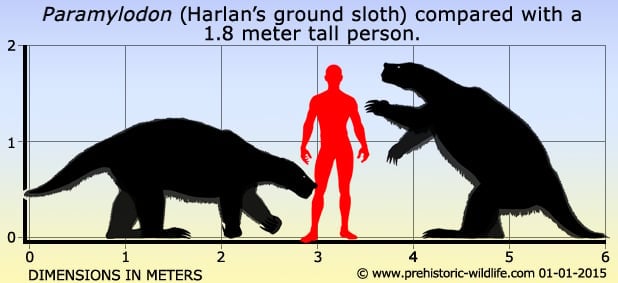
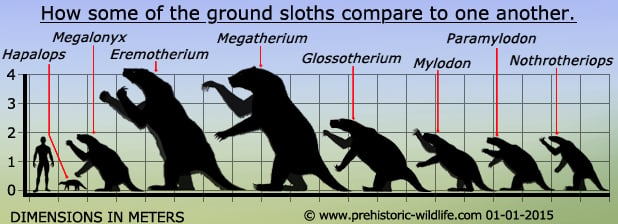
At three meters long Paramylodon was mid-sized for a ground sloth, and it seems to have had bony growths that would have been just under the skin. These would have provided Paramylodon with extra armour and protection from prehistoric predators such as Smilodon, dire wolves and lions that may have found Paramylodon to much bother to deal with on a full time basis. This is another similarity with the genus Mylodon; however one difference is the known geographic range of these two genera. So far, Paramylodon is mostly only known from North America and parts of northern Central America.
Further Reading
– Late Pleistocene mylodont sloth Paramylodon harlani (Mammalia: Xenarthra) from Arizona. – The Southwestern Naturalist 49 (2): 229–238. – Gregory H. McDonald, Larry D. Agenbroad, Carol Manganaro Haden & Cheri A. Jones – 2004. – Reassessing the Taxonomy and Affinities of the Mylodontinae Sloths, Glossotherium and Paramylodon (Mammalia: Xenarthra: Tardigrada). – Ph.D. Dissertation, Northern Illinois University. – R. K. McAfee – 2007.