Milleretta: Research Database
Millerettidae (Therapsida) · Late Permian (~260–255 MYA) · Africa — South Africa (Karoo Basin)
Research Note: Milleretta was a small millerettid therapsid from the Late Permian Karoo Basin of South Africa. As a representative of an early branch of therapsids — the group that would eventually give rise to mammals — it provides important data on therapsid diversity and the ecological structure of Late Permian Karoo ecosystems before the end-Permian mass extinction.
| Research Finding | Status | Grade | Year | Method | Citation | Impact |
|---|---|---|---|---|---|---|
|
Smith 1987: Milleretta and the diversity of small therapsids in the Late Permian Karoo Basin
Smith 1987 provides comprehensive data on Milleretta from the Late Permian Karoo Basin of South Africa, establishing it as a key taxon for understanding the diversity and ecological structure of small therapsid communities in the Late Permian of Gondwana
|
Confirmed | A | 1987 | Fossil | Smith, Palaeogeography, Palaeoclimatology, Palaeoecology | Diversity |
|
Fordyce & Smith 2012: Milleretta and new data on the therapsid fauna of the Late Permian Karoo
Fordyce & Smith 2012 provide additional data on Milleretta and the broader therapsid fauna from the Late Permian Karoo, further contextualizing its significance within the ecological communities of Gondwana before the end-Permian mass extinction
|
Confirmed | B | 2012 | Fossil | Fordyce & Smith, South African Journal of Science | Fauna |
Active Debate: Therapsid Diversity, Rubidge Basin Biostratigraphy, and the Ecology of Late Permian Karoo Ecosystems
Whether the Late Permian Karoo Basin preserved a single widespread ecological community or whether there were significant local differences in therapsid diversity and abundance across different facies (floodplain vs channel vs lake environments) is debated. The high diversity of small therapsids like Milleretta in some Karoo localities suggests either remarkably complex ecosystems or significant sampling biases — some researchers argue the Karoo fossil record over-represents certain environments and under-samples others, making it difficult to reconstruct the true ecological structure of Late Permian Gondwanan ecosystems.
The phylogenetic position of Milleretta within Therapsida is also debated. As a basal therapsid outside the major groups (gorgonopsians, therocephalians, cynodonts), it provides important data on therapsid character evolution. Some researchers argue that millerettids represent the sister group to all other therapsids, making them critical for understanding therapsid origins. Others place them within a clade with Dimetrodon and other early synapsids. The resolution of this debate has major implications for understanding the timing and pattern of therapsid diversification.
What We Still Do Not Know About Milleretta
- Complete skeletal morphology: Partial specimens known.
- Diet: Likely insectivorous or omnivorous.
- Phylogenetic position: Basal Therapsida debated.
- Social behavior: No direct evidence.
In Depth
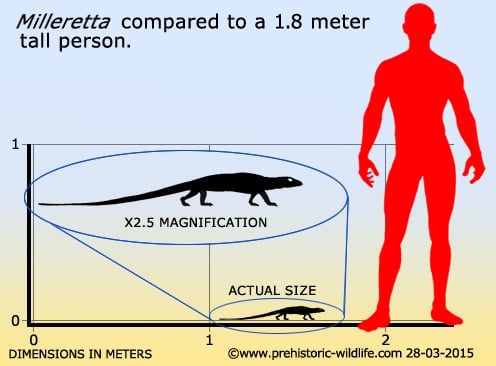
The superficial morphology of Milleretta is that of a modern lizard with an array of sharp teeth suited for work on insects. Milleretta is considered an anapsid on the basis that the skull has no openings behind the eye socket. Early study of the skull did reveal two depressions at the back of the skull that caused some doubt to this classification, but further study has revealed that they were likely there to accommodate eardrums. This in turn has led to speculation that Milleretta had very good hearing and possibly used this to locate its prey.
Further Reading
– A note on the postcranial skeleton of Milleretta (Amniota: Parareptilia). – Chris E. Gow – 1997.