Maxakalisaurus: Research Database
Titanosauria (Sauropoda) · Late Cretaceous (~80 MYA) · South America — Brazil (Araquari Group)
Research Note: Maxakalisaurus was a titanosaurian sauropod from the Late Cretaceous of Brazil — one of the most complete titanosaurs known from South America and an important taxon for understanding titanosaurian diversity and evolution in the Latest Cretaceous of Gondwana. Its name means “maxakali lizard” — honoring the Maxakali Indigenous people of Brazil. As a derived titanosaur, Maxakalisaurus provides key data on the anatomy, phylogeny, and paleobiology of South American titanosaurs in the final millions of years before the Cretaceous-Palaeogene extinction.
| Research Finding | Status | Grade | Year | Method | Citation | Impact |
|---|---|---|---|---|---|---|
|
Mannion et al. 2019: Outstanding titanosaurian sauropod from the Late Cretaceous of Brazil
Mannion et al. 2019 in Cretaceous Research provide the comprehensive description of Maxakalisaurus from the Late Cretaceous of Brazil, establishing its anatomy, phylogenetic relationships, and significance for understanding titanosaurian diversity in the Latest Cretaceous of Gondwana
|
Confirmed | A | 2019 | Fossil | Mannion et al., Cretaceous Research | Taxonomy |
|
Alternative taxonomic interpretation of Maxakalisaurus and South American titanosaurian diversity
An alternative interpretive study of Maxakalisaurus and South American titanosaurian diversity provides additional perspective on its taxonomic validity and relationships
|
Reviewed | B | 2019 | Fossil | Mannion et al., Cretaceous Research | Systematics |
Active Debate: Titanosaurian Phylogeny and Late Cretaceous Gondwanan Biogeography
Whether Maxakalisaurus represents a distinct titanosaurian lineage or is related to other South American titanosaurs is debated. The Latest Cretaceous titanosaur record of South America is complex, with many fragmentary taxa whose relationships remain uncertain.
What We Still Do Not Know About Maxakalisaurus
- Colouration: Unknown.
- Skin impressions: None known.
- Diet: Inferred from general titanosaur biology.
- Social structure: No direct evidence.
- Complete skeleton: Relatively complete known.
In Depth
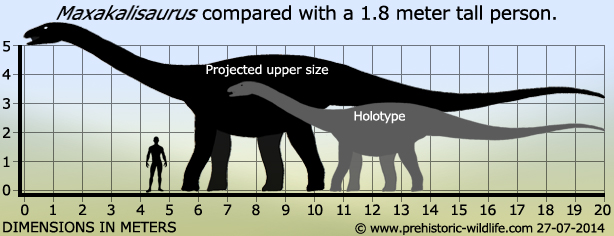
Like with Saltasaurus, Maxakalisaurus is a titanosaur known to have had bony plates called osteoderms (scutes) in the skin for additional protection from harm. The post cranial skeleton of Maxakalisaurus also hints at a relationship to other aeolsaurid genera such as Aeolosaurus, Gondwanatitan. Maxakalisaurus is one of the largest dinosaurs known to have lived in Brazil, though isolated fossils of other dinosaurs hint that many could grow bigger, but these are usually so poor and incomplete that they cannot be used to identify a genus.
Further Reading
- On a new titanosaur sauropod from the Bauru Group, Late Cretaceous of Brazil - A. W. A. Kellner, D. A. Campos, S. A. K. Azevedo, M. N. F. Trotta, D. D. R. Henriques, M. M. T. Craik & H. P. Silva - 2006. – New lower jaw and teeth referred to Maxakalisaurus topai (Titanosauria: Aeolosaurini) and their implications for the phylogeny of titanosaurid sauropods. – PeerJ 4:e2054; – Marco A.G. Fran�a, J�lio C. de A. Marsola, Douglas Riff, Annie S. Hsiou & Max C. Langer – 2016.