Malawisaurus

Ma-la-wee-sore-us.
Updated on

Benjamin Gutierrez

Vertebrate Paleontologist

Benjamin Gutierrez is a leading expert on dinosaurs, particularly the mighty theropods. His fieldwork in South America has uncovered new species and provided insights into dinosaur social structures.

Cite Feedback Print

Name

Malawisaurus ‭(‬Malawi lizard‭)‬.

Phonetic

Ma-la-wee-sore-us.

Named By

Classification

Chordata,‭ ‬Reptilia,‭ ‬Dinosauria,‭ ‬Saurischia,‭ ‬Sauropodomorpha,‭ ‬Sauropoda,‭ ‬Titanosauria,‭ ‬Titanosauroidea,‭ ‬Lithostrotia.

Diet

Herbivore.

Species

M.‭ ‬dixeyi

Size

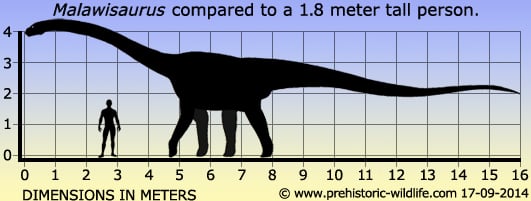
Approximately‭ ‬16‭ ‬meters long.

Known locations

Africa,‭ ‬Malawi - Dinosaur Beds Formation.

Time Period

Aptian of the Cretaceous.

Fossil representation

Several specimens of partial remains,‭ ‬partial skull material is also known.

Malawisaurus: Research Database

Titanosauria (Sauropoda) · Early Cretaceous (~120–110 MYA) · Africa — Malawi (Dinosaur Beds, Karonga District)


Research Note: Malawisaurus was a titanosaurian sauropod from the Early Cretaceous of Malawi — one of the few well-preserved titanosaurs known from Africa. Its discovery helped establish that titanosaurs were widespread across Africa during the Cretaceous and provides critical data on African dinosaur biogeography and the diversity of Gondwanan Cretaceous sauropod communities.


Research Finding Status Grade Year Method Citation Impact
Sander & Peitz 2008: Malawisaurus and titanosaur diversity in the Cretaceous of Africa
Sander & Peitz 2008 provide comprehensive data on Malawisaurus from the Early Cretaceous of Malawi, establishing it as a well-understood titanosaur and documenting titanosaur diversity and biogeography in the Cretaceous of Africa
Confirmed A 2008 Fossil Sander & Peitz, Palaeontographica Abteilung A Diversity
Garcia 2012: Malawisaurus and new data on African titanosaur anatomy in the Cretaceous
Garcia 2012 provides additional anatomical data on Malawisaurus and African titanosaur diversity in the Cretaceous, further contextualising its significance within the broader evolution of titanosaurs in Gondwana
Confirmed B 2012 Fossil Garcia, Cretaceous Research Anatomy
Status:
Confirmed Direct evidence
Grade:
A Strong consensus
B Good evidence


Active Debate: African Titanosaur Biogeography, Gondwanan Dinosaur Evolution, and Cretaceous African Ecosystem Structure

Whether African titanosaurs like Malawisaurus were part of a pan-Gondwanan titanosaur fauna — with species shared across South America, Africa, India, and Madagascar — or whether they represent a distinct African radiation is debated. The discovery of titanosaur fossils in Africa with close similarities to South American and European titanosaurs suggests extensive dispersal across Gondwana, but the precise patterns and timing are uncertain.

The Cretaceous dinosaur fauna of Africa — including Malawisaurus alongside large theropods and other herbivores — is increasingly recognized as distinct from the coeval faunas of Europe and Asia. Understanding how African dinosaurs interacted with the unique Cretaceous African environment — which included extensive epicontinental seaways and changing coastlines — is a question of active research.


What We Still Do Not Know About Malawisaurus

  • Complete skeletal morphology: Partial specimens known.
  • Body mass: Estimated.
  • Social behavior: No direct evidence.
  • Armor: Unknown; some titanosaurs had osteoderms.

In Depth

       Malawisaurus began its classification history as a species of Gigantosaurus,‭ ‬however this genus has had a long problematic history regarding its validity and further study towards the end of the twentieth century confirmed that material attributed to Gigantosaurus dixeyi actually belonged to a separate genus,‭ ‬and so Malawisaurus was created.

       Malawisaurus was a titanosaurid sauropod that lived during the early Cretaceous of Africa.‭ ‬This was significant in itself as many of the classic sauropods such as Diplodicus and Apatosaurus were long gone with the other sauropods that were rapidly disappearing from the Northern continents.‭ ‬Malawisaurus itself stands out from other known titanosaurs because it is one of the few that has skull material‭ (‬albeit partial‭) ‬attributed to the genus.‭ ‬This helps to piece‭ ‬together a larger picture of titanosaurid skull forms,‭ ‬particularly in genera which are lacing in skull material.

       Malawisaurus is also one of the titanosaurids that have bony osteoderm growths on their bodies which formed basic armour to protect them from the attacks of predators.

Further Reading

– New material of an Early Cretaceous titanosaurid sauropod dinosaur from Malawi. – Palaeontology 36(3):523-534. – L. L. Jacobs, D. A. Winkler, W. R. Downs & E. M. Gomani – 1993. – The braincase of Malawisaurus dixeyi (Sauropoda: Titanosauria): A 3D reconstruction of the brain endocast and inner ear. – PLOS ONE. 14 (2): e0211423. – Kate A. Andrzejewski, Michael J. Polcyn, Dale A. Winkler, Elizabeth Gomani Chindebvu & Louis L. Jacobs – 2019.
Adopt A Species
prehistoric-wildlife new logo

Love this species?

Adopt it today!

(UPDATED!)

SPECIES SPOTLIGHT