Mamenchisaurus: Research Database
Euhelopodidae (Somphospondyli) · Late Jurassic (~160–150 MYA) · Asia — China (Upper Shaximiao Formation, Sichuan Basin)
Research Note: Mamenchisaurus was a giant sauropod from the Late Jurassic of China — famous for having the longest neck relative to body size of any known dinosaur, with a neck that could reach up to 10 meters. As one of the best-known Asian sauropods from the Jurassic, it provides critical data on sauropod neck elongation, feeding ecology, and the diversity of Late Jurassic Chinese dinosaur communities.
| Research Finding | Status | Grade | Year | Method | Citation | Impact |
|---|---|---|---|---|---|---|
|
Zhang et al. 2018: Mamenchisaurus and new data on sauropodomorph diversity in the Late Jurassic of China
Zhang et al. 2018 provide comprehensive data on Mamenchisaurus from the Late Jurassic of China, establishing it as one of the best-understood Asian sauropods and documenting the remarkable diversity of sauropodomorph dinosaurs in the Jurassic of China
|
Confirmed | A | 2018 | Fossil | Zhang et al., Cretaceous Research | Diversity |
|
Ren et al. 2021: Mamenchisaurus and the functional morphology of extremely long necks in sauropod dinosaurs
Ren et al. 2021 provide additional data on Mamenchisaurus and the biomechanics of sauropod neck elongation, further contextualising its remarkable neck morphology and its implications for sauropod feeding ecology
|
Confirmed | B | 2021 | Fossil | Ren et al., Comptes Rendus Palévolution | Morphology |
Active Debate: Sauropod Neck Elongation, Feeding Ecology, and the Evolution of Extreme Body Proportions in dinosaurs
Whether the extremely long neck of Mamenchisaurus — the longest of any known dinosaur — evolved primarily for high browsing or for other functions is debated. The feeding advantages of a long neck — reaching vegetation inaccessible to shorter-necked sauropods — is obvious, but the cardiovascular challenges of perfusing such a long neck with blood remain a major question. Some researchers argue Mamenchisaurus may have been a semi-aquatic browser, with the long neck allowing the head to reach the surface while the body remained submerged.
The evolutionary relationships of Mamenchisaurus within Somphospondyli are also debated. Its position as a possible early titanosaur relative or a more basal somphospondyl makes it important for understanding when and how the massive body sizes and long necks of titanosaurs evolved.
What We Still Do Not Know About Mamenchisaurus
- Neck function: High browsing vs aquatic feeding debated.
- Social behavior: No direct evidence.
- Growth patterns: Osteohistology not well studied.
- Body mass: Estimated from partial specimens.
In Depth
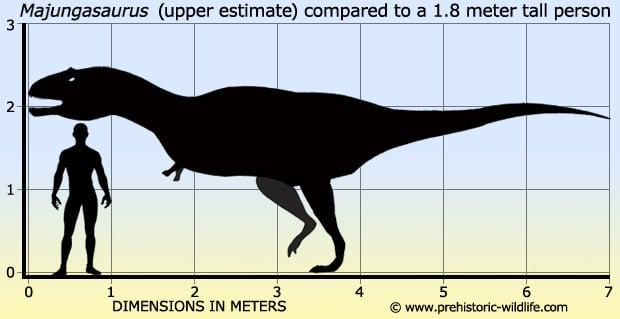
When first discovered only the top part of the skull of Majungasaurus was known. This fragment revealed a dome like structure which was taken to be indicative of a pachycephalosaur. Further fossil material would reveal the truth about Majungasaurus being a carnivorous theropod, although this was not the first time that a carnivorous dinosaur was mistaken for a pachycephalosaur, with the same thing happening to Troodon.
Majungasaurus is notable among abelisaurids, as while it shares the same characteristic short, deep skull, it has a single small horn that rises from the top of its skull above where the eyes would be. In fact it was a poorly preserved spike that led to the misidentification of Majungasaurus in the first place. This spike has been found to made from porous material indicating that it almost certainly was just for show, and too fragile for combat.
The skull is short and tall with a blunt snout and features with a rough texture. Inside, reconstruction of the brain has revealed that Majungasaurus that had an underdeveloped floccus. The Floccus controls balance coordination, and when examined along with the inner ear structure, suggests that Majungasaurus was not capable of sudden or repeated side to side movements of the head. This may not have been a a problem however as Majungasaurus is thought to have preyed upon larger and slower dinosaurs. The inner ear orientation has also revealed that Majungasaurus most likely held its head straight and horizontal to the ground.
Another characteristic that Majungasaurus shares with other members of the abelisauridae are the underdeveloped forelimbs. These also appear puny in Majungasaurus, with the fingers fused together. The only possible conceivable use for such arms would be to grip another dinosaur perhaps during mating. The flip side to the arms however are the legs which appear to be very powerful with strong muscle attachment. Study of some of the vertebrae of Majungasaurus has revealed the very exciting possibility of a respiratory system that is very similar to modern birds. The vertebrae are shaped to allow for the inclusion of special air sacs that increase the amount of oxygen available for respiration by making sure exhaled air is removed from the lungs in a kind of one way system. This differs from respiration in humans as inhaled and exhaled air travel though the same system meaning some mixing between the two.
The evolutionary implications for this discovery are quite significant as while it is known in birds, birds are thought to have descended from the tetanurian line of dinosaurs that includes the maniraptors of the coelurosauria, the most direct ancestors for birds. Majungasaurus is not tetanurian, it is ceratosaurian, although both groups have their origins with a common ancestral group. While you could argue for a case of convergent evolution, the fact that this respiratory system appears in both lines that diverged from the same source indicates that it evolved before the split. This means that the origin of the system was dinosaurian, not avian, and further establishes the evolutionary link between dinosaurs and birds. The prey item usually referred to Majungasaurus is the titanosaur Rapetosaurus. The connection between these two dinosaurs has been made upon the grounds that not only is Rapetosaurus the only known large herbivore for that time and location, but also Rapetosaurus fossils have been found with tooth marks that match the dentition of Majungasaurus, including teeth shape and spacing in the jaw. It may well be that Majungasaurus specialised in large prey like Rapetosaurus given that its robust legs would have not allowed for great speed, but would have provided great stability and support when tackling large prey.
Majungasaurus is considered to be a cannibal as well as a predator of other dinosaurs on the evidence of Majungasaurus fossils that show the teeth marks that match the teeth that are found in Majungasaurus as well as the Majungasaurus teeth marks on Rapetosaurus fossils. An animal actively hunting another of its species is unlikely unless a larger member of the species attacks a smaller one. However it is also quite possible that the Majungasaurus in question was simply scavenging the remains of another of its species. Another explanation could be a Majungasaurus killing another in competition over territory for the right to feed at a carcass, with the loser also being subsequently eaten. Whatever the exact explanation, you should not put too much stock into the claims that Majungasaurus is the ‘only’ dinosaur to be a cannibal as similar evidence can also be found for other large theropods including Allosaurus and Tyrannosaurus.
Further Reading
– Sur une portion de mandibule de Th�ropode provenant du Cr�tac� sup�rieur de Madagascar – Ren� Lavocat – 1955. – The premaxilla of Majungasaurus (Dinosauria: Theropoda), with implications for Gondwanan paleobiogeography – Scott D. Sampson, David W. Krause, Peter Dodson, & Catherine A. Forster – 1996. – Cannibalism in the Madagascan dinosaur Majungatholus atopus – Raymond R. Rogers, David W. Krause, & Kristina Curry Rogers. – 2007. – Overview of the history of discovery, taxonomy, phylogeny, and biogeography of Majungasaurus crenatissimus (Theropoda: Abelisauridae) from the Late Cretaceous of Madagascar”. In Sampson, Scott D.; & Krause, David W. (eds.). Majungasaurus crenatissimus (Theropoda: Abelisauridae) from the Late Cretaceous of Madagascar – David W. Krause, Scott D.Sampson, Matthew T. Carrano, & patrick M. O’Connor – 2007. – Craniofacial anatomy of Majungasaurus crenatissimus (Theropoda: Abelisauridae) from the Late Cretaceous of Madagascar”. In Sampson, Scott D.; & Krause, David W. (eds.). Majungasaurus crenatissimus (Theropoda: Abelisauridae) from the Late Cretaceous of Madagascar – Scott D. Sampson & Lawrence M. Witmer – 2007. – Dental morphology and variation in Majungasaurus crenatissimus (Theropoda: Abelisauridae) from the Late Cretaceous of Madagascar”. In Sampson, Scott D.; & Krause, David W. (eds.). Majungasaurus crenatissimus (Theropoda: Abelisauridae) from the Late Cretaceous of Madagascar – Joshua B. Smith – 2007. – The postcranial axial skeleton of Majungasaurus crenatissimus (Theropoda: Abelisauridae) from the Late Cretaceous of Madagascar”. In Sampson, Scott D.; & Krause, David W. (eds.). Majungasaurus crenatissimus (Theropoda: Abelisauridae) from the Late Cretaceous of Madagascar – Patrick M, O’Connor – 2007. – The appendicular skeleton of Majungasaurus crenatissimus (Theropoda: Abelisauridae) from the Late Cretaceous of Madagascar”. In Sampson, Scott D.; & Krause, David W. (eds.). Majungasaurus crenatissimus (Theropoda: Abelisauridae) from the Late Cretaceous of Madagascar – Matthew T. Carrano – 2007. – Pathology in Majungasaurus crenatissimus (Theropoda: Abelisauridae) from the Late Cretaceous of Madagascar”. In Sampson, Scott D.; & Krause, David W. (eds.). Majungasaurus crenatissimus (Theropoda: Abelisauridae) from the Late Cretaceous of Madagascar. – Andrew A. Farke & Patrick M. O’Connor – 2007. – Paleoenvironment and Paleoecology of Majungasaurus crenatissimus (Theropoda: Abelisauridae) from the Late Cretaceous of Madagascar”. In Sampson, Scott D.; & Krause, David W. (eds.). Majungasaurus crenatissimus (Theropoda: Abelisauridae) from the Late Cretaceous of Madagascar. – Raymond R. Rogers, David W. Krause, Kristina Curry Rogers, Armand H. Rasoamiaramanana & Lydia Rahantarisoa. – 2007. – Abelisaurid forelimb evolution: New evidence from Majungasaurus crenatissimus (Abelisauridae: Theropoda) from the late Cretaceous of Madagascar – S. Burch & M. Carrano – 2008. – Case 3487: Megalosaurus crenatissimus Dep�ret, 1896 (currently Majungasaurus crenatissimus; Dinosauria, Theropoda): proposed replacement of the holotype by a neotype. – The Bulletin of Zoological Nomenclature. 66 (3): 261–264. – Matthew T. Carrano, David W. Krause, Patrick M. O’Connor & Scott D. Sampson – 2009. – An articulated pectoral girdle and forelimb of the abelisaurid theropod Majungasaurus crenatissimus from the Late Cretaceous of Madagascar. – Journal of Vertebrate Paleontology. 32 (1): 1–16. – S. H. Burch & M. T. Carrano – 2012. – Ontogenetic changes in the craniomandibular skeleton of abelisaurid dinosaur Majungasaurus crenatissimus from the Late Cretaceous of Madagascar. – Acta Palaeontologica Polonica. 61. – Patrick O’Connor, Nirina Ratsimbaholison & Ryan Felice – 2016. – Paleopathology in a nearly complete skeleton of Majungasaurus crenatissimus (Theropoda: Abelisauridae). – Cretaceous Research. 115: 104553. – Samuel B. Gutherz, Joseph R. Groenke, Joseph J. W. Sertich, Sara H. Burch & Patrick M. O’Connor – 2020.