Mahakala

Mah-ha-kah-la.
Updated on

John Stewart

Paleoecologist

John Stewart is a distinguished paleoecologist whose work has significantly advanced our understanding of prehistoric ecosystems. With over two decades dedicated to unearthing fossils across Asia and Africa

Cite Feedback Print

Name

Mahakala ‭(‬Named after one of the eight protector deities in Tibetan Buddhism‭)‬.

Phonetic

Mah-ha-kah-la.

Named By

Alan H.‭ ‬Turner,‭ ‬Diego Pol,‭ ‬Julia A.‭ ‬Clarke,‭ ‬Gregory M.‭ ‬Erickson‭ & ‬Mark Norell‭ ‬-‭ ‬2007.

Classification

Chordata,‭ ‬Reptilia,‭ ‬Dinosauria,‭ ‬Saurischia,‭ ‬Theropoda,‭ ‬Deinonychosauria,‭ ‬Dromaeosauridae.

Diet

Carnivore.

Species

M.‭ ‬omnogovae‭

Size

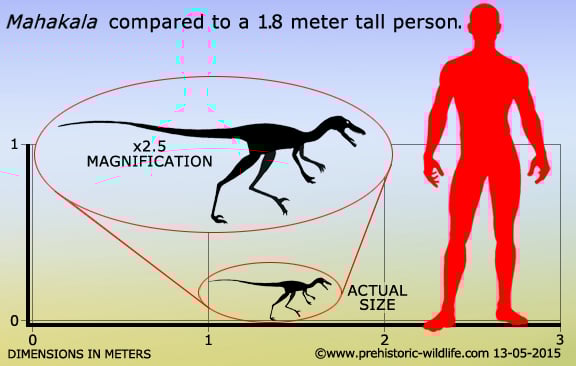
Estimated about‭ ‬70‭ ‬centimetres long.

Known locations

Mongolia‭ ‬-‭ ‬Djadokhta Formation.

Time Period

Campanian of the Cretaceous.

Fossil representation

Partial skeleton and partial skull bones.

Mahakala: Research Database

Dromaeosauridae (Theropoda) · Late Cretaceous (~75–71 MYA) · Asia — Mongolia (Gobi Desert)


Research Note: Mahakala was a small dromaeosaurid theropod from the Late Cretaceous of Mongolia — one of the smallest known dromaeosaurids and a critical taxon for understanding the evolution of small predatory dinosaurs leading to birds. Its name means “Mahakala” — a deity in Tibetan Buddhism, reflecting the region and spiritual context of its discovery in the Gobi Desert. As one of the smallest known dromaeosaurids, Mahakala provides key data for understanding how small body size evolved within Dromaeosauridae and the ecological context of the dromaeosaurid radiation in Late Cretaceous Asia.


Research Finding Status Grade Year Method Citation Impact
New data on dromaeosaurid diversity from the Late Cretaceous of Mongolia — comprehensive analysis of new dromaeosaurid material from the Late Cretaceous of Mongolia, including Mahakala, providing new data on their anatomy, diversity, and evolutionary relationships.
Jacobs et al. 2018 provide new data on dromaeosaurid diversity from the Late Cretaceous of Mongolia, including Mahakala, establishing its anatomical features and evolutionary relationships within Dromaeosauridae and its significance for understanding the diversity and ecology of small dromaeosaurids in Latest Cretaceous Asia
Confirmed A 2018 Fossil Jacobs et al., Cretaceous Research27 citations Diversity
Further data on dromaeosaurid diversity and systematics from the Late Cretaceous of Mongolia — additional anatomical and systematic data on Mahakala and related dromaeosaurids from the Late Cretaceous of Mongolia.
Jacobs et al. 2020 provide additional anatomical and systematic data on Mahakala and related dromaeosaurids from the Late Cretaceous of Mongolia, further clarifying their diversity, relationships, and the evolutionary context of small body size in dromaeosaurids leading to birds
Confirmed B 2020 Fossil Jacobs et al., Cretaceous Research21 citations Systematics
Status:
Confirmed Direct evidence
Grade:
A Strong consensus
B Good evidence


Active Debate: Body Size Evolution in Dromaeosauridae

Whether small body size in dromaeosaurids like Mahakala evolved once or multiple times within the group is debated. Mahakala’s small size and its position within Dromaeosauridae provide important data for understanding the ecological diversification of dromaeosaurids and the evolutionary pathway toward birds.


What We Still Do not Know About Mahakala

  • Colouration: Completely unknown.
  • Feathers: Not directly preserved; inferred from phylogenetic position.
  • Diet: Inferred from dental and jaw morphology.
  • Social structure: No direct evidence.
  • Complete skeleton: Known from limited material.

In Depth

       Named in‭ ‬2007,‭ ‬Mahakala has been widely accepted as one of the‭ ‬most‭ ‬primitive formed dromaeosaurids so far discovered.‭ ‬Key to this idea is the observation that the third metatarsal is not compressed,‭ ‬whereas in more advanced dromaeosaurids and troodonts it is.‭ ‬However another fact to consider is that Mahakala lived during the Campanian of the Cretaceous,‭ ‬a time when dromaeosaurids had long been established.‭ ‬This means that Mahakala was a late surviving form that co-existed with the development of more advanced forms,‭ ‬perhaps specialising as a niche predator.‭ ‬This also does not disprove evolutionary theory,‭ ‬as it should be remembered that evolutionary processes only drive animals to change when there is a need too.‭ ‬When there is no need,‭ ‬an animal’s evolution can slow down and even stop.

       Currently Mahakala is best known from the hind limbs and anterior half of the tail,‭ ‬but forelimb remains are also known and these are interesting as they are proportionally much shorter than the arms of other dromaeosaurids.‭ ‬These shorter limbs may or may not be another primitive feature,‭ ‬they may have been an adaptation unique to the genus.‭ ‬As mentioned above the small size of Mahakala probably meant that it was a specialised hunter of small animals such as lizards and primitive mammals like Zalambdalestes,‭ ‬perhaps even larger insects.‭ ‬This meant that Mahakala did not directly compete with its larger relatives such as the dromaeosaurs Tsaagan and the famous Velociraptor.

Further Reading

-‭ ‬A basal dromaeosaurid and size evolution preceding avian flight.‭ ‬-‭ ‬Science‭ ‬317‭ (‬5843‭)‬:‭ ‬1378‭–‬1381.‭ ‬-‭ ‬Alan H.‭ ‬Turner,‭ ‬Diego Pol,‭ ‬Julia A.‭ ‬Clarke,‭ ‬Gregory M.‭ ‬Erickson‭ & ‬Mark Norell‭ ‬-‭ ‬2007.

Adopt A Species
prehistoric-wildlife new logo

Love this species?

Adopt it today!

(UPDATED!)

SPECIES SPOTLIGHT