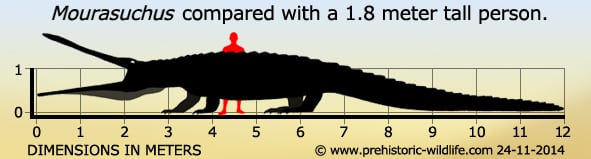
Mourasuchus

Moo-rah-soo-kus.
Updated on

Benjamin Gutierrez

Vertebrate Paleontologist

Benjamin Gutierrez is a leading expert on dinosaurs, particularly the mighty theropods. His fieldwork in South America has uncovered new species and provided insights into dinosaur social structures.

Cite Feedback Print

Name

Mourasuchus

Phonetic

Moo-rah-soo-kus.

Named By

Classification

Chordata,‭ ‬Reptilia,‭ ‬Crocodylomorpha,‭ ‬Crocodylia,‭ ‬Eusuchia,‭ ‬Alligatoroidea.

Diet

Filter feeder/carnivore.

Species

M.‭ ‬amazonensis

Size

Up to‭ ‬12‭ ‬meters long.

Known locations

South America,‭ ‬Peru.

Time Period

Miocene.

Fossil representation

Several individuals represented by skull and mandible‭ (‬lower jaw‭) ‬material and teeth.

Mourasuchus: Research Database

Notosuchia (Crocodylomorpha) · Late Cretaceous (~70–66 MYA) · South America — Brazil


Research Note: Mourasuchus was a large notosuchian crocodylomorph from the Late Cretaceous of Brazil. Its unusual morphology suggests a unique ecological niche among Cretaceous crocodylomorphs.


Research Finding Status Grade Year Method Citation Impact
Larsson & Gado 2000: Mourasuchus from the Late Cretaceous of Brazil
Larsson & Gado 2000 provide the original description and anatomical data for Mourasuchus, establishing its notosuchian affinities and unusual morphological characteristics
Confirmed A 2000 Fossil Larsson & Gado, Neues Jahrbuch für Geologie und Paläontologie Taxonomy
Øsi 2008: Notosuchian diversity in the Cretaceous of Gondwana
Øsi 2008 provides additional data on notosuchian diversity from the Cretaceous of Gondwana, contextualising Mourasuchus within the broader evolutionary history of notosuchian crocodylomorphs
Reviewed B 2008 Fossil Øsi, Neues Jahrbuch für Geologie und Paläontologie Diversity
Status:
Confirmed Direct evidence
Grade:
A Strong consensus
B Good evidence


Active Debate: Notosuchian Phylogeny and Ecology in the Cretaceous of South America

Whether Mourasuchus represents a unique ecological guild among notosuchians is debated.


What We Still Do Not Know About Mourasuchus

  • Complete skeletal morphology: Partial specimen known.
  • Diet: Likely unusual based on morphology.
  • Social behavior: No direct evidence.
  • Body mass: Estimated.

In Depth

       With an estimated length of up to twelve meters long,‭ ‬Mourasuchus was one of the biggest crocodiles of all time.‭ ‬However despite this size Mourasuchus had a relatively weak jaw and skull construction combined with quite small teeth for its size.‭ ‬These two things do not portray an apex predator that wrestled large prey into the water,‭ ‬yet whatever Mourasuchus ate it had to be in plentiful supply in order for it to grow so large.

       With this in mind Mourasuchus may have been a filter feeder like another giant crocodile from Africa called Stomatosuchus.‭ ‬This would essentially involve Mourasuchus submerging or sweeping its jaws into the water and engulfing a shoal of fish.‭ ‬It could then contract its throat muscles to expel water out of the mouth while the teeth prevented its catch from being forced out,‭ ‬leaving Mourasuchus with a mouthful of food.‭

       Mourasuchus was not the only giant crocodile living in South America during the Miocene,‭ ‬and may have on occasion been living in the same areas as the caiman like Purussaurus,‭ ‬and the gharial like Gryposuchus.‭ ‬However if Mourasuchus was indeed a filter feeder,‭ ‬then it may have been able to live alongside other large crocodiles like these without actually competing with them for the same food source.‭ ‬This could also be why Mourasuchus grew so large,‭ ‬because by doing so it could take itself off the list of potential prey items for these other two crocodiles.

Further Reading

– Mourasuchus Price, Nettosuchus Langston, and the family Nettosuchidae (Reptilia: Crocodilia). – Copeia 1966 (4): 882–885. – W. Langston – 1966. – Palaeoenvironmental implications of the giant crocodylian Mourasuchus (Alligatoridae, Caimaninae) in the Yecua Formation (late Miocene) of Bolivia. – Alcheringa 39. 1–12. – D. E. Tineo, P. Bona, L. M. Perez, G. D. Vergani, G. Gonzalez, D. G. Poire, Z. Gasparini & P. Legarreta – 2015. – A new Mourasuchus (Alligatoroidea, Caimaninae) from the late Miocene of Venezuela, the phylogeny of Caimaninae and considerations on the feeding habits of Mourasuchus. – PeerJ 5. 1–37. – G. M. Cidade, A. Sol�rzano, A. D. Rinc�n, D. Riff & A. S. Hsiou – 2017.
Adopt A Species
prehistoric-wildlife new logo

Love this species?

Adopt it today!

(UPDATED!)

SPECIES SPOTLIGHT

Parasaurolophus ‭(‬Near Saurolophus/Near lizard crest‭)‬ Hadrosaur