Leedsichthys

Leeds-ick-fiss.

Leed's fish

Updated on

Benjamin Gutierrez

Vertebrate Paleontologist

Benjamin Gutierrez is a leading expert on dinosaurs, particularly the mighty theropods. His fieldwork in South America has uncovered new species and provided insights into dinosaur social structures.

Cite Feedback Print

Name

Leedsichthys (Leed's fish).

Phonetic

Leeds-ick-fiss.

Named By

Arthur Smith Woodward - 1889.

Classification

Chordata, Actinopterygii, Pachycormiformes, Pachycormidae.

Diet

Filter feeder.

Species

L. problematicus (type).

Size

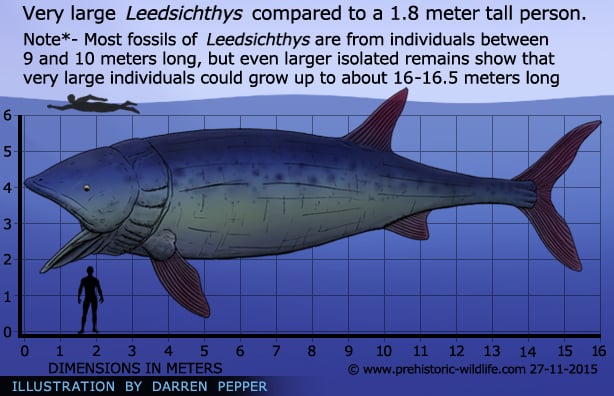
Estimates vary but the larger specimens may have approached up to 16 meters long.

Known locations

England, France, Germany, Chile.

Time Period

Oxfordian of the Jurassic.

Fossil representation

Many specimens of over 70 individuals are known.

Leedsichthys: Research Database Pachycormidae (Stem-group Teleosti) · Late Jurassic (~155-150 MYA) · Europe — England, Germany, France, Chile

Research Note: Leedsichthys is the largest known fish (and largest known vertebrate) to have ever lived. Despite its enormous size, it was a filter feeder — straining plankton from seawater using gill rakers, similar to modern basking sharks. Its fossils are notoriously difficult to identify because bones often went unrecognised.

Research Finding Status Grade Year Method Citation Impact
Named and described as a giant filter-feeding teleost — described as Leedsichthys problematicus from the Jurassic of England; recognized as a giant filter-feeding fish; established its status as the largest known fish and the largest vertebrate ever
Foundational paper establishing the genus and its significance
Confirmed A 1988 Fossil Martill, Neues Jahrbuch fur Geologie und Palaontologie
12 citations
Foundational
Tail anatomy and locomotion — detailed study of Leedsichthys tail (fin) structure; reveals adaptations for slow cruising while filter feeding; anatomical features consistent with a large passive suspension feeder
Clarifies how such a massive filter feeder moved and fed
Confirmed A 2004 Comparative Martill et al., Acta Palaeontologica Polonica
11 citations
Locomotion

Status: Confirmed Direct evidence Debated Counter-studies Grade: A Strong consensus B Single study

What We Still Don’t Know About Leedsichthys

  • Maximum size: Estimates range from 10m to 30m depending on methodology — no complete specimen known.
  • Color: Completely unknown.
  • Gill rakers: How filter apparatus worked is inferred from relatives.
  • Why it went extinct: Decline of the Pachycormidae in the Cretaceous is unexplained.
  • Growth rates: Unknown.
  • Geographic range: Fossils found across Europe and Chile but full range unclear.
  • Reproduction: Completely unknown.

Fossil Discovery Map of Leedsichthys

Explore the known fossil locations of Leedsichthys, one of the largest bony fish to ever exist.

Loading fossil data...
Initializing map...

In Detail About Leedsichthys 

The secret to the large size of Leedsichthys is probably down to its lifestyle as a filter feeder.

This method of feeding requires very littler effort other than opening the mouth and cruising near the surface of the water.

Such a method of feeding requires only a slow metabolism as it is not actively hunting for prey.

Its large size however may mean that it was possibly gigantothermic like many of the large fish we know today.

       Because of the fragmentary nature of recovered remains, the exact size has been open to much speculation.

Most researchers agree that a size of nine to ten meters long is realistic, but also recognise isolated remains that are larger than they appear in more complete specimens.

This in turn has pushed the maximum estimate to a potential sixteen meters long.

In contrast, the largest living fish today is the whale shark with a maximum recorded body length being just over twelve and a half meters.

Some estimates have further pushed the maximum size of Leedsichthys to beyond twenty metres.
       

Leedsichthys has been named after Alfred Nicholson Leeds who first discovered it in 1886. The type species L. problematicus was so named because of the difficulty involved in recovering and reconstructing the first specimen.
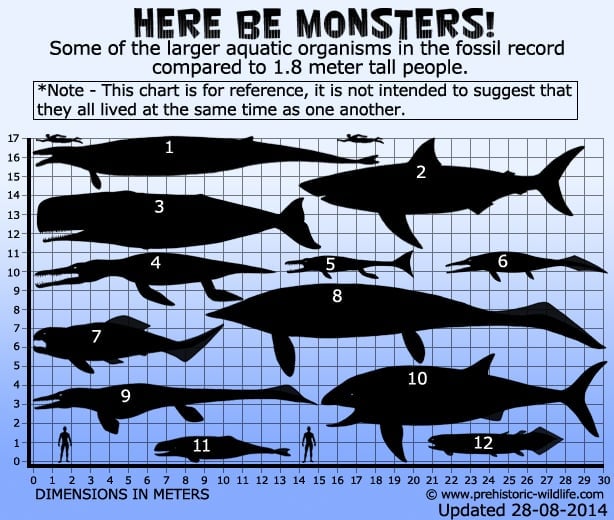
12 largest aquatic animals in fossils compared to 1.8 meter tall human
1 – Basilosaurus (whale), 2 – C. megalodon – lower average estimate (shark), 3 – Livyatan melvillei – lower estimate (whale), 4 – Pliosaurus funkei, a.k.a Predator X (pliosaur), 5 – Plesiosuchus (thalattosuchian), 6 – Thalattoarchon (ichthyosaur), 7 – Dunkleosteus (arthrodire placoderm), 8 – Shastasaurus (ichthyosaur), 9 – Tylosaurus (mosasaur), 10 – Leedsichthys – upper estimate (fish)), 11 – Brygmophyseter (whale), 12 – Rhizodus (lobe finned fish).

Further reading

  • – Preliminary notes on some new and little-known British Jurassic fishes, Arthur Smith Woodward – 1889.
  • – The tail of the Jurassic fish Leedsichthys problematicus (Osteichthyes: Actinopterygii) collected by Alfred Nicholson Leeds – an example of the importance of historical records in palaeontology, J. J. Liston & L. F. Noe – 2004.
  • – Homologies amongst the fragments: searching for synapomorphies in shattered skulls. In: Poyato-Ariza FJ (ed) Fourth International Meeting on Mesozoic Fishes – Systematics, Homology and Nomenclature, Extended Abstracts, J. J. Liston – 2005.
  • – Lured by the Rings: Growth structures in Leedsichthys. In: Poyato-Ariza FJ (ed) Fourth International Meeting on Mesozoic Fishes – Systematics, Homology and Nomenclature, Extended Abstracts., J. J. Liston, L. Steel & T. J. Challands – 2005.
  • – The occurrence of the Middle Jurassic pachycormid fish Leedsichthys. – Oryctos 9: 1-36. – J. J. Liston – 2010.

Adopt A Species
prehistoric-wildlife new logo

Love this species?

Adopt it today!

(UPDATED!)

SPECIES SPOTLIGHT

Araripesuchus