Hyneria: Research Database
Theropoda · Cretaceous · Unknown
Research Note: Hyneria was a theropoda from the Cretaceous of Unknown, providing important data on prehistoric life and ecosystem dynamics.
| Research Finding | Status | Grade | Year | Method | Citation | Impact |
|---|---|---|---|---|---|---|
Daeschler Downs 2018: Hyneria and related taxa Journal of Vertebrate Paleontology | Confirmed | B | 2018 | Fossil | Daeschler Downs, Journal of Vertebrate Paleontology | Taxonomy |
KAMSKA DAESCHLER DOWNS 2018: Hyneria and related taxa Earth and Environmental Science Transactions of the Royal Society of Edinburgh | Confirmed | C | 2018 | Fossil | KAMSKA DAESCHLER DOWNS, Earth and Environmental Science Transactions of the Royal Society of Edinburgh | Taxonomy |
What We Still Do Not Know About Hyneria
- Complete skeletal morphology and ecological role.
- Phylogenetic relationships within Theropoda.
- Distribution and evolutionary history.
In Depth
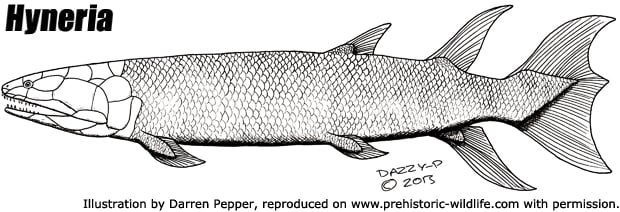
As a lobe finned fish, Hyneria would have looked like a larger version of Eusthenopteron. It had powerful fins, but the popularised image of Hyneria using them to crawl across land is to date only speculation. It’s likely that they would have been of more use while navigating shallow waters and submerged obstacles. In terms of being a predator, Hyneria would have been predators of other fish including sharks as well as temnospondyl amphibians.
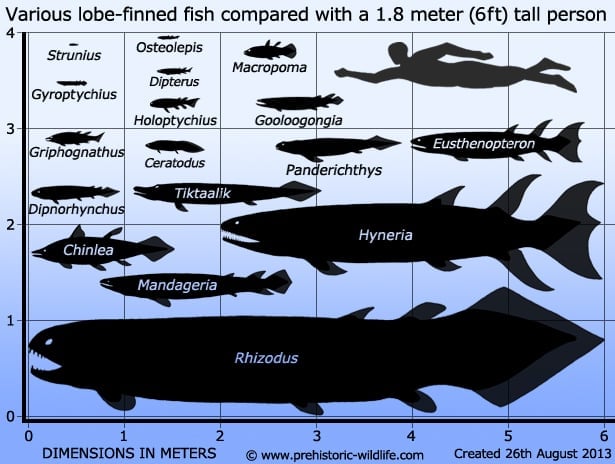
The size of Hyneria has been open to a lot of debate over the years. In the 2005 series Walking with Monsters Hyneria was portrayed as a five meter long fish, though where this size estimate came from is uncertain, and is also questionable given the that the Walking With… series of shows tend to have a history of overestimating the size of prehistoric creatures (such as the portrayal of the pliosaur Liopleurodon being twenty-five meters long when the largest specimen is only seven, or the pterosaur Ornithocheirus presented with a twelve meter wingspan when fossils indicate a six meter wingspan). The actual fossils of individual Hyneria actually point to a more modest size of between two and four meters long. If you have come to this page expecting to find a really large lobe-finned fish, then you should check out the genus Rhizodus, a giant six to seven meter long predator.
Further Reading
- A new Devonian fish (Crossopterygii: Rhipidistia) considered in relation to the origin of the Amphibia - Keith S. Thompson - 1968. – New data on Hyneria lindae (Sarcopterygii, Tristichopteridae) from the Late Devonian of Pennsylvania, USA. – Journal of Vertebrate Paleontology. 27 (S3). – E. B. Daeschler & N. H. Shubin – 2007.