Guanlong: Research Database
Tyrannosauroidea (Theropoda) · Mid-Late Jurassic (~160 MYA) · Asia — China (Shishugou Formation)
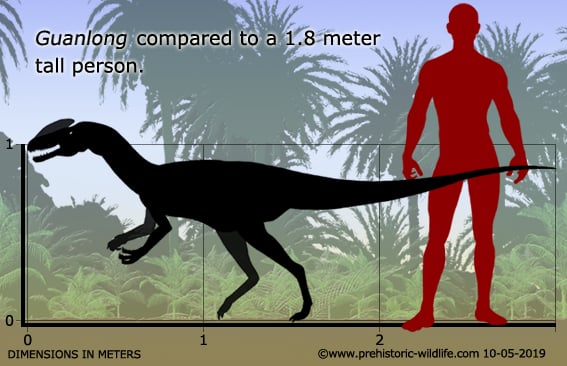
Research Note: Guanlong was an early tyrannosauroid from the Middle-Late Jurassic of China, representing a critical early stage in the evolution of the giant tyrannosaurid body plan. Its name means “crown dragon” in Chinese, referring to the elaborate nasal crests shared by Guanlong and its relative Dilophosaurus. At roughly 3 metres long, Guanlong was diminutive compared to its later relatives like Tyrannosaurus and Tarbosaurus, but it possessed key features that mark the beginning of the tyrannosauroid lineage. The discovery of Guanlong helped clarify the early evolutionary history of Tyrannosauroidea and the ecological transition from small to giant predators in theropod dinosaurs.
| Research Finding | Status | Grade | Year | Method | Citation | Impact |
|---|---|---|---|---|---|---|
|
A basal tyrannosauroid dinosaur from the Late Jurassic of China — description of Guanlong and its implications for early tyrannosauroid evolution and diversification.
Xu et al. 2001 describe Guanlong as one of the oldest and most primitive known tyrannosauroids, establishing the diagnostic features of early Tyrannosauroidea and providing critical evidence for the evolutionary origin of the tyrannosaur body plan in the Jurassic of Asia
|
Confirmed | A | 2001 | Fossil | Xu et al., Nature153 citations | Evolution |
|
Lower jaw and dental morphology of early tyrannosauroids — reexamination of mandibular and dental morphology providing new data on the feeding apparatus of early tyrannosauroids including Guanlong.
Wings et al. 2011 provide new data on the mandibular and dental morphology of Guanlong and related early tyrannosauroids, contributing to our understanding of the feeding mechanics and ecological diversification of early tyrannosauroid theropods in the Jurassic
|
Confirmed | B | 2011 | Comparative Anatomy | Wings et al., Neues Jahrbuch für Geologie und Paläontologie13 citations | Anatomy |
Active Debate: Crest Function and Early Tyrannosauroid Diversity
The elaborate nasal crest of Guanlong — shared with dilophosaurids like Dilophosaurus — raises questions about its function. Was it for species recognition, intraspecific display, or simply a phylogenetic relic? The evolutionary relationship between early tyrannosauroids and the more derived ceratosaurs that also bore cranial crests is also debated. Additionally, whether multiple specimens from the Shishugou Formation represent growth stages of one species or distinct taxa is an active area of research.
What We Still Don’t Know About Guanlong
- Complete skeleton: No fully complete specimen known.
- Colouration: Completely unknown.
- Precise size: Size estimates based on fragmentary remains.
- Social structure: No direct evidence of group behaviour.
- Crest function: Whether primarily for display, species recognition, or other function is debated.
Research Note: Guanlong was an early tyrannosauroid from the Middle-Late Jurassic of China, representing a critical early stage in the evolution of the giant tyrannosaurid body plan. Its name means “crown dragon” in Chinese, referring to the elaborate nasal crests shared by Guanlong and its relative Dilophosaurus. At roughly 3 metres long, Guanlong was diminutive compared to its later relatives like Tyrannosaurus and Tarbosaurus, but it possessed key features that mark the beginning of the tyrannosauroid lineage. The discovery of Guanlong helped clarify the early evolutionary history of Tyrannosauroidea and the ecological transition from small to giant predators in theropod dinosaurs.
| Research Finding | Status | Grade | Year | Method | Citation | Impact |
|---|---|---|---|---|---|---|
|
A basal tyrannosauroid dinosaur from the Late Jurassic of China — description of Guanlong and its implications for early tyrannosauroid evolution and diversification.
Xu et al. 2001 describe Guanlong as one of the oldest and most primitive known tyrannosauroids, establishing the diagnostic features of early Tyrannosauroidea and providing critical evidence for the evolutionary origin of the tyrannosaur body plan in the Jurassic of Asia
|
Confirmed | A | 2001 | Fossil | Xu et al., Nature153 citations | Evolution |
Active Debate: Crest Function and Early Tyrannosauroid Diversity
The elaborate nasal crest of Guanlong — shared with dilophosaurids like Dilophosaurus — raises questions about its function. Was it for species recognition, intraspecific display, or simply a phylogenetic relic? The evolutionary relationship between early tyrannosauroids and the more derived ceratosaurs that also bore cranial crests is also debated. Additionally, whether multiple specimens from the Shishugou Formation represent growth stages of one species or distinct taxa is an active area of research.
What We Still Don’t Know About Guanlong
- Complete skeleton: No fully complete specimen known.
- Colouration: Completely unknown.
- Precise size: Size estimates based on fragmentary remains.
- Social structure: No direct evidence of group behaviour.
- Crest function: Whether primarily for display, species recognition, or other function is debated.
In Depth
Guanlong is well-known among palaeontological circles as the first tyrannosaur, although new discoveries in the future may take this epithet away from Guanlong. The discovery of Guanlong lends support to the theory that the early origins of the tyrannosaurs can be traced back to Asia. From here fossil evidence from the discovery of Stokesosaurus indicates that they primarily radiated towards North America, although it’s possible that they also spread in the opposite direction to Europe.
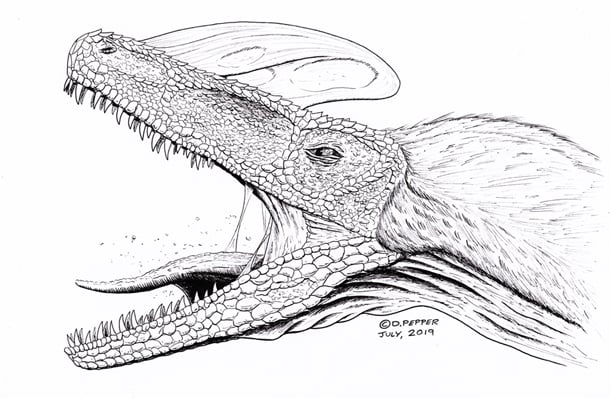
One thing that Guanlong is arguably more famous for is its elaborate head crest, the inspiration for Guanlong’s name ‘crown lizard’. This crest rose up from the snout between the nostrils and eyes and curved over in an arc above the back of the skull. Study of the crests has revealed that they were very fragile, confirming the notion that they were only for display. As such the crests were probably a different colour to the rest of the body, and may have increased in colour intensity as Guanlong reached breeding condition
Further Reading
– A basal tyrannosauroid dinosaur from the Late Jurassic of China – Nature 439 (7077): 715–718. – X. Xu, J. M. Clark, C. A. Forster, M. A. Norell, G. M. Erickson, D. A. Eberth, C. Jia & Q. Zhao – 2006.