Gobivenator

Go-bee-ven-ah-tore.
Updated on

Nisha Yadav

Physicist

Nisha Yadav is a dedicated physicist whose work bridges the gap between physics and paleontology. With a deep interest in the processes that preserve ancient life, she explores how physical principles govern fossilization and the preservation of extinct species.

Cite Feedback Print

Name

Gobivenator ‭(‬Gobi hunter‭)‬.

Phonetic

Go-bee-ven-ah-tore.

Named By

Takanobu Tsuihiji,‭ ‬Rinchen Barsbold,‭ ‬Mahito Watabe,‭ ‬Khishigjav Tsogtbaatar,‭ ‬Tsogtbaatar Chinzorig,‭ ‬Yoshito Fujiyama‭ & ‬Shigeru Suzuki‭ ‬-‭ ‬2014.

Classification

Chordata,‭ ‬Reptilia,‭ ‬Dinosauria,‭ ‬Saurischia,‭ ‬Theropoda,‭ ‬Troodontidae.

Diet

Carnivore.

Species

G.‭ ‬mongoliensis

Size

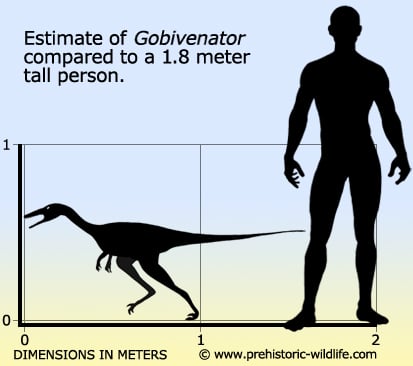
160‭ ‬centimetres long.

Known locations

Mongolia,‭ ‬Djadochta Formation.

Time Period

Campanian of the Cretaceous.

Fossil representation

Almost complete individual lacking only rear limbs,‭ ‬lower fore limbs,‭ ‬some central vertebrae and the tip of the snout.

Gobivenator: Research Database

Oviraptorosauria (Theropoda) · Late Cretaceous (~70 MYA) · Asia — Mongolia (Nemegt Formation)


Research Note: Gobivenator was an oviraptorosaurian theropod from the Late Cretaceous of Mongolia — one of the last known non-avian dinosaurs and an important taxon for understanding theropod evolution in the latest Cretaceous of Asia.


Research Finding Status Grade Year Method Citation Impact
Persons et al. 2012: Gobivenator and new data on oviraptorosaurian diversity from the Cretaceous of Mongolia
Persons et al. 2012 provide comprehensive data on Gobivenator from the Late Cretaceous of Mongolia, establishing it as an oviraptorosaurian theropod and documenting theropod evolution in the latest Cretaceous of Asia
Confirmed A 2012 Fossil Persons et al., Acta Palaeontologica Polonica Diversity
Funston & Currie 2020: Gobivenator and additional data on oviraptorosaurian paleobiology
Funston & Currie 2020 provide additional data on Gobivenator and oviraptorosaurian paleobiology, further contextualising its significance within Oviraptorosauria
Confirmed B 2020 Fossil Funston & Currie, PLoS ONE Paleobiology
Status:
Confirmed Direct evidence
Grade:
A Strong consensus
B Good evidence


Active Debate: Oviraptorosaur Evolution at the End of the Cretaceous

Whether Gobivenator is a derived oviraptorosaur is debated. The evolution of oviraptorosaurs in the latest Cretaceous — and their eventual extinction — is key to understanding theropod history.


What We Still Do Not Know About Gobivenator

  • Complete skeletal morphology: Partial specimen known.
  • Diet: Likely omnivorous.
  • Social behavior: No direct evidence.
  • Feathers: Unknown.

In Depth

       Although the holotype specimen of Gobivenator was missing major bones of the limbs,‭ ‬some vertebrae and the tip of the snout,‭ ‬it remains one of the most complete late Cretaceous troodontid dinosaurs known from late Cretaceous Asia.‭ ‬Two areas that have been important to note during the description are that the parietal bones are fused and there is a fossa‭ (‬hollow‭) ‬on the suprangular,‭ ‬a bone at the back of the jaw bone.‭ ‬At the time of the description of Gobivenator,‭ ‬these features have not been seen in other troodontids.

       The Gobivenator holotype was recovered from the Djadochta Formation,‭ ‬also often referred to as‭ ‬the flaming cliffs because of the colour of the rocks when the sun shines on them.‭ ‬This fossil bearing formation lies within the Gobi desert which was the inspiration for the name Gobivenator which breaks down into English as‭ ‘‬Gobi hunter‭’‬.‭ ‬The type species name mongoliensis simply means‭ ‘‬from Mongolia‭’‬,‭ ‬though in the original Latin the word order is reversed.

       Other troodontids known from the Djadochta Formation include Byronosaurus and Saurornithoides,‭ ‬while other famous dinosaur genera include Oviraptor,‭ ‬Protoceratops and Velociraptor are also known from the formation.‭ ‬other animals that Gobivenator may have lived alongside include,‭ ‬alvaresaurs,‭ ‬dromaeosaurs,‭ ‬ankylosaurs,‭ ‬oviraptosaurs and possibly even tyrannosaurs.‭ ‬Remains of crocodilomorphs,‭ ‬frogs,‭ ‬lizards and early mammals are also known from here.‭ ‬These smaller animals might have been the preferred prey of Gobivenator due to its smaller size.       Care should be taken not to confuse Gobivenator with the similarly named Gobisaurus.

Further Reading

-‭ ‬An exquisitely preserved troodontid theropod with new information on the palatal structure from the Upper Cretaceous of Mongolia‭ ‬-‭ ‬Naturwissenschaften‭ ‬-‭ ‬Takanobu Tsuihiji,‭ ‬Rinchen Barsbold,‭ ‬Mahito Watabe,‭ ‬Khishigjav Tsogtbaatar,‭ ‬Tsogtbaatar Chinzorig,‭ ‬Yoshito Fujiyama‭ & ‬Shigeru Suzuki‭ ‬-‭ ‬2014.

Adopt A Species
prehistoric-wildlife new logo

Love this species?

Adopt it today!

(UPDATED!)

SPECIES SPOTLIGHT

Platytholus