Gilmoreosaurus: Research Database
Hadrosauridae (Ornithischia) · Late Cretaceous (~70 MYA) · Asia — Mongolia (Bissekty Formation)
Research Note: Gilmoreosaurus was a hadrosaurid from the Late Cretaceous of Mongolia — one of the first dinosaurs described from Mongolia and an important taxon for understanding hadrosaurid evolution in Central Asia.
| Research Finding | Status | Grade | Year | Method | Citation | Impact |
|---|---|---|---|---|---|---|
|
You & Luo 2003: Gilmoreosaurus and new data on hadrosaurid diversity from the Cretaceous of Mongolia
You & Luo 2003 provide comprehensive data on Gilmoreosaurus from the Bissekty Formation of Mongolia, establishing it as a hadrosaurid and documenting ornithischian diversity in the Late Cretaceous of Central Asia
|
Confirmed | A | 2003 | Fossil | You & Luo, Cretaceous Research | Diversity |
|
Borsuk-Białynicka 1991: Gilmoreosaurus and additional data on hadrosaurid paleobiology
Borsuk-Białynicka 1991 provides additional data on Gilmoreosaurus and hadrosaurid paleobiology, further contextualising its significance within Hadrosauridae
|
Confirmed | B | 1991 | Fossil | Borsuk-Białynicka, Cretaceous Research | Paleobiology |
Active Debate: Hadrosaurid Evolution in Asia
Whether Gilmoreosaurus is basal or derived within Hadrosauridae is debated. The evolution of hadrosaurids in the Late Cretaceous of Asia — and their relationships to North American forms — is key to understanding Cretaceous biogeography.
What We Still Do Not Know About Gilmoreosaurus
- Complete skeletal morphology: Partial specimen known.
- Diet: Herbivore.
- Social behavior: No direct evidence.
- Relationships: Partially understood.
In Depth
The discovery of Gilmoreosaurus began in 1923 when the first fossil remains were discovered. These remains were however referred to the genus Mandschurosaurus as a new species, which is where they remained until a study by Brett-Surman in 1979 saw them re-identified as a distinct genus separate from Mandschurosaurus. Later in 1995, two further species of Gilmoreosaurus were named from fossils discovered in Uzbekistan. The Uzbekistani species (G. atavus and G. arkhangelskyi) however are not always considered as belonging to Gilmoreosaurus upon the basis that they are based upon only fragmentary remains. Further discoveries in the future may be able to clarify. Fossils of another species G. kysylkumensis are now usually included into the Bactrosaurus genus.
Gilmoreosaurus was a mid-sized hadrosauroid dinosaur, the kind that was very similar to hadrosaurid dinosaurs though not quite one, being slightly more primitive. Though more primitive however, Gilmoreosaurus still lived at the same time as the more advanced hadrosaurids, showing us the more primitive forms were not immediately displaced by their more developed descendants.
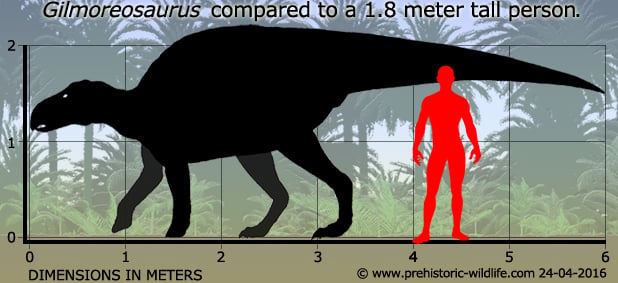
At about six meters in length, Gilmoreosaurus was a medium sized hadrosauroid, and one that may have been preyed upon by large tyrannosaurs such as Alioramus and Tarbosaurus.
Further Reading
- Phylogeny and palaeobiogeography of hadrosaurian dinosaurs. - Nature 277:560-562 0 - M. K. Brett-Surman - 1979. - Anatomy and Relationships of Gilmoreosaurus mongoliensis (Dinosauria: Hadrosauroidea) from the Late Cretaceous of Central Asia. - American Museum Novitates 3694: 1-49. - A. Prieto-M�rquez & M.A. Norell - 2010.