In Depth
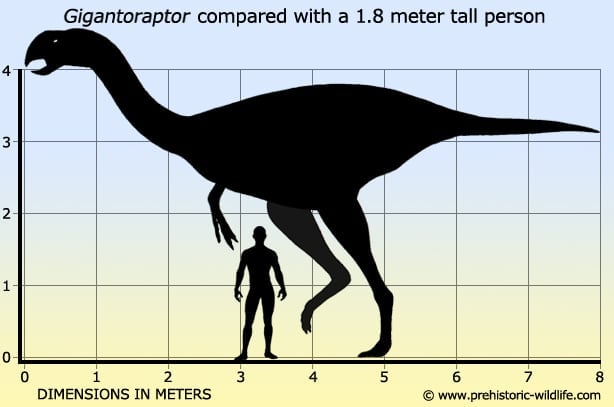
At eight meters Gigantoraptor is the largest oviraptorid dinosaur currently known, and is many times larger than other members of the group. Problems that exist at the time of writing are the remains that while incomplete show two characteristics belonging to different lifestyles. What can be ascertained is that Gigantoraptor had a long neck, a trait found in many herbivores. On the flip side however, Gigantoraptor had large sharp claws like you may expect with a carnivore. The different body features make it difficult to establish how Gigantoraptor actually lived and what it ate, although it had a similar morphology of long neck and sharp claws are also known in other dinosaurs such as therizinosaurs like Therizinosaurus and ornithomimids like Deinocheirus.
Another feature that can be interpreted either way is the long hind legs, particularly the long lower portions of the legs. These kinds of legs are found across the known theropods in both dinosaurs that chased after others, and dinosaurs that relied upon running faster than their predators. It is hard to say which is truer for Gigantoraptor, but as a herbivore it may have had to cover large distances in a semi-arid environment in order to find enough food to keep its large body going. As a predator it would have had an easy time chasing after prey. Either way they may have to keep out of the way of large predators such as tyrannosaurs like Tarbosaurus.
One aspect of Gigantoraptor which requires pause for thought is if it had feathers. As an oviraptorid it would actually be unusual if Gigantoraptor didn’t have feathers, but feathers, like hair, are usually only present for the purpose of insulation, and as animals get bigger, they tend to need less insulation because of gigantothermy. This has brought speculation that Gigantoraptor may have had severely reduced feathers, and may have actually lacked them all together. If Gigantoraptor did have feathers, they may have served a purely display purpose, or if for the purpose of insulation, to cope with harsh environmental conditions such as the cold nights of arid landscapes.
Further Reading
– A gigantic bird-like dinosaur from the Late Cretaceous of China – Nature 447 (7146): 844–847 – X. Xu, Q. Tan, J. Wang, X. Zhao, L. Tan – 2007. – Functional anatomy of a giant toothless mandible from a bird-like dinosaur: Gigantoraptor and the evolution of the oviraptorosaurian jaw. – Scientific Reports. 7 (1): 16247. – W. Ma, J. Wang, M. Pittman, Q. Tan, L. Tan, B. Guo & X. Xu – 2017.