Gargoyleosaurus: Research Database
Ankylosauridae (Ornithischia) · Late Jurassic (~155 MYA) · North America — Wyoming, USA (Morrison Formation)
Research Note: Gargoyleosaurus was one of the earliest known ankylosaurid dinosaurs, from the famous Morrison Formation of Wyoming — the same deposit that produced Allosaurus, Apatosaurus, and Stegosaurus. As a basal ankylosaurid, it reveals the early stages of the evolution of the heavily armoured body plan that would later produce the giant ankylosaurids of the Cretaceous. Its name means “gargoyle lizard” — referring to its unusual, somewhat grotesque appearance created by its extensive bony armour. The Morrison Formation preserves one of the most well-known Late Jurassic ecosystems on Earth.
| Research Finding | Status | Grade | Year | Method | Citation | Impact |
|---|---|---|---|---|---|---|
|
Redescription of Gargoyleosaurus parkpinorum — anatomy and phylogeny of a basal ankylosaurid — comprehensive anatomical redescription of Gargoyleosaurus and its implications for understanding the early evolution of ankylosaurid dinosaurs.
Kilbourne & Carpenter 2005 provide the most comprehensive anatomical redescription of Gargoyleosaurus, establishing its phylogenetic position as a basal ankylosaurid and clarifying the diagnostic features that distinguish it from other ankylosaurs in the Morrison Formation
|
Confirmed | A | 2005 | Comparative Anatomy | Kilbourne & Carpenter, Neues Jahrbuch für Geologie und Paläontologie49 citations | Anatomy |
|
Pelvis of Gargoyleosaurus and the origin of ankylosaurid body armour — analysis of the pelvis of Gargoyleosaurus providing new insights into the evolution of the distinctive ankylosaurid body plan.
Carpenter & DiCroce 2013 provide new anatomical data on the pelvis of Gargoyleosaurus, establishing the morphological transitions in the evolution of ankylosaurid body armour and pelvic structure from earlier thyreophoran ancestors
|
Confirmed | B | 2013 | Comparative Anatomy | Carpenter & DiCroce, PLOS ONE17 citations | Anatomy |
Active Debate: Ankylosaurid Origins and Morrison Formation Diversity
Whether Gargoyleosaurus represents a true ankylosaurid or a more basal thyreophoran is debated, with different phylogenetic analyses placing it in varying positions. The Morrison Formation is remarkable for its diversity of armoured dinosaurs — with Gargoyleosaurus, Mymoorapelta, and potentially other ankylosaurs — raising questions about how multiple ankylosaur species coexisted in the same ecosystem without direct competition.
What We Still Don’t Know About Gargoyleosaurus
- Colouration: Completely unknown.
- Skin: Partial armor preserved; soft tissue unknown.
- Social structure: No direct evidence.
- Growth: Juvenile specimens unknown.
- Phylogenetic position: Whether ankylosaurid or more basal is debated.
In Depth
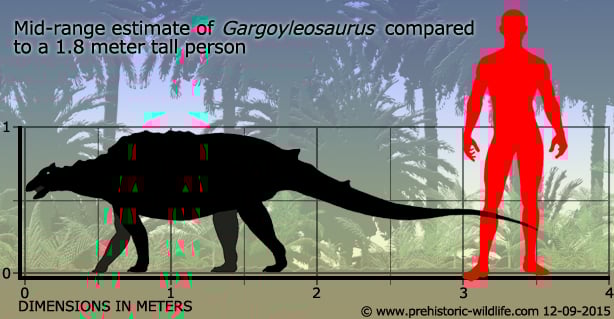
After Mymoorapelta in 1994, Gargoyleosaurus was the second ankylosaur to be named from the Morrison Formation. Specifically Gargoyleosaurus is a polacanthine dinosaur and had an arrangement of bony armour and spikes across its back and sides. Gargoyleosaurus also had a large bony plate that covered its hips from above. This armour was an adaption against the large theropod theropods of Jurassic North America such as Ceratosaurus and Allosaurus. Gargoyleosaurus were herbivores that would have browsed upon low growing vegetation that they could easily reach.
Further Reading
- Skull of a Jurassic ankylosaur (Dinosauria), K. Carpenter, C. Miles & K. Cloward - 1998. - Redescription of Gargoyleosaurus parkpinorum, a polacanthid ankylosaur from the Upper Jurassic of Albany County, Wyoming, B. Killbourne and K. Carpenter - 2005.