In Depth
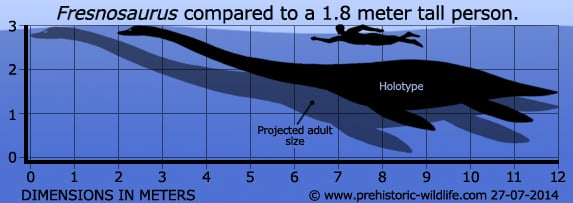
Fresnosaurus was a late Cretaceous era elasmosaurid plesiosaur that seems to have the signature feature of this group of a very long neck proportionately greater than in earlier and more primitive plesiosaur forms. Like with these other genera, Fresnosaurus was probably a specialist hunter of fish and soft bodied cephalopods like squid.
Fresnosaurus is not the only plesiosaur from the Moreno Formation with others including Morenosaurus, Aphrosaurus and Hydrotherosaurus. Additionally not only have all of these plesiosaurs come from the Moreno Formation, but they were all described by Samuel Paul Welles and all in 1943. Other marine reptiles to be discovered in the Moreno Formation include the mosasaurs Plotosaurus and Plesiotylosaurus, as well as the remains of marine turtles.
The name Fresnosaurus is a reference to Fresno County in California, while the type species name F. drescheri is in honour of Arthur Drescher.
Further Reading
– Elasmosaurid plesiosaurs with description of new material from California and Colorado. Memoirs of the University of California 13:125-254. – S. P. Welles – 1943.