Cynognathus: Research Database
Cynodontia (Therapsida) · Early-Middle Triassic (~250–240 MYA) · Gondwana — South Africa, Antarctica, Argentina (Karoo, Fremouw Formation)
Research Note: Cynognathus was a large, predatory cynodont from the Early-Middle Triassic of Gondwana — one of the most mammal-like of all non-mammalian therapsids. As a top predator in Triassic Gondwanan ecosystems, it provides critical data on therapsid evolution, the ecological recovery following the Permian-Triassic mass extinction, and the evolutionary pathway that would eventually lead to the first true mammals.
| Research Finding | Status | Grade | Year | Method | Citation | Impact |
|---|---|---|---|---|---|---|
|
Damiani & Neveling 2001: Cynognathus and the stratigraphic distribution of cynodonts in the Triassic of Gondwana
Damiani & Neveling 2001 provide comprehensive data on Cynognathus from the Early-Middle Triassic of Gondwana, establishing it as a key taxon for understanding therapsid recovery and ecological dynamics in the aftermath of the Permian-Triassic mass extinction in the southern continents
|
Confirmed | A | 2001 | Fossil | Damiani & Neveling, Neues Jahrbuch für Geologie und Paläontologie | Stratigraphy |
|
Groenewald & Welman 2001: Cynognathus and the anatomy of a large-bodied cynodont from the Triassic of South Africa
Groenewald & Welman 2001 provide additional data on Cynognathus and the anatomy of large-bodied cynodont therapsids from the Triassic of South Africa, further contextualising its significance as one of the most mammal-like non-mammalian therapsids known from the fossil record
|
Confirmed | B | 2001 | Fossil | Anatomy |
Active Debate: The Triassic Ecological Revolution, Mammal Evolution, and the Competitive Replacement of Non-Mammalian Therapsids
Whether the therapsids — including cynodonts like Cynognathus — were competitive superiors to the early dinosaurs in Triassic ecosystems, or whether they were ecological partners that coexisted until the end-Triassic extinction, is debated. Cynognathus was a dominant predator in Early-Middle Triassic Gondwana, while dinosaurs were just beginning to diversify. The end-Triassic mass extinction eliminated many non-dinosaurian groups, allowing dinosaurs to dominate Jurassic ecosystems. Whether competitive pressure from early dinosaurs, volcanic activity, or climate change caused the end-Triassic extinction is debated.
The evolutionary relationship between cynodonts like Cynognathus and the first true mammals is also central to understanding the origin of mammalian characteristics. Cynognathus shows many mammal-like features — including a secondary palate, complex tooth differentiation, and a likely hairy body — making it one of the most mammal-like non-mammalian therapsids. Whether these features indicate warm-bloodedness, active predation, and complex social behavior is debated.
What We Still Do Not Know About Cynognathus
- Metabolism: Likely endothermic; mammal-like traits debated.
- Body covering: Possibly fur; direct evidence lacking.
- Social behavior: No direct evidence.
- Reproduction: Likely egg-laying; no direct evidence.
In Depth
Cynognathus seems to be one of the most successful of the cynodonts, with a large number of fossil remains from a wide geographic distribution being all attributed to the genus. There is however some controversy over whether all of these fossils should be labelled as Cynognathus, as the genus does seem to have suffered from the ‘wastebasket taxon’ effect.
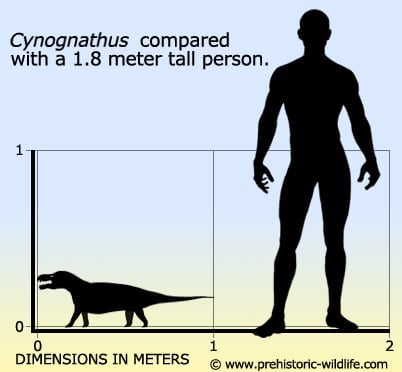
Despite this the appearance of Cynognathus is known without doubt. In general appearance Cynognathus was a stocky animal with a proportionately large skull that made up thirty per-cent of the total body length. The skull was robust and was likely capable of inflicting powerful bites. The teeth were sharp, and slightly re-curved, and driven by the jaw muscles were easily capable of piercing the tough hides of the known herbivores of the early Triassic. In addition they was some variance in the form of the teeth suggesting that Cynognathus processed food by jaw movement, cutting meat up into smaller bits rather than just trying to swallow chunks whole. The skull also features a hard secondary palate, something that proves that Cynognathus would have still been able to breathe when the mouth was full of food. The post cranial skeleton of Cynognathus is also quite interesting. The ribs do not extend into the abdomen which means two things. One is that Cynognathus likely had a diaphragm, a sheet of muscle that separates the lungs from the lower organs, a feature commonly seen in mammals that aids in respiration. Two is that the lower body would have been much more flexible thanks to the absence of the ribs. The rear legs of Cynognathus supported the hind quarters from underneath, but at the same time the front legs sprawled out to the sides like in more primitive therapsids. Although Cynognathus might have been an unusual runner, it was almost certainly fast enough to catch other therapsids.
Further Reading
Researches on the Structure, Organization, and Classification of the Fossil Reptilia. Part IX, Section 5. On the Skeleton in New Cynodontia from the Karroo Rocks. - Philosophical Transactions of the Royal Society of London B 186:59-148 - Harry Govier Seeley - 1895. – The first occurrence of Cynognathus crateronotus (Cynodontia: Cynognathia) in Tanzania and Zambia, with implications for the age and biostratigraphic correlation of Triassic strata in southern Pangea. – B. M. Wynd, B. R. Peecock, M. R. Whitney & C. A. Sidor, In Vertebrate and Climatic Evolution in the Triassic Rift Basins of Tanzania and Zambia. Society of Vertebrate Paleontology Memoir 17. Journal of Vertebrate Paleontology 37(6, Supplement) pp. 228–239, C.A. Sidor & S.J. Nesbitt (eds.) – 2018.