In Depth
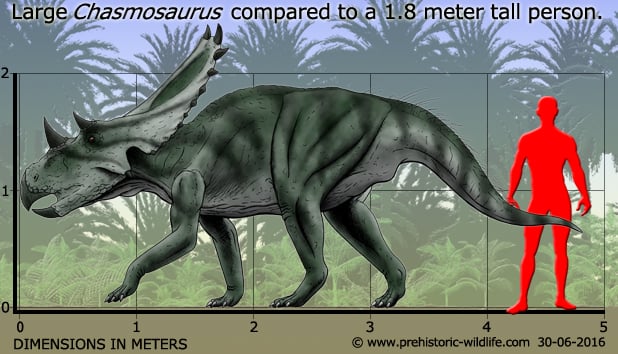
The elongated frill of Chasmosaurus had two large fenestra in the middle which would have had a skin covering in life giving the appearance of a ‘solid’ frill. As a display device the frill may have been brightly coloured with an elaborate display. Also since the frill in these parts was soft tissue, Chasmosaurus may have flushed blood into the area to make the colours even more vivid. The flushing of blood has also brought forth ideas of a possible heat exchange device for thermoregulation, with blood flushed into the area to allow it to cool across a larger surface area. However, because the large fenestrae were filled only with skin, the frill would have provided only minimal defence against a predator.
Chasmosaurus has also been used as the base for the name of the ceratopsian group Chasmosaurinae. The ceratopsian dinosaurs of this group are noted for their large, long neck frills and relatively short horns, and include others such as Pentaceratops and Anchiceratops.
Further Reading
– New genera and species from the Belly River Series (mid-Cretaceous) – Geological Survey of Canada Contributions to Canadian Palaeontology 3(2): 25-81 – L. M. Lambe – 1902. – On Gryposaurus notabilis, a new genus and species of trachodont dinosaur from the Belly River Formation of Alberta, with a description of the skull of Chasmosaurus belli – The Ottawa Naturalist 27: 145-155 – L. M. lambe – 1914. – Integument of Chasmosaurus belli – Canadian Field-Naturalist 39: 108-110 – C. M. Sternberg – 1925. – Ceratopsidae from Alberta – Journal of Paleontology 14(5):468-480 – C. M. Sternberg – 1940. – Chasmosaurus mariscalensis, sp. nov., a new ceratopsian dinosaur from Texas – Journal of Vertebrate Paleontology, 9(2): 137-162 – T. M. Lehman – 1989. – The ceratopsian subfamily Chasmosaurinae: sexual dimorphism and systematics – T. M. Lehman – 1990 – In Dinosaur Systematics: Perspectives and Approaches, Cambridge University Press, Cambridge, pp. 211-229 – K. Carpenter & P. J. Currie (eds.). – Chasmosaurus mariscalensis skull from Big Bend National Park – C. A. Forster & P. C. Sereno – 1993 – In National Park Service Paleontology Research Abstract Volume. Technical Report NPS/NRPEFO/NRTR 93/11:14 – V. Santucci (ed.). – Cranial morphology and systematics of Chasmosaurus (Dinosauria: Ceratopsidae) from the Upper Cretaceous of western Canada – Journal of Vertebrate Paleontology 15(4):726-742 – S. J. Godfrey & R. Holmes – 1995. – A new species of Chasmosaurus (Dinosauria: Ceratopsia) from the Dinosaur Park Formation of southern Alberta – Canadian Journal of Earth Sciences 38: 1423–1438 – R. B. Holmes, C. A. Forster, M. J. Ryan & K. M. Shepherd – 2001. – Re-evaluation of Pentaceratops and Chasmosaurus (Ornithischia: Ceratopsidae) in the Upper Cretaceous of the Western Interior – S. G. Lucas, R. M. Sullivan & A. P. Hunt – 2006 – In Late Cretaceous Vertebrates from the Western Interior. New Mexico Museum of Natural History and Science Bulletin 35:367-370 – S. G. Lucas and R. M. Sullivan (eds.). – Mojoceratops perifania, A New Chasmosaurine Ceratopsid from the Late Campanian of Western Canada. – Journal of Paleontology 84 (4): 681–694. – Nicholas R. Longrich – 2010. – A new specimen of Chasmosaurus belli (Ornithischia: Ceratopsidae), a revision of the genus, and the utility of postcrania in the taxonomy and systematics of ceratopsid dinosaur – Zootaxa, 2963: 1-47 – S. C. R. Maidment & P. M. Barrett – 2011. – A Re-Evaluation of the chasmosaurine ceratopsid genus Chasmosaurus (Dinosauria: Ornithischia) from the Upper Cretaceous (Campanian) Dinosaur Park Formation of Western Canada. – PLoS ONE, 11(1): e0145805. – J. A. Campbell, M. J. Ryan, R. B. Holmes & C. J. Schr�der-Adams – 2016.