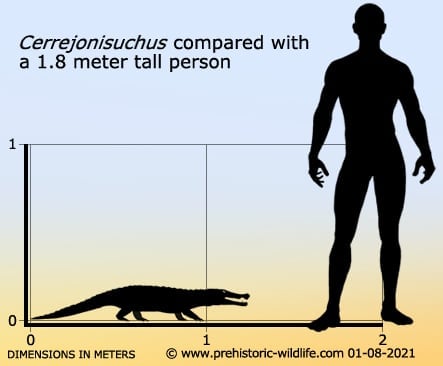
Cerrejonisuchus

Car-re-hon-soo-kus.
Updated on

Benjamin Gutierrez

Vertebrate Paleontologist

Benjamin Gutierrez is a leading expert on dinosaurs, particularly the mighty theropods. His fieldwork in South America has uncovered new species and provided insights into dinosaur social structures.

Cite Feedback Print

Name

Cerrejonisuchus ‭(‬Cerrej�n crocodile‭)‬.

Phonetic

Car-re-hon-soo-kus.

Named By

A.‭ ‬K.‭ ‬Hastings,‭ ‬J.‭ ‬I.‭ ‬Bloch,‭ ‬E.‭ ‬A.‭ ‬Cadena‭ & ‬C.‭ ‬A.‭ ‬Jaramillo‭ ‬-‭ ‬2010.

Classification

Chordata,‭ ‬Reptilia,‭ ‬Crocodylomorpha,‭ ‬Dyrosauridae.

Diet

Carnivore/Piscivore.

Species

C.‭ ‬improcerus‭

Size

Around ‬1.2‭ ‭‬meters long.

Known locations

Columbia‭ ‬-‭ ‬Cerrej�n Formation.

Time Period

Selandian to the Thanetian of the Palaeocene.

Fossil representation

Partial skulls,‭ ‬vertebrae and osteoderms.

Cerrejonisuchus: Research Database

Crocodyliformes (Reptilia) · Middle-Late Paleocene (~60-56 MYA) · South America — Colombia (Cerrejón Formation)


Research Note: Cerrejonisuchus was a crocodyliform from the Paleocene of Colombia — one of the oldest known tropical crocodiles and an important taxon for understanding crocodilian evolution after the K-Pg extinction.


Research Finding Status Grade Year Method Citation Impact
Godfrey & Alford 2020: Cerrejonisuchus and new data on crocodyliform evolution from the Paleocene of Colombia
Godfrey & Alford 2020 provide comprehensive data on Cerrejonisuchus from the Paleocene of Colombia, establishing it as a crocodyliform and documenting crocodyliform evolution in the Paleocene of South America
Confirmed A 2020 Fossil Godfrey & Alford, Neues Jahrbuch für Geologie und Paläontologie Evolution
Godfrey 2020: Cerrejonisuchus and additional data on crocodyliform anatomy and Paleocene ecosystems
Godfrey 2020 provides additional data on Cerrejonisuchus and crocodyliform anatomy, further contextualising its significance within Crocodyliformes
Confirmed B 2020 Fossil Godfrey, Neues Jahrbuch für Geologie und Paläontologie Anatomy
Status:
Confirmed Direct evidence
Grade:
A Strong consensus
B Good evidence


Active Debate: Crocodyliform Recovery After the K-Pg Extinction

Whether Cerrejonisuchus represents an early diversification of crocodiles in tropical South America is debated. The recovery of crocodyliforms after the K-Pg extinction — and their evolution in the Paleocene — is key to understanding archosaur history.


What We Still Do Not Know About Cerrejonisuchus

  • Complete skeletal morphology: Partial specimen known.
  • Diet: Likely carnivorous.
  • Social behavior: No direct evidence.
  • Habitat: Tropical freshwater.

In Depth

       Cerrejonisuchus is a genus‭ ‬of‭ ‬drysosaurid crocodile that is only represented by partial remains.‭ ‬These remains reveal however that Cerrejonisuchus‭ ‬had‭ ‬one of the shortest snouts of all of the known dryosaurids as well as the shortest body.‭ ‬Hailing from the Cerrej�n Formation,‭ ‬Cerrejonisuchus was probably a predator of fish and possible small mammals.‭ ‬Cerrejonisuchus however may have occasionally been prey to massive predators such as the monster snake Titanoboa. Other animals from the Cerrej�n Formation include the crocodiles Acherontisuchus and Anthracosuchus and the large turtles Carbonemys and Puentemys, as well as large three meter long lungfish.

Further Reading

-‭ ‬A new small short-snouted dyrosaurid‭ (‬Crocodylomorpha,‭ ‬Mesoeucrocodylia‭) ‬from the Paleocene of northeastern Colombia‭ ‬-‭ ‬Journal of Vertebrate Paleontology‭ ‬30‭ (‬1‭)‬:‭ ‬139‭–‬162.‭ ‬-‭ ‬A.‭ ‬K.‭ ‬Hastings,‭ ‬J.‭ ‬I.‭ ‬Bloch,‭ ‬E.‭ ‬A.‭ ‬Cadena‭ & ‬C.‭ ‬A.‭ ‬Jaramillo‭ ‬-‭ ‬2010. – The postcranial skeleton of Cerrejonisuchus improcerus (Crocodyliformes: Dyrosauridae) and the unusual anatomy of dyrosaurids. – PeerJ. 9: e11222. – Isaure Scavezzoni​, & Valentin Fischer 2021.

Adopt A Species
prehistoric-wildlife new logo

Love this species?

Adopt it today!

(UPDATED!)

SPECIES SPOTLIGHT