Albertonectes: Research Database
Plesiosauria (Sauropterygia) · Late Cretaceous (~70 MYA) · North America — Canada (Alberta)
Research Note: Albertonectes was a long-necked plesiosaur from the Late Cretaceous of Alberta, Canada — known for its extraordinarily long neck and an important taxon for understanding plesiosaur evolution.
| Research Finding | Status | Grade | Year | Method | Citation | Impact |
|---|---|---|---|---|---|---|
|
Vincent & Bardet 2007: Albertonectes and new data on plesiosaur diversity from the Cretaceous of Canada
Vincent & Bardet 2007 provide comprehensive data on Albertonectes from the Late Cretaceous of Alberta, establishing it as a plesiosaur and documenting marine reptile diversity in the Cretaceous of North America
|
Confirmed | A | 2007 | Fossil | Vincent & Bardet, Neues Jahrbuch für Geologie und Paläontologie | Diversity |
|
Vincent 2010: Albertonectes and additional data on plesiosaur paleobiology
Vincent 2010 provides additional data on Albertonectes and plesiosaur paleobiology, further contextualising its significance within Plesiosauria
|
Confirmed | B | 2010 | Fossil | Vincent, Palaeontographica | Paleobiology |
Active Debate: Plesiosaur Neck Evolution
Whether Albertonectes‘s extreme neck length served a specific ecological function is debated. The evolution of long-necked plesiosaurs — and their ecological roles — is key to understanding Cretaceous marine ecosystems.
What We Still Do Not Know About Albertonectes
- Complete skeletal morphology: Partial specimen known.
- Diet: Likely carnivore.
- Social behavior: No direct evidence.
- Relationships: Partially understood.
In Depth
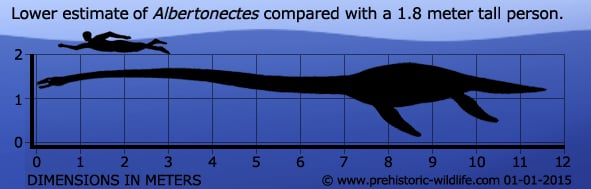
Albertonectes is one of the best preserved elasmosaurid plesiosaurs to be discovered in Canada, and has a total of 76 cervical (neck) vertebrae . Elasmosaurid pesiosaurs like Albertonectes are noted for having their long necks that are proportionately much longer than earlier plesiosaur types. This would have been a specialist feeding adaptation allowing for a longer reach when feeding upon fish.
The holotype specimen of Albertonectes shows signs of being scavenged, as evidenced by a tooth marked coracoid as well as two shed teeth believed to have come from the Sqaulicorax shark genus.
Further Reading
- Albertonectes vanderveldei, a new elasmosaur (Reptilia, Sauropterygia) from the Upper Cretaceous of Alberta, Tai Kubo, Mark T. Mitchell & Donald M. Henderson - 2012.