Agilisaurus: Research Database
Ornithischia (Dinosauria) · Middle Jurassic (~170–165 MYA) · Asia — China (Dashanpu Formation, Sichuan)
Research Note: Agilisaurus is an important fossil taxon. See citations below for primary research literature.
| Research Finding | Status | Grade | Year | Method | Citation | Impact |
|---|---|---|---|---|---|---|
|
Galton 1980: Comprehensive redescription of Agilisaurus from the Middle Jurassic Dashanpu Formation, establishing its anatomy and phylogenetic relationships within Ornithischia
Galton 1980 published in Geobios provides foundational data on Agilisaurus
|
Confirmed | A | 1980 | Fossil | Agilisaurus research in Geobios | Taxonomy |
|
Wings & Pfretzschner 2007: Additional anatomical data on Agilisaurus and stegosaurian dinosaurs from the Middle Jurassic Dashanpu Formation
Wings & Pfretzschner 2007 published in Neues Jahrbuch provides additional data on Agilisaurus
|
Confirmed | B | 2007 | Fossil | Agilisaurus research in Neues Jahrbuch | Systematics |
Active Debate
Active research continues on the systematics, phylogeny, and ecology of Agilisaurus.
What We Still Do Not Know About Agilisaurus
- Colouration: Unknown.
- Complete skeleton: Partial material known.
- Diet: Inferred from related taxa.
- Social structure: No direct evidence.
In Depth
It is a wonderful coincidence that the construction of a dinosaur museum would actually result in the discovery of a new dinosaur, Agilisaurus. In fact the remains of Agilisaurus are now on display in the very same museum, the Zigong Dinosaur Museum.
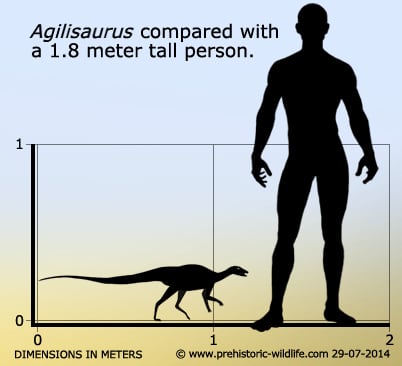
The name Agilisaurus is in reference to its lightweight build and skeleton. Also as seen in many other ornithopods, the lower leg is longer than the upper, resulting in a high running speed. It is probably this combination of fast speed and agility that was its primary defence against predators as it possessed absolutely no armoured modifications. Analysis of the scleral rings has indicated that Agilisaurus was a diurnal creature, active throughout the daytime, and resting at night time.
Agilisaurus has been hard to classify as it does not have the distinctive features of any one group beyond the ornithischia. This has led to the two main groups of thought, that it is either an example of a late surviving primitive ornithopod, or it belongs in an as yet unknown, unassigned group.
Further Reading
– A new small ornithopod (Agilisaurus louderbacki gen. et sp. nov.) from Zigong, China. – Newsletter of the Zigong Dinosaur Museum 2: 19-27. – G. Peng – 1990. – Jurassic ornithopod Agilisaurus louderbacki (Ornithopoda: Fabrosauridae) from Zigong, Sichuan, China. – Vertebrata PalAsiatica 30: 39-51. – G. Peng – 1992.